Concrete Slab Cost Per Square Foot: Guide in 2026
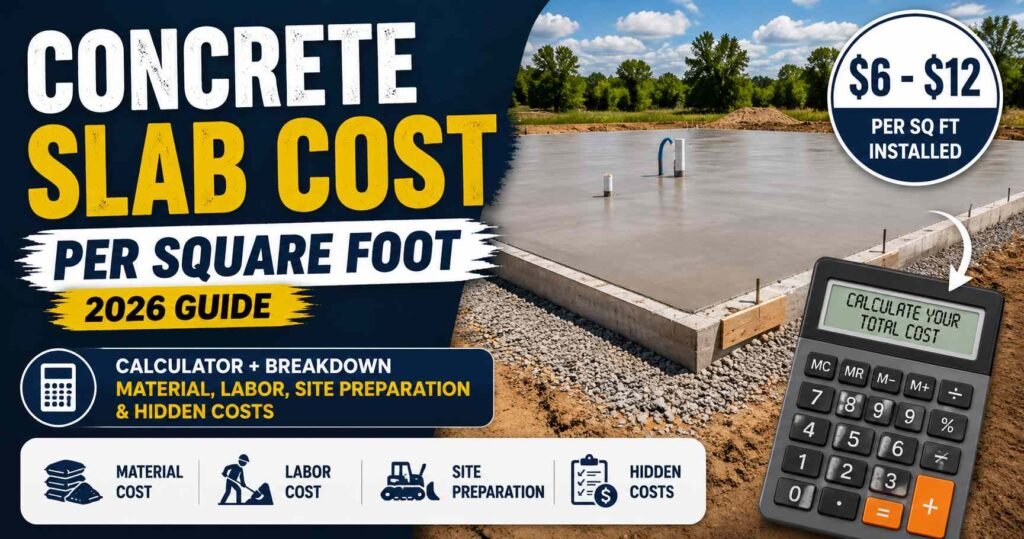
How much does a concrete slab really cost per square foot, and what hidden costs could make your final bill higher than the price you see online? In the USA, concrete slabs typically cost $6–$12 per square foot in 2026. Hidden costs like labor, reinforcement, delivery, and site preparation can increase the total price.
Different websites show different concrete slab rates because prices depend on location, project type, and what the estimate includes. For example, Concrete Network lists about $6–$10.50 per sq. ft., as other sources may show higher installed prices. The per-square-foot price is only a starting point.
Slab thickness, reinforcement, site preparation, labor, delivery, finishing, local building codes, and location can all change the final cost. Here, we’ll cover 2026 installed rates, calculator use, material and labor costs, site preparation, and hidden expenses.
How Much Does a Concrete Slab Cost Per Square Foot
Average Concrete Slab Cost Per Square Foot
Plain concrete slab: A standard 4-inch plain slab typically costs about $6–$10.50 per square foot for the concrete work.
Installed concrete slab: Including site preparation, pouring, and finishing, costs can range from $6–$12 per square foot.
Decorative concrete: Stamped, colored, or polished finishes can increase costs to $12+ per square foot.
Project size matters: Total costs vary because slab size, site conditions, materials, labor, and finishing requirements differ from one project to another.
Concrete Material vs. Installed Cost
Concrete materials: Cement, sand, and gravel are included in the basic material cost, along with other required concrete materials.
Site preparation: This can be a major cost because it may include excavation, grading, sub-base, compaction, drainage, and old concrete removal.
Main installation costs: Concrete delivery, labor, reinforcement, forms, and equipment can significantly affect the final price.
Finishing: Options such as broom finish, smooth finish, stamped concrete, or decorative finishes can change the cost. Two contractors may both charge $8 per sq. ft., but one quote may include site preparation and finishing while the other does not. Always check what each quote includes before comparing prices.
Concrete Slab Cost Calculator
Calculate Your Slab Area
First, calculate the total square footage of the slab by using the concrete cost calculator.
Formula:
Length × Width = Area (sq. ft.)
Example:
20 ft × 20 ft = 400 sq. ft.
Multiply Square Footage by the Cost
As soon as you know the square footage, multiply it by the cost per square foot to find the base cost.
Formula:
Square Feet × Cost per Sq. Ft. = Base Cost
Example:
400 sq. ft. × $8 = $3,200
Add Costs Not Included in the Per-Square-Foot Price
The base price may not include additional project expenses, such as: gravel, leveling, excavation, old slab removal, rebar, wire mesh, or fiber reinforcement. Concrete delivery, pump, and placement costs, stamping, coloring, or other decorative finishes. These extras can increase the final concrete slab cost.
Concrete Slab Cost by Size
24×24 Concrete Slab Cost
Multiply the length by the width: 24 × 24 = 576 sq. ft.
At $6 per sq. ft.: 576 × $6 = $3,456
At $12 per sq. ft.: 576 × $12 = $6,912
A 24 × 24 slab may cost around $3,456–$6,912, depending on the project requirements. These are estimates, not fixed prices.
30×30 Concrete Slab Cost
Calculate the area: 30 × 30 = 900 sq. ft.
At $6 per sq. ft.: 900 × $6 = $5,400
At $12 per sq. ft.: 900 × $12 = $10,800
The total can be around $5,400–$10,800, depending on materials, labor, preparation, and finishing.
30×40 Concrete Slab Cost
Calculate the area: 30 × 40 = 1,200 sq. ft.
At $6 per sq. ft.: 1,200 × $6 = $7,200
At $12 per sq. ft.: 1,200 × $12 = $14,400
The final cost may range from $7,200–$14,400, depending on site conditions and included services.
How Slab Thickness Affects Cost Per Square Foot
- Inch Slab
A 4-inch slab is often suitable for lighter residential applications such as walkways, patios, and some driveways, depending on the project design. Because the slab is thinner, it generally requires less concrete than a thicker slab. Less concrete usually means a lower material cost, although labor, site preparation, and finishing still affect the final price.
- Inch Slab
A 5-inch slab may be considered for applications with greater loads, such as vehicle areas or sheds, when the design calls for it. Compared with a 4-inch slab, a 5-inch slab requires about 25% more concrete for the same area. More concrete increases the material cost, so the total price can also be higher.
Why Thickness Raises Cost
Greater thickness means more concrete volume for the same slab area. Still, thickness should not be chosen by guesswork or weight alone. Consider the expected loads, soil conditions, and project design to determine the appropriate thickness and avoid performance problems.
Concrete Slab Cost Breakdown
Concrete Material Cost
Ready-mix concrete comes pre-mixed and saves time. It is measured and priced by cubic yards. Thicker slabs need more concrete. Prices vary by city and supplier. Longer delivery distances can increase costs. Labor and finishing are separate costs.
Labor Cost
Labor covers concrete placing and finishing. Workers handle forming, placing, screeding, leveling, and finishing. Control joints are added to guide cracking. Cleanup may also be included. Labor costs depend on slab size and site conditions.
Site Preparation Cost
Removing soil to the required depth, preparing a smooth, level surface, compacting soil and base material, adding gravel or crushed stone, installing drainage where required; difficult soil or access can increase costs.
Reinforcement Cost
Steel bars and installation, mesh material and placement, fibers added to the concrete mix, cutting, placing, and tying reinforcement, chairs or supports to hold reinforcement in place.
Delivery Cost
Delivery cost is separate from the concrete material price. Greater distance from the plant can increase delivery charges. Narrow streets may require extra equipment or manual handling. Waiting time charges may apply when the truck stays longer than the allowed time, such as 30 minutes. Pump charges may apply when concrete cannot reach the slab directly.
Finishing Cost
Finishing is an additional cost after placing the concrete slab.
Broom finish: Creates a rough surface for better traction and is an affordable choice for driveways and walkways.
Smooth finish: Provides a clean, even surface.
Stamped finish: Adds decorative patterns to the concrete.
Decorative finish: Usually costs more because it requires extra materials and labor.
Concrete Slab Cost by Project Type
Patio
A patio is a small outdoor area where you can sit, relax, or spend time with family. It is not usually designed for heavy loads such as vehicles. A standard patio slab is often around 4 inches thick. The total concrete cost depends on the patio size. A larger area needs more concrete, but the cost per square foot may decrease on larger projects because some fixed costs are spread over more square feet. For a basic patio, a smooth finish is a simple and budget-friendly option.
Garage
A garage slab needs to handle more weight because vehicles are parked on it and it may also carry stored items. As a result, garage slabs are commonly made around 5 to 6 inches thick, depending on the expected load and site conditions.
A thicker slab requires more concrete, which increases the material cost. Wire mesh, rebar, or fiber reinforcement may also be used to improve crack control and overall performance. The final price depends on the slab size, thickness, reinforcement, site preparation, and finish
Driveway
A driveway connects the garage or house to the main road and must handle repeated vehicle traffic. It may also need to support heavier vehicles, so it generally requires more strength than a typical patio. A driveway slab is often around 5 to 6 inches thick, while areas expected to carry heavier vehicles may require 7 inches or more, based on the design and local requirements.
Reinforcement such as rebar and wire mesh may be included where needed. A broom finish is commonly used because its textured surface provides better traction and helps reduce slipping when the concrete is wet.
Residential vs. Commercial Concrete Slab Cost
Residential Slabs
Residential concrete slabs are used for smaller home projects, typically around 200 to 1,000 square feet. Common examples include patios, garages, driveways, basements, and subfloors.
These slabs generally use a smooth or standard finish, depending on the project requirements and budget. If the concrete truck cannot easily reach the site because of a narrow street, limited access, or other obstacles, additional labor, equipment, or pumping may be required, which can increase the overall cost.
Commercial Slabs
Commercial concrete slabs are designed for larger projects, such as offices, stores, warehouses, factories, and other commercial buildings. These projects can range from approximately 5,000 to 50,000 square feet and usually require stronger slabs because they may support heavy equipment, machinery, vehicles, and frequent foot traffic.
Commercial slabs commonly use 6- to 8-inch thickness, along with reinforcement such as rebar or wire mesh, depending on the structural design.
Large commercial projects may also require concrete pump trucks, specialized equipment, and larger crews, which can increase labor and equipment costs.
Before starting a commercial slab project, it is important to work with a qualified engineer to determine the required slab thickness, reinforcement, load capacity, and other design specifications. Local permits or approvals may also be required before construction begins
Does Site Preparation Increase Concrete Slab Cost
Excavation
Excavation is the first step in preparing the site for a concrete slab. The work area must be cleared of grass, debris, old concrete, roots, and other unwanted materials. The excavation depth depends on the required slab thickness, sub-base, soil condition, and project design.
In some projects, excavation may be several inches deep, while difficult sites may require deeper digging. If workers find rocks, hard concrete, large roots, or other obstacles underground, additional equipment and labor may be needed. Groundwater can also make excavation more difficult. Then, temporary drainage pipes or pumps may be required, increasing the total project cost.
Grading
Grading involves preparing the excavated area so the ground is level, stable, and properly shaped for the concrete slab. Workers remove loose material, spread the soil evenly, and create the required slope.
For a driveway, a slight slope is normally provided so rainwater can flow away instead of collecting on the concrete surface. Proper grading helps control drainage and provides a suitable base for the next construction steps.
Subbase
The sub-base is the layer of gravel or crushed stone placed over the prepared soil. A common residential slab may use around 4 inches of sub-base, depending on the project requirements.
This layer provides stability and helps improve drainage beneath the concrete. The cost of gravel, delivery, spreading, and installation should be included when estimating the total slab cost.
Compaction
Compaction makes the soil and sub-base firm by pressing the material tightly together. Workers commonly use a plate compactor or similar equipment to create a stable surface. Proper compaction reduces movement and weak spots beneath the concrete and helps provide a stronger foundation for the slab. Equipment rental and labor for compaction can add to the project cost.
Drainage
Drainage is important because water should not collect beneath or around a concrete slab. The site should be designed with suitable slopes and drainage paths so rainwater can flow away from the slab. Depending on the site, drainage pipes, channels, or other systems may be required. Additional drainage work can increase material, equipment, and labor costs.
Existing Concrete Removal
Existing concrete removal is required when an old or damaged slab must be removed before installing a new one. Workers may need to break the old concrete into smaller pieces using suitable demolition equipment and then collect and load the debris.
The cost can include demolition labor, equipment, loading, hauling, and disposal fees. If the removed concrete must be transported to a landfill or other approved disposal site, these additional hauling and disposal costs should also be included in the estimate.
How Much Does Reinforcement Add to Concrete Slab Cost?
Wire Mesh
Wire mesh is a grid of steel wires placed inside a concrete slab to provide additional reinforcement. It helps the slab handle tension and reduces the risk of cracks becoming wider. Wire mesh is commonly used for patios, garages, driveways, walkways, and residential slabs where moderate reinforcement is needed.
One advantage of wire mesh is that it is generally an affordable reinforcement option.
Yet, installation also adds labor costs. The mesh may need to be measured, cut, positioned, and supported properly before the concrete is poured. Correct placement is important because the mesh needs to remain in the proper position inside the slab to provide effective reinforcement.
Rebar
Rebar, or reinforcing steel bars, provides stronger reinforcement than standard wire mesh and is often used where a concrete slab needs to handle heavier loads or greater stress. Steel bars are arranged in a planned pattern inside the slab before concrete is poured.
Rebar can help control cracking and improve the slab’s ability to handle tension and bending. It is commonly considered for driveways, garage floors, structural slabs, and areas exposed to heavier vehicles or loads.
The total cost can be higher because rebar itself costs more than basic wire mesh. Installation also requires additional labor for measuring, cutting, placing, and tying the bars together. The required rebar size and spacing should be based on the project’s design and local building requirements.
Fiber Reinforcement
Fiber reinforcement uses many small synthetic or steel fibers that are mixed directly into the concrete. Unlike wire mesh or rebar, there is no need to place separate reinforcement sheets or bars across the slab before pouring.
Because the fibers are already mixed into the concrete, they can make the installation process simpler and reduce some reinforcement-related labor. Fiber reinforcement is mainly useful for helping control small shrinkage and temperature-related cracks and improving the overall durability of the concrete.
Still, fiber does not mean the slab will never crack. It mainly helps control cracking rather than completely preventing it. For slabs carrying heavy structural loads, fiber may not replace rebar or other reinforcement required by the project design.
When Reinforcement Requirements Change
For slabs that carry cars, trucks, or other heavy loads, rebar may be needed instead of basic wire mesh. Rebar may also be required when the soil is weak, the slab is very large, or the edges and corners need extra strength. The engineer decides the rebar size and spacing based on the design, structural requirements, and local building codes.
How Location Affects Concrete Slab Cost
Labor Rates
Labor rates can change the total concrete slab cost from one city to another. In large cities such as Lahore, Karachi, and Islamabad, a worker may charge around PKR 3,500–5,000 per day. In smaller cities and towns, daily labor may be closer to PKR 2,000–3,000. Higher wages in urban areas can make slab projects more expensive.
Ready-Mix Availability
The availability of a nearby concrete plant can also affect the price. If the project site is close to a ready-mix plant, delivery may cost less. Nevertheless, if the plant is 60–70 km away, transportation charges can increase the total cost. Longer distances may also require additional delivery charges.
Transportation Distance
The farther the concrete truck has to travel, the more transportation can add to the project cost. Ready-mix concrete also needs proper delivery timing so it can be placed before its workable time becomes a problem. Traffic, road conditions, and waiting time can further affect delivery costs.
Regional Material Costs
Material prices vary by region. The local cost of rebar, sand, gravel, cement, and other materials can change the final concrete slab price. Areas with cheaper and easily available materials may have lower overall costs.
Urban vs. Rural Projects
| Factors | Urban Areas | Rural Areas |
| Labor | Usually higher | Usually lower |
| Accessibility | Traffic and limited access can cause delays | Often easier access |
| Transportation | Traffic can increase delivery time and cost | Longer distances may increase cost |
| Supplier Availability | More suppliers and stronger competition | Fewer suppliers in some areas |
| Pricing | Rates are often more competitive | Prices may vary between suppliers |
Common Mistakes When Estimating Concrete Slab Cost
One common mistake is looking only at the contractor’s basic price. Extra work may be charged separately, which can make the final bill much higher. Before accepting a quote, ask whether it includes excavation, leveling, gravel, compaction, forms, and finishing.
Some people skip wire mesh, fiber, or other reinforcement to save money. so, reinforcement can help control cracking and improve slab performance. Saving on reinforcement may lead to higher repair costs later.
Concrete delivery, truck charges, pump fees, and other site-related costs can add around PKR 10,000–20,000 or more, depending on the project and distance. Always ask the supplier about these charges before ordering.
Slab thickness should match its intended use. Using an unsuitable thickness can either increase your cost or reduce the slab’s performance. For example, a driveway may need different requirements than a light-use patio.
Do not choose a contractor only because the quoted price looks cheaper. Check the concrete quality, reinforcement, labor, finishing, and included work. A low initial quote may become expensive after extras are added.
Online prices are not the same in every city. Labor, cement, sand, gravel, and transportation costs vary by location. Instead of applying one online rate everywhere, get at least three local quotations and compare what each quote includes.
Frequently Asked Questions
How much does a 20×20 concrete slab cost?
For a 20 × 20 ft concrete slab, the estimated cost at $6–$12 per sq. ft. would be around $2,400–$4,800. This is only a basic estimate.
Does slab thickness affect cost?
Yes, thickness affects the cost. The thicker the slab, the more it will cost.
How much does labor add to concrete slab cost?
In the USA, labor can account for around 50–60% of the total project cost, depending on the work, location, and project requirements.
Does reinforcement increase the price?
Yes, using steel rebar increases the overall cost because of the additional material, labor, cutting, and installation expenses required for reinforcement.
What is the cheapest concrete slab option?
The most economical slab option is the plain, rough-finish type, with a 4-inch thickness and no rubber used in its construction.
How accurate is a concrete slab cost estimate?
The calculation is usually 85–90% accurate, but due to delivery fees and permits, we should still order 10–15% extra to cover any small wastage or loss.
Conclusion
A per-square-foot price is mainly a starting estimate, not the final cost. The actual price can be different depending on the project details. A thicker slab requires more concrete and can increase the cost.
For example, increasing thickness from 4 to 6 inches can significantly raise the concrete quantity and overall cost. Labor, site preparation, rebar, delivery, finishing, and local material prices all affect the final price. When comparing two contractors, do not choose only by the lowest per-square-foot rate.
Check what each quotation includes and whether extra charges are listed separately. Rates can vary by location, access, material availability, and transportation distance. This gives you a more realistic idea of the actual slab cost.