Concrete Price Per Yard 2026: Cost Per Square Foot
Concrete Price Per Yard 2026: Cost Per Square Foot
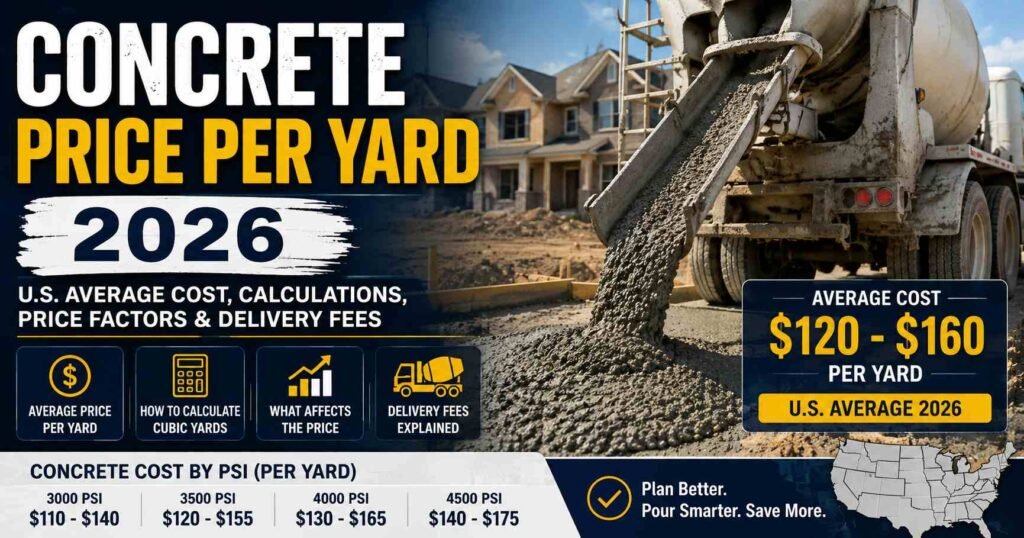
How much does a concrete price per yard in 2026? In 2026, a cubic yard of concrete typically costs around $140 to $200. This is an estimated range rather than a fixed rate, as the actual price can vary depending on location, project size, concrete mix, and other project-specific factors. Different suppliers may also offer different mix designs and pricing.
Understanding the expected concrete price per yard is essential for any construction budget. Before ordering concrete for a patio, slab, driveway, or larger building project, estimate your required quantity and overall cost rather than relying on a general price range. Checking local supplier rates and delivery charges can give you a more accurate budget.
In this manual, you’ll find 2026 concrete pricing information, a concrete cost calculator, delivery fees, and the key factors that affect the final cost, helping you estimate your project more accurately.
How Much Does a Yard of Concrete Cost in 2026
This concrete cost per yard acts as a baseline for your estimates. In 2026, concrete prices in the USA can vary depending on what is included in the quoted price. As a general range, concrete-only prices may fall around $125–$170 per cubic yard, while concrete with delivery may range from $140–$200 per cubic yard. When material, delivery, and installation are included, the total can reach approximately $200–$350 per cubic yard, especially for driveways, slabs, and similar projects.
Comparison Websites
| Website | Concrete Price Per Cubic Yard | Price Range | Comparison |
| Concrete Network | $179.95 average | $160-$195+ | Higher Average |
| Constructem | About $155 average | $125-$195 | Lower Awerage |
Location is another important factor. Prices can be higher in areas such as California and New York because of local labor rates, operating costs, fuel expenses, demand, and delivery distance. In comparison, prices may be different in states such as Florida or Texas because local market conditions and labor costs vary. Extra charges can also affect the final quote. Thus, for the most accurate pricing, contact a local ready-mix concrete supplier and confirm delivery, labor, mix requirements, and any additional charges before ordering.
What Is a Cubic Yard of Concrete
A cubic yard is a unit of volume used to measure concrete price per yard. Because concrete has three dimensions, its volume is calculated using length, width, and thickness (or depth). You multiply these three measurements to determine how much concrete is required.
Length × Width × Thickness( height) = Volume
3 ft× 3 ft× 3 ft = 27 cubic ft
One cubic yard is equal to 27 cubic feet. So, if your project requires 27 cubic feet of concrete, you have exactly 1 cubic yard of concrete.
For example, if one 80-lb bag of concrete has a yield of 0.60 cubic feet, you can calculate the number of bags needed for 27 cubic feet by dividing:
27 ÷ 0.60 = 45 bags
So, you would need 45 bags to produce approximately 27 cubic feet of concrete. Still, this number is only an example because concrete bag yields vary by manufacturer and product. A bag may yield 0.56, 0.45, 0.60 cubic feet, or another amount.
Concrete is commonly sold by the cubic yard since contractors need to know the total volume of concrete required for a project. Unlike square feet or square yards, cubic measurements account for thickness or depth.
Square feet/square yards: Length × Width = Area
Cubic feet/cubic yards: Length × Width × Thickness = Volume
Thus, you should calculate the concrete volume first and then determine how many cubic yards you need to order. Without the thickness, you cannot accurately calculate the required concrete volume, which could result in ordering too little or too much concrete.
Example:
A 10ft×10ft slab
4 inches thick
100sq ft× 0.33 ft=33 cubic ft
33 cubic ft ÷27= 1.22 cubic yards
How to Calculate Concrete Cost Per Yard
Step 1 — Measure the Project
Start by measuring the project area. Multiply the length by the width to calculate the area. Then determine the required concrete thickness, which may vary depending on the project. For example, a typical driveway may use a 4-inch thickness, while other projects may require 6 inches or more.
For L-shaped or irregular areas, divide the project into smaller rectangles. Calculate the volume of each rectangle separately and then add the results together to get the total volume.
Step 2 — Convert Thickness to Feet
Concrete thickness is usually measured in inches, but the volume calculation should use feet. To convert inches to feet, divide the thickness by 12.
For example:
4 inches ÷ 12 = 0.333 feet
This conversion keeps all measurements in the same unit before calculating cubic feet.
Step 3 — Calculate Cubic Feet
Once the length, width, and thickness are in feet, multiply them together to find the concrete volume in cubic feet.
For example, for a 10 × 10-foot area with a 4-inch thickness:
10 × 10 × 0.333 = 33.3 cubic feet
So, the project requires approximately 33.3 cubic feet of concrete before adding any waste allowance.
Step 4 — Convert Cubic Feet to Cubic Yards
Since concrete is commonly ordered by the cubic yard, convert the calculated cubic feet into cubic yards. Because 1 cubic yard = 27 cubic feet, divide the total cubic feet by 27.
33.3 ÷ 27 = 1.23 cubic yards
Step 5 — Add a Project-Specific Waste Allowance
A waste allowance is a small extra percentage added to the calculated concrete quantity to account for material that may be lost or for variations between the calculated volume and the actual project conditions. This helps prevent the work from stopping because of a shortage of concrete.
The required allowance depends on the project’s shape, size, and complexity. Regular projects may need a smaller allowance, while irregular or uneven shapes may require more. For example, if the calculated requirement is 1.23 cubic yards and you add a 10% waste allowance:
1.23 × 1.10 = 1.35 cubic yards
So, you would order approximately 1.35 cubic yards of concrete.
Step 6 — Calculate the Estimated Material Cost
Once the waste allowance has been added, multiply the final cubic yards by the price per cubic yard to estimate the concrete cost.
Cubic yards × Price per cubic yard = Total concrete cost
Keep in mind that the specific concrete cost per cubic yard can vary based on local suppliers.
For example:
1.35 cubic yards × $150 = $202.50
So, the estimated concrete cost would be $202.50, before any additional charges such as delivery or other project-specific fees.
You can also use online tools such as concrete calculators to estimate the quantity and cost. Though, calculating the measurements manually, step by step, gives you a clearer understanding of how the final concrete quantity and cost are determined.
Concrete Cost Example: How Much Would 3 Cubic Yards Cost
After calculating the required concrete volume, the next step is to estimate its cost. In this example, our required volume is 3 cubic yards, calculated using the project’s measurements and a concrete calculator.
For a hypothetical 2026 estimate, we can assume an average concrete price of $150 per cubic yard. This is only an example and should not be considered a fixed or confirmed market rate because prices vary by location, concrete mix, supplier, and project requirements.
The calculation is:
3 cubic yards × $150 = $450
Next, we can add an example delivery fee of $80:
$450 + $80 = $530
Keep in mind that the $150 rate and $80 delivery fee are hypothetical figures. Actual delivery charges may depend on the supplier, distance, order size, and other factors. Always request a current quote from a local supplier before placing your order.
Estimated Total Cost = (Cubic Yards × Price per Yard) + Delivery Fee
Actual concrete prices vary depending on the project location, supplier, concrete mix, order size, and current local market conditions.
What Factors Affect the Price of Concrete Per Yard
Location and Regional Pricing
Concrete prices can range from around $180–$220 per cubic yard because operating and delivery costs can be higher in these areas. Prices are often around $140–$170 per cubic yard, although the actual rate can vary by supplier and project location. If your project is far from the concrete supplier or batch plant, longer delivery distances can increase transportation costs and, hence, the overall concrete price per yard.
During periods of high demand, such as when large construction projects are underway, suppliers may charge higher rates because more concrete is needed in the area. Actual rates can vary depending on the supplier, location, order size, delivery distance, and current market demand then you can calculate concrete price per yard.
Concrete Strength
PSI stands for pounds per square inch and is a unit used to measure the compressive strength of concrete. Different projects require different concrete strengths. For example, around 3,000 PSI concrete may be suitable for patios. Driveways or projects with heavier loads may require 4,000–5,000 PSI concrete, which can increase the overall cost. Using a higher PSI than your project requires can raise your concrete expenses. Choose the appropriate strength based on your project requirements and applicable building codes.
Delivery Distance
The distance between the concrete supplier and your project site directly affects delivery charges. A longer distance usually means higher transportation costs. Concrete trucks consume more fuel when they travel farther, so increased fuel usage can add to the delivery cost. Longer trips require more driving time, which can also increase transportation and labor expenses. On the other hand, choosing a nearby supplier can help keep transportation costs more manageable.
Order Size
If you only need 1-2 cubic yards of concrete, the price per yard may be higher because delivery and truck costs are spread across a small order. Even for a small amount of concrete, the supplier still has to send a concrete truck to your project site, which can make the overall cost less economical. Ordering around 10–12 cubic yards can sometimes result in a lower price per yard because suppliers may offer volume discounts. Before placing an order, ask the supplier about minimum-order charges, delivery fees, and available discounts to get a clearer estimate of your total concrete cost.
Short-Load and Minimum-Load Fees
Short load means ordering less concrete than the supplier’s minimum order or standard truckload limit. If you request a smaller quantity, the supplier may still need to send the same concrete truck and cover similar delivery costs. Because the ordered quantity is below the supplier’s minimum load, a short-load or minimum-load fee may be added to your bill. This can make the cost per cubic yard higher, even though you are ordering less concrete. Before placing an order, ask the supplier about minimum load requirements and short-load fees so you can estimate the total concrete cost more accurately.
Additives and Specialty Mixes
Concrete additives can change the performance and appearance of concrete and may increase its overall cost. Fiber reinforcement can be added to improve crack resistance and durability, depending on the project requirements. Air entrainment creates tiny air bubbles in the concrete, which can improve its resistance to freeze-thaw conditions and harsh weather. Colored concrete uses pigments or other coloring methods to give the concrete a specific appearance, making it a popular choice for decorative projects. The final price depends on the type of additive, amount required, supplier, and project specifications. Thus, choose special concrete options only when they are suitable for your project.
Site Access and Placement
Site access and placement can affect the overall concrete cost, especially when the delivery truck cannot reach the work area directly. If the site has a clear, level driveway with easy access, additional equipment or placement charges may not be necessary.
Yet, narrow, steep, uneven, or difficult-to-access areas may require a concrete pump or specialized placement equipment, increasing costs. Concrete Network reports pump fees can commonly add around $150–$400, depending on the project and site conditions. Keep material, labor, and equipment costs separate when estimating the total project budget.
Concrete Price Per Yard vs. Cost Per Square Foot
Used mainly by concrete suppliers to sell the material by volume. The required quantity depends on the project’s length, width, and concrete thickness. Commonly used by contractors for installed concrete, covering both materials and construction work. The area covered depends on thickness. At 4 inches, 8 cubic yards covers about 648 sq. ft.. At 6 inches, it covers about 432 sq. ft.
Coverage formula:
Square feet = 8 × 27 ÷ thickness (in feet)
Labor, site preparation, forms, rebar or wire mesh, concrete placement, and finishing.
Concrete price per yard usually refers to concrete material, while a per-square-foot contractor rate generally includes installation and related work. Installation costs can add roughly $6–$10 per sq. ft., depending on the project.
Cubic yards are primarily used for ordering concrete from a supplier, while square feet are commonly used by contractors to price the completed concrete work.
What Is Included in the Price of a Yard of Concrete?
The advertised price of ready-mix concrete does not always represent the final amount you will pay. For example, a supplier may list concrete at around $150 per cubic yard, but additional charges can increase the total cost. The base concrete price is only one part of the estimate; delivery fees, short-load charges, fuel surcharges, and applicable taxes may be added separately. Special additives such as fiber, color, air entrainment, or fast-setting mixtures can also increase the concrete price per yard.
Waiting-time charges may apply if the concrete truck has to remain at the job site longer than the supplier’s standard unloading time. Because supplier policies differ, some companies include delivery in their quoted price while others charge it separately. For this reason, always ask the supplier for an itemized quote that clearly lists the concrete price per yard, delivery, fees, additives, taxes, and any other applicable charges before placing your order.
How Much Concrete Do Common Projects Need
Concrete quantity is calculated from length × width × thickness. The required thickness can vary depending on the project type, soil conditions, design, and local requirements.
Driveway
A driveway may have different shapes, such as an L-shape. For example, a 12 ft × 50 ft driveway at 4 inches thick requires approximately 7.4 cubic yards of concrete.
Patio
For a 10 ft × 10 ft patio with 4-inch thickness, the estimated requirement is approximately 1.2 cubic yards.
Sidewalk
A 3 ft × 40 ft sidewalk at 4 inches thick requires approximately 1.5 cubic yards.
Concrete Slab
A 20 ft × 20 ft slab with 4-inch thickness requires approximately 4.9 cubic yards.
Footings and Foundations
For a continuous footing measuring 100 ft long × 1 ft wide × 1 ft deep, the requirement is approximately 3.7 cubic yards.
Important note:
These examples use 4-inch thickness for illustration only. Actual thickness may be 6 inches or more depending on the project, soil conditions, structural requirements, and location. For footings and foundations, always check local building codes and project plans before calculating the final concrete quantity.
How to Save Money When Buying Concrete
Order the correct amount of concrete based on accurate project measurements, and avoid adding unnecessary extra yards unless a reasonable waste allowance is needed. Before placing an order, compare quotes from three or four local suppliers to understand their concrete rates, minimum-order requirements, delivery fees, and short-load charges. For smaller orders, ask the supplier about any additional fees before confirming the order.
Also, check whether the concrete truck can easily access the job site. If direct truck access is limited, you may need additional equipment, such as a concrete pump, which can increase the overall project cost. Prepare the site and make sure workers are ready before the truck arrives to avoid unnecessary waiting-time charges.
Most importantly, do not judge the cost only by the advertised $150 Concrete Price Per Yard. Delivery, taxes, additives, short-load fees, and other charges can increase the final bill. Compare the total quoted cost, not just the Concrete Price Per Yard.
Finally, focus on reducing unnecessary expenses without compromising concrete quality. Choose the mix and quantity that your project actually requires rather than selecting cheaper materials simply to save money.
Common Mistakes When Estimating Concrete Cost
One common mistake is using the thickness in inches without converting it to feet. For example, a 4-inch slab should be converted to 4 ÷ 12 = 0.33 feet before calculating the concrete volume. This conversion is necessary because the length, width, and thickness must use the same unit.
Still, concrete orders are based on volume, not just area. For example, a 10 × 10-foot slab has 100 square feet, but its concrete requirement depends on whether it is 4, 5, or 6 inches thick.
After calculating the concrete volume in cubic feet, some people forget to convert it into cubic yards. Since ready-mix concrete is commonly sold by the cubic yard, divide the cubic-foot volume by 27 to determine the number of cubic yards needed. For example, a 10 × 10-foot slab at 4 inches thick requires much less concrete than the same slab at 6 inches thick.
Ordering the exact calculated quantity without allowing for waste can leave you short of concrete. Depending on the project, adding around 5% to 10% for waste and minor variations can provide a safer estimate.
Another common mistake is estimating only the concrete price per yard while ignoring delivery and other supplier charges.
Small concrete orders may be subject to a short-load fee if they do not meet the supplier’s minimum order quantity. For example, ordering only 2 cubic yards may result in an additional charge, so always ask the supplier about minimum loads and short-load fees before ordering.
A lower price per cubic yard does not always mean a lower total cost. For example, a supplier offering concrete at $145 per cubic yard may charge higher delivery or additional fees, making the final bill more expensive than a supplier with a higher base price. Always compare the complete, itemized quote rather than the advertised yard price alone.
Frequently Asked Questions
Q: How much does a yard of concrete cost in 2026?
In 2026, Concrete price per yard in the USA typically ranges from $140–$200 per cubic yard, depending on location, supplier, project size, and mix requirements.
Q: How many square feet does one yard of concrete cover?
4-inch thickness: 1 cubic yard of concrete covers approximately 81 sq. ft.
6-inch thickness: 1 cubic yard of concrete covers approximately 54 sq. ft.
Coverage varies based on the concrete thickness of the project.
Q: How do I calculate how many yards of concrete I need?
Cubic Yards = (Length × Width × Thickness in feet) ÷ 27
Q: Is delivery included in the concrete price?
Delivery charges are not always included in the concrete price; they depend on the supplier’s pricing policy.
Conclusion
When planning your budget, checking the most recent concrete price per yard is your first step. In 2026, ready-mix concrete in the USA may cost around $140–$200 per cubic yard, but prices vary by location, supplier, project size, and mix. Calculate your required volume in cubic yards first, then ask local suppliers for an itemized quote. Online prices are only general estimates, so compare the total delivered cost before ordering.