Concrete Stairs Calculator: Accurate Guide 2026
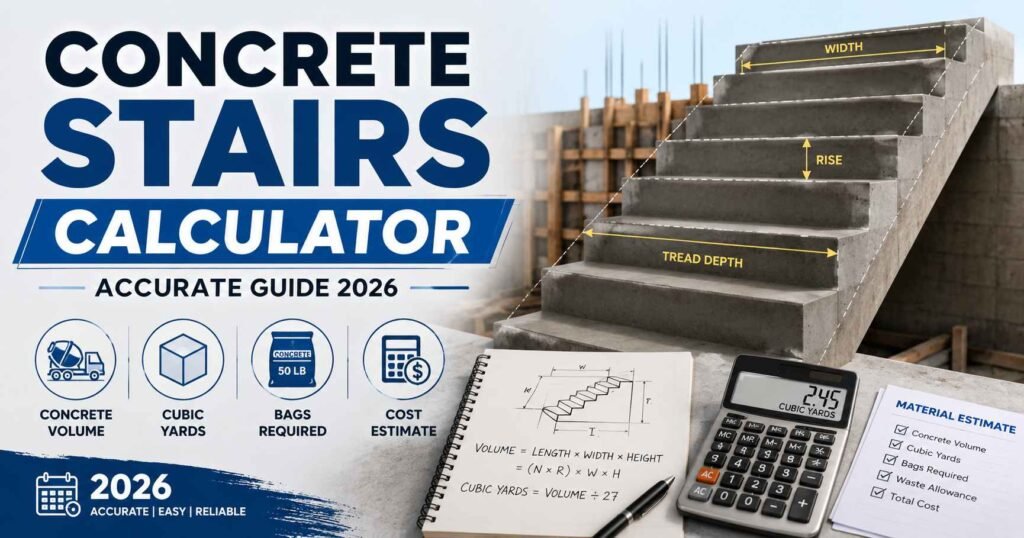
How much concrete do you need for concrete stairs? Start with the number of steps, tread size, riser height, and stair width. For 10 steps, a 12-inch tread, 6-inch riser, and 3-foot width require about 15 cubic feet of concrete. Convert 15 cubic feet to yards: 15 ÷ 27 = 0.56 cubic yards. Add a 5–10% waste allowance based on project size; with 10%, you need about 0.62 cubic yards.
Estimating the amount of concrete needed for stairs can be challenging because stair designs include several measurements, such as: width, riser, tread, concrete calculator, extra costs, and waste allowance. So we should use a concrete stairs calculator for this purpose.
We’ll explain how to calculate concrete for stairs, convert measurements, estimate costs, add waste allowance, and understand the calculation with practical examples.- I built a 10-step concrete staircase and used a concrete stairs calculator designed specifically for stairs to estimate the required concrete.
Still, the estimate was lower than the actual amount needed because each step adds its own concrete volume. The concrete ran short before the staircase was completed, so I had to stop the work and order additional concrete. When the new concrete was added, a cold joint formed because the first pour had already started setting.
What Is a Concrete Stairs Calculator
A concrete stairs calculator is a tool used to estimate how much concrete is needed to build a staircase. It uses measurements such as the stair height, tread depth, width, and number of steps to calculate the required concrete volume. Each step has a different volume, so the calculator considers the individual steps and combines them to estimate the total amount of concrete.
The result may be shown in cubic yards, cubic feet, or the number of concrete bags needed for the project. A general concrete stairs calculator mainly helps determine step dimensions, such as height and width, while a concrete stairs calculator focuses on concrete quantity. It is useful for estimating materials, but it does not replace structural design or local building codes. Always check local requirements and consult a qualified engineer or professional when structural approval is needed.
Measurements You Need Before Calculating Concrete Stairs
Number of Steps
Start by counting the total number of steps in the staircase. More steps generally mean a larger staircase and a greater amount of concrete will be required. The concrete quantity depends on the overall size and dimensions of the staircase, so increasing the number of steps can increase the total volume.
Stair Width
Stair width is another important measurement because it is multiplied into the volume calculation. A wider staircase covers more area, increasing the amount of concrete needed. For example, if you increase the stair width while keeping other measurements the same, the total concrete volume will also increase.
Riser Height
The stair riser is the vertical height of each step. For a safe and comfortable staircase, the risers should generally have a consistent height. Uneven risers can make stairs uncomfortable to use and may increase the risk of tripping, so the planned riser height should be kept consistent.
Tread Depth/Run
The stair tread is the horizontal part of a step where you place your foot. Its depth affects the overall volume of the staircase. When the tread depth increases, each step covers more space, which can increase the total concrete volume required for the stairs.
Landing or Platform Depth
A landing is a flat platform placed between sections of stairs. When estimating concrete, calculate the landing separately and include its volume in the total amount. Forgetting the landing can make the concrete estimate too low, which may cause a shortage during the project and affect the overall stair design and safety.
How to Calculate Concrete for Stairs
Step 1: Calculate Each Step’s Volume
To calculate one step’s volume, multiply the tread × riser × stair width. This gives the volume in cubic feet. Once you know the volume of one step, you can multiply it by the total number of steps to calculate the volume for all steps.
Formula:
Tread × Riser × Width = Volume of One Step
Step 2: Add All Step Volumes
After calculating one step, multiply its volume by the total number of steps. For example, if one step contains 2 cubic feet and there are 10 steps, the total step volume is 20 cubic feet. Check the complete stair layout so no risers are missed.
Formula:
Volume of One Step × Number of Steps = Total Step Volume
Step 3: Add the Landing Volume
Calculate the landing separately because it is a platform, not another step. Multiply its length × width × thickness to find its volume. Add this value to the total step volume to get the complete concrete volume for the stairs.
Formula:
Length × Width × Thickness = Landing Volume
Step 4: Convert Cubic Feet to Cubic Yards
Once you have the total concrete volume in cubic feet, convert it to cubic yards by dividing the answer by 27. Concrete suppliers commonly sell ready-mix concrete by the cubic yard, so this conversion helps you determine the correct order quantity.
Formula:
Total Cubic Feet ÷ 27 = Cubic Yards
Step 5: Add Waste Allowance
Add a 5% to 10% waste allowance based on your project conditions. Concrete can be lost through spillage, formwork differences, measurement errors, or uneven areas. I once ordered without enough allowance and ended up short by about two wheelbarrows, which stopped the work temporarily.
Formula:
Volume of 1 Step = Width x Tread x Riser
Total Volume = Volume of 1 Step x Number of Steps
Example:
Width = 3 ft
Tread = 1 ft
Riser = 0.5 ft
Steps = 10
1 Step = 3 x 1 x 0.5 = 1.5 cubic feet
Total = 1.5 x 10 = 15 cubic feet
+ 7% Waste = 16.05 cubic feet
0.59 Cubic Yards
Concrete Stairs Calculator Formula
A concrete stairs calculator helps estimate the amount of concrete needed for building stairs. It calculates the volume of the steps, waste slab, and landing, giving you the total concrete quantity. Use Length × Breadth × Thickness. For example, a 10 ft × 4 ft slab with 0.5 ft thickness has a volume of 20 cubic feet. Use 0.5 × Number of Steps × Riser × Tread. For example, 10 steps with a 0.5 ft riser and 1 ft tread give 2.5 cubic feet. Calculate it like a small slab using Length × Breadth × Thickness.
The vertical height of each step. The horizontal depth where you place your foot. Add around 5%–10% extra concrete based on project size and possible waste.
The common step-volume method works well for straight, L-shaped, and U-shaped stairs with uniform steps. Floating or spiral stairs can be more complex, so their volume alone cannot determine structural strength. An engineer should review these designs.
Remember, this concrete stairs calculator estimates material quantity, not structural design. Stair dimensions and reinforcement should be checked against ACI 318 and local building codes before construction.
How to Use the Concrete Stairs Calculator
Follow these simple steps to use the concrete stairs calculator correctly:
1. Enter the Number of Steps: Add the total number of steps required for your staircase.
2. Enter Riser Height: Enter the vertical height of each step. A common residential riser is around 7 inches, but it is not fixed.
3. Enter Tread Depth: Add the horizontal tread depth, usually around 10–11 inches, depending on the design.
4. Add Stair Width: Enter the staircase width. Residential stairs are commonly around 3 feet wide.
5. Add Landing Details: If your stairs have a landing, enter its length, width, and thickness to calculate its volume.
6. Check the Result: The concrete stairs calculator may show the concrete quantity in cubic feet or cubic yards.
7. Review Before Ordering: Carefully check all measurements because incorrect inputs can affect the final quantity.
8. Verify the Quantity: Cross-check the result using the manual volume formula and, when possible, confirm the measurements with an experienced mason.
This calculator is mainly designed for uniform-step RCC stairs. It estimates concrete quantity only and does not include reinforcement steel, formwork, or their costs. For unusual stair designs, get the dimensions checked by a qualified professional.
Worked Example: How Much Concrete Do 3 Steps Need
Let’s take a simple example of three concrete steps and calculate the required material step by step.
– Number of Steps: 3
– Slab Thickness: 4 inches
– Stair Width: 36 inches (3 feet)
– Tread Depth: 10 inches
– Riser Height: 7 inches
1. Convert Inches to Feet
Convert the measurements into feet before calculating the volume.
4 inches = 0.333 ft
10 inches = 0.833 ft
7 inches = 0.583 ft
2. Calculate One Step
Use the step-volume formula:
=0.5 × Riser × Tread × Width
= 0.5 × 0.583 × 0.833 × 3
= 0.729 cubic feet.
3. Calculate Three Steps
0.729 × 3 = 2.187 cubic feet.
4. Add Slab and Landing Volume
Calculate the waste slab and landing separately using Length × Width × Thickness, then add their volumes to the step volume.
5. Convert to Cubic Yards
Divide the combined cubic feet by 27.
6. Add Waste Allowance
Add around 10% extra for spillage, formwork variations, and site waste. This percentage can be adjusted according to the project.
The final quantity gives you a practical estimate for ordering concrete. The same transparent method can be applied to different stair sizes. Always check the measurements on-site before placing an order.
How Many Concrete Bags Do You Need for Stairs
Once you know the total concrete volume in cubic yards, you need to convert it into the number of concrete bags required for your project. The bag size depends on the project size, and each manufacturer may provide a different yield. Thus, always check the yield information printed on the bag before making your calculation.
40-Lb Bags
A 40-lb bag typically yields around 0.30 cubic feet of concrete. These bags are convenient for small projects, such as filling minor cracks, repairing small areas, or building a few small steps. They are easy to handle, but using many small bags can become more expensive for larger projects.
60-Lb Bags
A 60-lb bag typically provides around 0.45 cubic feet of concrete. These bags are a practical choice for medium-sized projects because they provide more concrete per bag while remaining manageable. For example, they can work well for projects such as a small three- to five-step staircase.
80-Lb Bags
An 80-lb bag typically yields around 0.60 cubic feet of concrete. These bags are commonly preferred for larger projects because they provide more concrete per bag and can reduce the number of bags required. Yet, they are heavier and may be harder to handle.
Keep in mind that these yield values are not fixed. The actual yield can vary between manufacturers and products, so an 80-lb bag may provide slightly more or less than 0.60 cubic feet.
Formula:
Total Number of Bags = Total Concrete Volume ÷ Yield per Bag
Before ordering concrete bags, always check the manufacturer’s instructions and the exact yield printed on the bag. This helps you calculate the required quantity more accurately and avoid ordering too much or too little concrete.
How Much Extra Concrete Should You Order for Stairs
After calculating the total volume of concrete needed for stairs, add a waste allowance to cover minor spillage, uneven site conditions, and measurement differences. Common allowances are 5%, 10%, or 15%, but these percentages are not fixed and may change depending on the project.
5% Waste Allowance: This is generally suitable for small and simple projects, such as a few concrete steps or minor repairs where there is less chance of material waste.
10% Waste Allowance: This is commonly used for medium-sized projects, such as driveways, patios, or small sheds. These projects may have more spillage and handling waste.
15% Waste Allowance: This may be suitable for large or complex projects, such as building work or stairs with L-shaped or U-shaped designs, where site conditions and construction complexity can increase waste.
These percentages are practical estimates, not building-code requirements. Site conditions vary, so there is no single fixed rule. It is best to have a contractor review the project and recommend the appropriate waste allowance before placing the final concrete order.
Concrete Stairs With a Landing: What Changes
When calculating concrete for stairs, the landing slab should be measured separately if it is designed as a separate slab. This helps ensure the total concrete quantity includes the landing accurately.
Formula:
Landing Volume = Length × Width × Thickness
For example, a landing that is 3 ft long, 3 ft wide, and 4 inches thick requires about 2.97 cubic feet of concrete.
When adding the landing volume, avoid counting the top step twice. Some calculations treat the top step as part of the stairs, while others include it with the landing. Our calculator treats the landing as a separate slab, so its concrete volume is added separately.
For more complex designs, concrete requirements can also increase. L-shaped and U-shaped stairs may require around 30%–40% more concrete than straight stairs, depending on the landing size, stair layout, and overall design. Always check the actual dimensions rather than relying only on a percentage estimate.
Concrete Stairs Cost Accuracy
When estimating the total cost of ready-mix or bagged concrete, include more than just the concrete price. Reinforcement such as rebar or wire mesh may be required depending on the stair design and structural needs. You should also consider delivery charges, formwork, labor for pouring and finishing, and surface finishing.
As a general local estimate, a ready-mix concrete cost may range around 28,000–35,000 per cubic yard, but this is not a fixed price. Rates can vary based on location, supplier, material quality, and project requirements. For a more accurate budget, get two or three quotes from local suppliers and contractors before finalizing the project cost.
Common Mistakes When Estimating Concrete for Stairs
Measure the complete stair layout carefully before calculating concrete. Count the total number of steps correctly. Use the total rise and divide it by the riser height. Do not confuse riser height with tread depth. Check every stair dimension before calculating volume. Calculate the waist slab separately when required. Measure the landing separately if it is a separate slab.
Forgetting the landing can significantly reduce the concrete estimate. Add the landing volume to the stair volume. Convert measurements into consistent units before calculating. Convert cubic feet to cubic yards by dividing by 27. Do not forget to include all required stair sections.
Add around 5%–10% waste allowance when appropriate. Waste allowance may vary with project conditions. Check the bag yield before ordering bagged concrete. Different manufacturers can provide different bag yields. Follow the yield information printed on the bag.
A calculator estimates quantity, not structural strength. It does not determine reinforcement or structural requirements. Verify measurements and calculations with a contractor before ordering. A final site check can help prevent shortages and unnecessary costs.
Frequently Asked Questions
Q: How much concrete do I need for 4 steps?
Concrete quantity varies by project. Stair width, riser height, and tread depth affect the required concrete volume.
Q: Should I add extra concrete when ordering stairs?
Order a little extra concrete because some material may be wasted. Exact measurements do not always match site conditions.
Q: Does a concrete stairs calculator include a landing?
Check whether the calculator includes the landing. If not, calculate it separately to avoid underestimating concrete by 30%–40%.
Q: Can I use a concrete stairs calculator for structural design?
A concrete calculator estimates the required concrete quantity, but it does not provide structural design or reinforcement details.
Conclusion
Estimating concrete for stairs is fairly simple. First, measure the stairs and calculate the volume of the steps, waste slab, and landing. Convert the total volume into cubic feet or cubic yards, then add a 5%–10% waste allowance.
Before placing the order, double-check all measurements and calculations to reduce the chance of errors. A concrete calculator only estimates the required concrete quantity; it does not provide structural design. For structural requirements, such as reinforcement or floating stairs, consult a qualified engineer.