Concrete Slab Cost Calculator 2026: Get an Accurate Total Cost
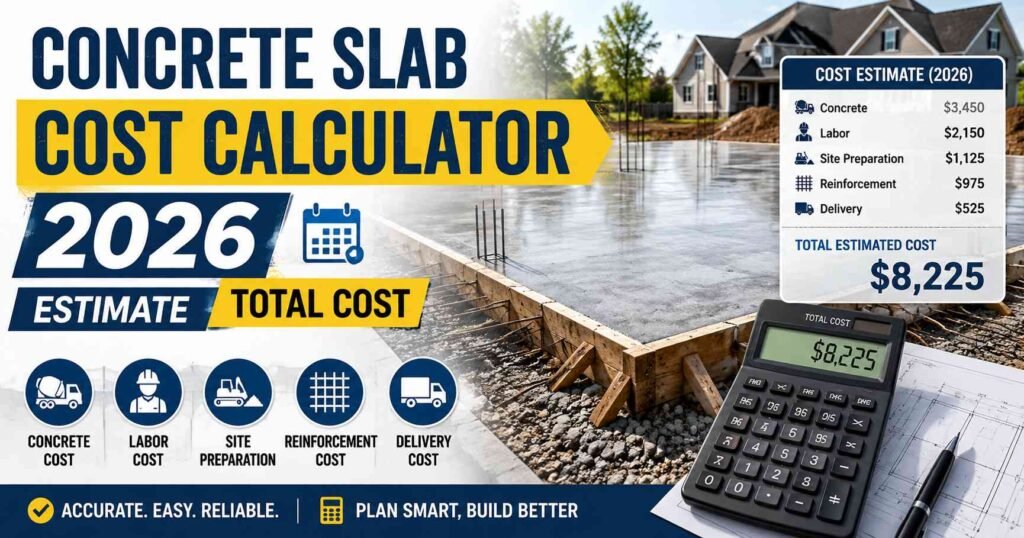
How much will your entire concrete slab project actually cost in 2026? In 2026, a concrete slab may cost around 6–12 per square foot, depending on slab size, concrete prices, labor, site preparation, finishing, delivery, and pumping. A concrete slab cost calculator does more than estimate the amount of concrete needed.
The total concrete slab cost depends on several factors, including: Thicker slabs require more concrete and may cost more. Local material prices can vary by supplier and location. Installation costs depend on project size and the work required. Difficult access, excavation, or preparation can increase costs. Rebar or wire mesh adds to the overall budget. Distance, truck access, and delivery charges can affect the final price. Different slab finishes may require additional labor and materials.
Unlike a basic concrete volume calculator, a concrete slab cost calculator can help estimate the overall project budget. Concrete cost should be estimated before preparing the overall slab budget. Prices vary by location and project size, the calculator provides an estimate rather than a final cost.
What Is a Concrete Slab Cost Calculator
A concrete slab cost calculator helps estimate the total cost of building a concrete slab. Enter the slab length to calculate its size. Add the width to find the total area. Thickness helps determine how much concrete is needed. The calculator estimates the required concrete, such as 5.5 cubic yards.
It estimates the cost of the required concrete. It may include the cost of delivering concrete to the site. Labor expenses can also be included in the estimate. Other project expenses may affect the final price. At the end, the calculator combines these costs to give an estimated project price, such as $25,000.
What Information Do You Need to Calculate Concrete Slab Cost
Before calculating concrete slab cost, the concrete slab cost calculator should ask for five key inputs. These details help produce a more accurate estimate and avoid incorrect costs.
Slab Length and Width
Enter the slab dimensions to calculate the total area. For example, 20 ft × 20 ft = 400 square feet.
Slab Thickness
Thickness directly affects the amount of concrete needed. A thicker slab requires more concrete and can also affect preparation costs.
Concrete Price
The condition of the site and required base preparation can change the overall project cost.
Waste Allowance
Concrete waste allowance helps cover spills, uneven surfaces, and small calculation differences. Add about 5–10% extra concrete based on the project size. This prevents shortages during the pour.
Other Project Costs
Include labor, reinforcement, base preparation, concrete delivery, and pumping when needed. Final finishing work also adds to the total slab cost and should be included in the estimate.
How to Calculate Concrete Slab Volume
Step 1 — Calculate Slab Area
First, calculate the slab area by multiplying its length by its width. This gives the area in square feet. For example, if the slab is 20 feet long and 20 feet wide:
20 × 20 = 400 square feet
Step 2 — Convert Thickness to Feet
Slab thickness is usually given in inches, so convert it into feet by dividing the thickness by 12. For example, a 4-inch slab is:
4 ÷ 12 = 0.33 feet
Now multiply length, width, and thickness to find the concrete volume:
20 × 20 × 0.33 = 133.2 cubic feet
Step 3 — Calculate Cubic Feet
Now multiply length, width, and thickness to find the concrete volume:
20 × 20 × 0.33 = 133.2 cubic feet
Step 4 — Convert Cubic Feet to Cubic Yards
Since concrete is commonly ordered in cubic yards, divide the cubic feet by 27:
133.2 ÷ 27 = 4.93 cubic yards
So, you would need about 5 cubic yards of concrete.
It is also a good idea to allow 5–10% extra concrete for waste, spillage, and small measurement differences. This extra allowance helps prevent delays if you need more concrete during the project.
How to Calculate Concrete Slab Cost
The first step in calculating the cost of a concrete slab is to find the required concrete volume. Once you know the volume, you can calculate the concrete material cost and then add the other project costs.
The basic formula is:
Concrete Material Cost = Required Concrete Volume (cubic yards) × Local Price per Cubic Yard. For example, if you need 5.4 cubic yards of concrete and the local price is $X per cubic yard, the material cost is:
5.4 × $X = Concrete Material Cost
This formula only calculates the cost of the concrete material. Other expenses are calculated separately and added to get the total slab cost by using a concrete slab cost calculator. After calculating the concrete material cost, add the other costs of the project, such as:
Delivery
Labor
Site preparation
Reinforcement
Finishing
Other expenses
The total cost can be calculated as:
Total Slab Cost = Concrete + Delivery + Labor + Site Preparation + Reinforcement + Finishing + Other Costs
The prices used in this example are only for explanation. They are not actual market prices. Concrete and labor costs can vary depending on your location and local market rates.
How Much Does a Concrete Slab Cost Per Square Foot
It gives a rough cost range for early project planning, but it should not be treated as a final estimate. The actual price varies based on slab size, thickness, materials, labor, site conditions, and finishing requirements. A 6-inch slab requires more concrete than a basic 4-inch slab, increasing material and labor costs. Rebar, wire mesh, or fiber reinforcement can increase the overall project price.
If a concrete truck cannot reach the site, pumping or other placement methods may be required. Decorative or colored finishes generally cost more than a basic concrete finish. Local material and labor prices vary by area, so square-foot rates are not fixed. For a more accurate estimate, use a concrete slab cost calculator to calculate the required concrete volume and confirm what is included in the quoted price, such as delivery, pumping, labor, and finishing.
A complete concrete slab cost calculator estimate can include concrete, labor, delivery charges, site preparation, reinforcement, and finishing. Depending on the project, it may also include equipment, permits, and a waste allowance.
What Factors Affect Concrete Slab Cost
Slab Thickness
Slab thickness directly affects the amount of concrete required. A thicker slab uses more concrete, which can increase the overall cost. Yet, thickness should not be chosen based on cost alone. It depends on the intended use, expected load, soil conditions, structural design, and applicable building codes.
- Patio = A 4-inch slab is enough.
- Driveway = 5 to 6 inches needed.
- Warehouse = 8 inches or more for heavy loads.
Concrete Mix
Concrete cost can vary based on several factors. These include strength specifications (e.g., 3,000 or 4,000 PSI), mix design, additives, and any special requirements. Higher-strength mixes or special materials may increase the price, so the final cost depends on the concrete specifications selected for the project.
Site Preparation
Site preparation includes several important steps before pouring the concrete slab. First, excavation is done to prepare the required depth. Next, the ground is graded and leveled to create a proper surface. Finally, a gravel layer is added and compacted to provide a stable base for the slab.
Reinforcement
Reinforcement helps make a concrete slab stronger and reduces cracking. The required reinforcement depends on the project, expected load, slab design, and soil conditions. Common reinforcement options include fiber reinforcement, rebar, and wire mesh. The right type depends on the slab’s purpose, thickness, load, and construction requirements.
Every project may need different reinforcement. A residential patio may require less reinforcement, while a driveway usually needs stronger reinforcement because it carries heavier and repeated loads. For a patio, 6 × 6 wire mesh may be suitable for some slab designs. Still, reinforcement should always match the project’s actual load and design requirements.
Finish Type
The concrete finish also affects the overall cost and work involved. A basic finish is usually more affordable, while decorative finishes cost more but provide a better appearance. Reinforcement should be installed correctly before concrete placement, while the selected finish should be planned. Both choices can affect labor, materials, and the final slab cost.
Site Access
Site access can affect the total concrete slab cost. If the concrete truck can reach the slab area directly, delivery and placement are usually easier. If the truck cannot access the site, additional equipment, pumping, or labor may be required to move the concrete to the slab location.
Location
Concrete slab costs can vary depending on the project location. Labor and material prices are often higher in large cities because operating and transportation costs are greater. Local supplier rates, labor availability, and material transportation can also affect the final project cost.
How Much Waste Allowance Should You Add
Concrete waste allowance helps cover spills, uneven surfaces, and small calculation differences. Add about 5–10% extra concrete based on the project size. This prevents shortages during the pour. Concrete orders can vary from the exact calculated amount for several reasons. Measurement differences may occur, and uneven areas can require extra concrete.
Wooden forms can also shift slightly during pouring, causing some concrete to spill or settle below the planned level. Irregular slab areas and small changes during the work can also increase the amount needed.
A common approach is to keep extra concrete based on the project difficulty. For a simple slab, 5% extra is usually enough. For a more difficult project, keep around 10% extra. For very uneven or complex areas, 15% extra may be safer.
There is no single percentage that works for every slab.
Concrete Slab Cost Example: 20 × 20 Slab
Length: 20 feet
Width: 20 feet
Thickness: 4 inches
Add the recommended percentage to cover measurement differences and unexpected concrete loss.
Use these measurements with the concrete slab cost calculator to calculate concrete volume, waste allowance, required quantity, and estimated slab cost.
- Calculate square footage = Find the Area: 20 × 20 = 400 sq ft
- Convert thickness = Convert 4 inch to ft: 4 ÷ 12 = 0.33 ft
- Calculate cubic feet = 400 × 0.33 = 133.2 cubic ft
- Convert to cubic yards = 133.2 ÷ 27 = 4.93 cubic yards
- Add waste = 4.93 + 10% = 5.42 cubic yards
- Multiply by concrete price = 5.42 × $150 = $813
- Add the cost of concrete delivery to the site. This includes truck charges, fuel, and pump fees if needed.
- Add labor, site preparation, reinforcement, and finishing costs. These depend on your location and project size.
DIY vs. Professional Concrete Slab Cost
DIY Installation: DIY concrete work can reduce labor and contractor costs, making it suitable for small and simple projects. Still, you may need mixers, forms, equipment, pouring tools, finishing tools, and additional labor. You also need enough time and basic skills to complete the work correctly.
Professional Installation: Professional concrete installation includes site preparation, forming, pouring, labor coordination, leveling, and finishing. Professionals can manage the concrete quickly because it must be placed and finished within the proper working time. This is especially useful for large, complex, or time-sensitive projects.
Cost Consideration: DIY is not always cheaper. Equipment rental, mistakes, material waste, and rework can quickly reduce or eliminate the expected savings.
How to Get the Most Accurate Concrete Slab Cost Estimate
Start by measuring the slab’s length and width to find its total area. Decide the required slab thickness based on the project’s use and load. Use the slab measurements and thickness to calculate the total concrete volume. Add around 5%–10% extra concrete.
The exact allowance depends on the project size and is not fixed. Find the current local price of concrete for accurate cost planning. Check delivery and minimum-load charges, then add site preparation, reinforcement such as fiber mesh, labor, and finishing costs. Preferably, compare two or three quotes. Don’t look only at the final price; check what each quote includes, such as delivery, reinforcement, labor, and other charges.
Common Mistakes
Many people consider only the concrete price and forget additional costs such as delivery or minimum-load charges. Costs for excavation, grading, gravel, and compaction are sometimes left out of the estimate. Some estimates do not include reinforcement costs, such as fiber mesh, wire mesh, or rebar. Labor and finishing expenses can also affect the final slab cost and should be included.
Ordering only the calculated concrete quantity can leave you short, especially when the site has small variations. Depending on a single quote may not give you the best budget. Compare two or three quotes when possible. A concrete slab cost calculator gives an estimate, not a contractor’s final price. Always consider actual project conditions and included costs.
Frequently Asked Questions
Q: How much does a 10×10 concrete slab cost?
A 10 × 10 ft slab covers 100 square feet. The total concrete needed depends on the slab thickness, project size, and the type of project.
Q: How do I calculate concrete slab cost?
First, calculate the slab’s volume using its length, width, and thickness, then add material, delivery, waste allowance, reinforcement, and site preparation costs.
Q: How much extra concrete should I order?
Order 5% extra concrete for simple jobs, 10% for moderately difficult work, and 15% for irregular or uneven sites, depending on the project requirements.
Q: Can I use this calculator for a garage slab?
Use this concrete slab cost calculator to find concrete quantity and an initial cost estimate. Garage slabs are thicker, usually 6 inches, and need more reinforcement.
Conclusion
Measure the step’s length, width, and thickness to calculate how much concrete you need. Add the costs of concrete, reinforcement, formwork, delivery, site preparation, and labor. A concrete calculator helps estimate the concrete needed, but it cannot give the exact total project cost.
Concrete costs can change based on your location, site conditions, material prices, and labor rates. First, calculate the concrete amount with a concrete slab cost calculator, then compare quotes from local contractors to estimate your total cost.