Round Footing Concrete Calculator: Complete Guide in 2026
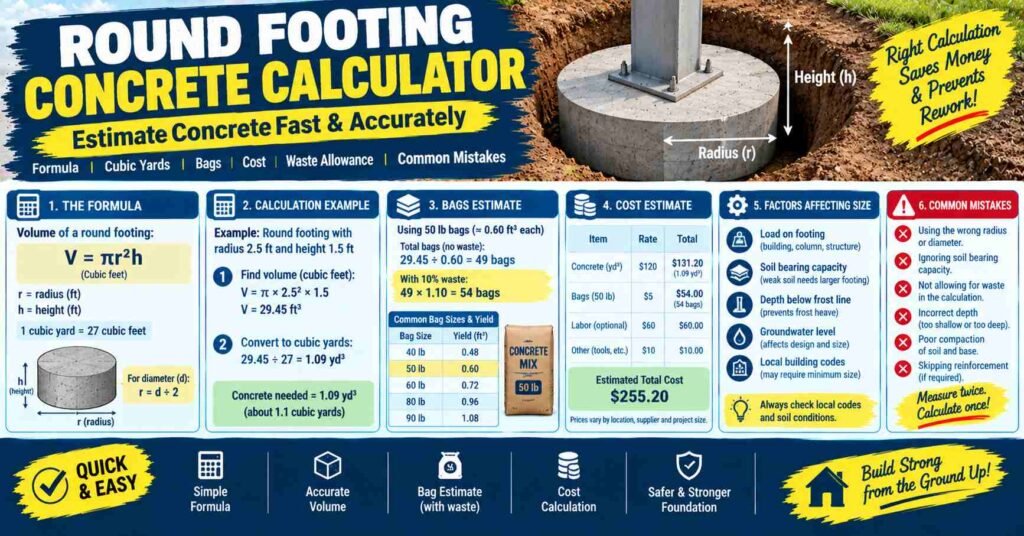
How much concrete do you need for a round footing, and how can you avoid ordering too much or too little? Ordering the right amount helps save time, money, and materials. A round footing concrete calculator makes this task easier by estimating the concrete required for your project.
Enter the footing diameter, depth, total number of footings, and extra waste allowance. The calculator provides the estimated concrete volume in cubic feet or cubic yards, along with the number of concrete bags needed.
In this guide, you will learn the formula, calculation examples, and common mistakes to avoid. Recall that the calculator estimates material quantities; it does not determine the footing’s structural size or strength.
What Is a Round Footing Concrete Calculator
A round footing concrete calculator estimates the concrete needed to fill cylindrical holes. It is useful for deck posts, fence posts, sign supports, and small column foundations. An online concrete calculator makes it easier to estimate the concrete needed for cylindrical holes.
By calculating the required volume, it saves time and helps you order the right amount of concrete. Recall, estimating concrete quantity and designing a foundation are two different tasks. Large building foundations require proper structural design by a qualified engineer.
Round Footing Concrete Formula
The Circular Footing Volume Formula
The formula for calculating round footing concrete volume is:
V= r²h
Where:
V: Concrete volume in cubic feet.
: (Pi): A constant value of 3.14.
r: Radius of the footing, calculated by dividing the diameter by 2.
h: Depth or height of the footing. A round footing concrete calculator uses the circular volume formula to estimate the required concrete.
Calculate Volume in Cubic Feet
Convert all measurements into feet before calculating. Divide the diameter by 2 to find the radius. Square the radius and multiply it by 3.14. Multiply the result by the footing depth to find the volume in cubic feet. A concrete yard calculator helps convert cubic feet into cubic yards for ordering purposes
.
A round footing concrete calculator can simplify the process of calculating volume in cubic feet. A concrete estimator can simplify volume calculations when all measurements are entered correctly.
Convert Cubic Feet to Cubic Yards
To convert cubic feet into cubic yards, divide the volume by 27.
Cubic Yards=cubic feet/27
Ready-mix concrete suppliers in the United States commonly sell concrete by the cubic yard, making this conversion useful when ordering materials. A round footing concrete calculator helps estimate the volume needed before converting cubic feet into cubic yards.
Calculate the Total for Multiple Footings
Calculate the volume of one footing first. Multiply it by the total number of footings.
Add an extra 5–10% for potential waste and spillage, depending on project conditions. A round footing concrete calculator can estimate the total concrete required for several identical footings.
Example Calculation
Suppose you need 4 round footings, each with a diameter of 2 feet and a depth of 3 feet. Use a round footing concrete calculator to check the estimated concrete quantity for this example.
Radius = 2 ÷ 2 = 1 foot
Volume per footing = 3.14 × 1 × 1 × 3 = 9.42 cubic feet
Total volume = 9.42 × 4 = 37.68 cubic feet
Cubic yards = 37.68 ÷ 27 = 1.4 cubic yards
With 10% extra = 1.54 cubic yards
Result: You need approximately 1.54 cubic yards of concrete, including the extra allowance. Use a calculator for concrete yards to estimate the total quantity required for multiple footings.
Round Footing Concrete Calculation Example
Example Measurements
Use the following measurements to estimate the concrete required for four round footings. A round footing concrete calculator helps verify the estimated volume using the given footing measurements.
Diameter: 2 feet
Radius: 1 foot
Depth: 3 feet
Number of footings: 4
Calculate One Footing
Use the circular footing volume formula:
V=3.1416×r²×h
V=3.1416×1²×3
Volume = 9.42 cubic feet
Cubic yards = 9.42 ÷ 27 = 0.35 cubic yards. A round footing concrete calculator can help check the volume calculated for one footing.
Calculate Four Footings
Multiply the volume of one footing by the total number of footings.
Total volume = 9.42 × 4 = 37.70 cubic feet
Total volume in cubic yards = 37.70 ÷ 27 = 1.40 cubic yards
Add 5–10% extra concrete to account for spillage, uneven excavation, and minor measurement differences.
With 5% extra = 1.47 cubic yards
With 10% extra = 1.54 cubic yards
A concrete yardage calculator helps estimate the total volume before adding the waste allowance.
Final estimate: Approximately 1.47–1.54 cubic yards of concrete, depending on the waste allowance. A round footing concrete calculator helps estimate the combined concrete volume before adding extra material for waste.
Note: These measurements are for calculation purposes only. A round footing concrete calculator estimates material quantities; it does not recommend footing dimensions or confirm structural safety. Follow approved plans and local building codes.
Factors That Affect Round Footing Concrete Quantity
A round footing concrete calculator gives a useful estimate when footing dimensions and excavation conditions are measured carefully.
Diameter of the Footing
The diameter directly affects the amount of concrete required for a round footing. Concrete volume increases with the square of the radius, so even a small increase in diameter can significantly increase the total concrete needed. Always measure the diameter accurately before calculating the concrete volume.
Footing Depth
When the diameter remains constant, concrete volume increases in direct proportion to the footing depth. If the depth doubles, the required concrete volume also doubles. Accurate depth measurements help prevent material shortages.
Number of Footings
The total concrete requirement depends on the number of footings. Ten identical footings require ten times the concrete needed for one footing. Calculate the volume of one footing first, then multiply it by the total number of footings.
Soil and Excavation Conditions
Soft soil, uneven excavation, and irregular hole shapes can increase actual concrete consumption. Excavated holes may be wider or deeper than the planned dimensions. Inspect and measure each excavation before ordering concrete.
Concrete Waste and Formwork
Concrete spillage, uneven placement, and incorrectly sized formwork can increase material requirements. Proper formwork helps maintain the planned footing dimensions. Consider adding 5–10% extra concrete to cover normal waste and minor variations, depending on site conditions.
Common Mistakes When Calculating Round Footing Concrete
Using the full diameter instead of the radius can lead to incorrect results.
Solution: Divide the diameter by 2 to calculate the radius before applying the formula.
Using different units in the same formula can produce inaccurate calculations.
Solution: Convert all measurements to a single unit, preferably feet, before calculating concrete volume.
Calculating only one footing’s volume may result in ordering insufficient concrete.
Solution: Multiply the volume of one footing by the total number of identical footings.
Irregular excavation and concrete spillage can increase material requirements.
Solution: Inspect excavation dimensions and consider adding 5–10% extra concrete, depending on site conditions.
A calculator estimates concrete quantity but does not verify soil strength, structural safety, or building code compliance.
Solution: Consult a qualified structural engineer to determine safe footing dimensions and design requirements. A round footing concrete calculator depends on accurate measurements and consistent units to produce a useful estimate.
How to Estimate Round Footing Concrete Cost
Calculate the Required Volume
Calculate the required concrete volume first to determine the order quantity in cubic yards or bags. A round footing concrete calculator helps estimate the quantity needed to calculate the expected concrete cost. A concrete cost calculator can help estimate material expenses using the required quantity and local supplier prices.
Apply the Local Concrete Price
Multiply the required quantity by the supplier’s unit price. Concrete rates vary by location, concrete quality, city, and pricing date.
Include Additional Project Costs
Include delivery, bags, materials, mixing equipment, labor, excavation, formwork, pumping, and site-access charges. Check current local rates because total costs depend on project requirements.
Frequently Asked Questions
Q: How do you calculate concrete for a round footing?
Use V=r²h convert measurements to feet, divide by 27 for cubic yards, and add 5–10% for waste. A round footing concrete calculator simplifies the process of estimating concrete volume for round footings.
Q: How much concrete is needed for a 12-inch round footing?
A 12-inch diameter footing with a 3-foot depth requires approximately 0.087 cubic yards of concrete.
Q: Can a round footing concrete calculator determine footing size?
No, it estimates concrete quantity only. A structural engineer determines footing size based on loads and soil conditions.
Conclusion
A round footing concrete calculator works like a concrete volume calculator by estimating the amount of concrete required for circular footings. It converts cubic feet into cubic yards and simplifies material planning for construction projects.
For accurate results, measure the footing diameter and depth carefully, confirm the number of footings, and convert all dimensions into feet before calculating. Check the supplier’s specifications and current pricing before placing your order. Recall that this calculator estimates concrete quantity only. It does not determine foundation design, soil strength, or the structural safety of a footing.
These factors should be evaluated by a qualified professional. Accurate measurements and verified specifications help you order the right amount of concrete, reduce material waste, and avoid unnecessary expenses. Always confirm your project requirements before ordering concrete for your round footings.