Weight of Yard of Concrete: Complete Guide 2026
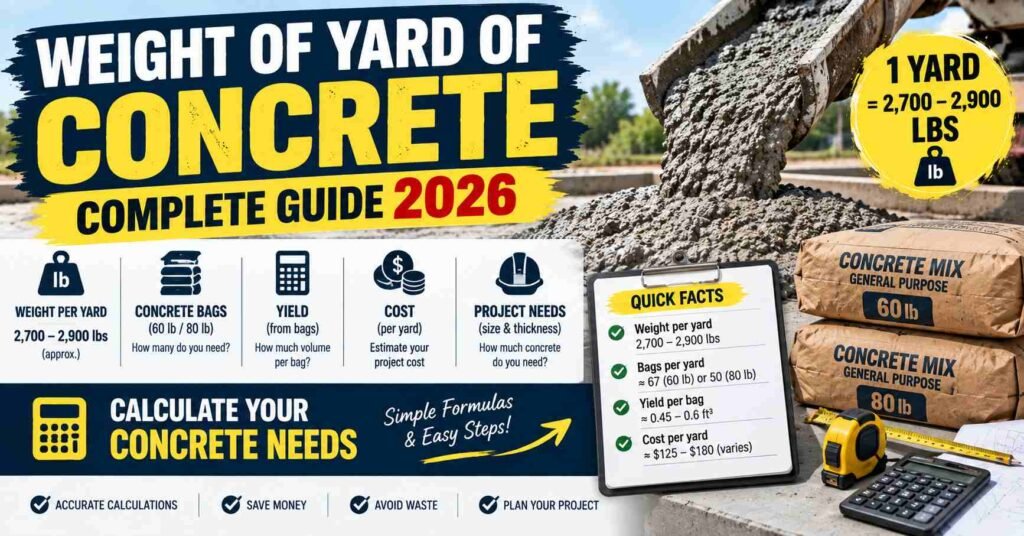
Weight of Yard of Concrete is an important factor to understand when planning a concrete project. Are you choosing a concrete bag by its weight, or do you know how much concrete it actually produces? Many people choose concrete bags only by their weight, but the bag size does not always tell you how much concrete it will produce.
Concrete bags come in different sizes, such as 40 lb, 50 lb, 60 lb, and 80 lb, and they can be useful for small home projects. The important thing is to check the yield listed on the manufacturer’s label.
Bag weight and concrete yield are not always the same. For example, an 80 lb bag may not always provide twice the concrete of a 40 lb bag. In some cases, the difference in yield can be smaller than expected.
When choosing a bag, consider your project size, cost, strength requirements, and how easily the bag can be handled. A 60 lb bag may be easier for one person to lift, while larger bags may reduce the total number of bags needed. Always check the manufacturer’s label for the bag’s yield before calculating the required quantity.
What Is the Weight of a Concrete Bag
What Does a 60 lb Concrete Bag Weigh
A 60 lb concrete bag weighs 60 pounds (27.2 kg) before water is added. It contains a dry mix of cement, sand, and gravel. The bag is easier to handle, so one person can usually lift it more easily. After adding water, its wet weight may increase slightly, but once the concrete dries, the final weight returns close to its original dry weight of yard of concrete.
What Does an 80 lb Concrete Bag Weigh
An 80 lb concrete bag weighs 80 pounds (36.3 kg) as a dry mix. It is 20 pounds heavier than a 60 lb bag, so it can be harder to lift and handle. Depending on the job and working conditions, two people may be needed to move larger bags safely. Still, larger bags can reduce the total number of bags required for a project weight of yard of concrete.
Does Bag Weight Mean Concrete Strength
Bag weight does not tell you how strong the finished concrete will be. Strength depends mainly on the mix design, cement content, water amount, and curing. Adding too much water can make concrete weaker. Concrete strength is usually measured in PSI, so always check the manufacturer’s label before buying. For example, a 4,000 PSI mix is designed to reach that specified strength when mixed, placed, and cured according to the manufacturer’s instructions.
Concrete Bag Weight Chart
Concrete bags are available in different weights, and the amount of concrete produced can vary by product and manufacturer. Consequently, you should not choose a bag only by its weight. Check the product label to find its yield, which tells you how much concrete one bag can produce weight of yard of concrete.
| Bag weight | Approx. Dry weight | Handling |
| 40 lb | 18.1 kg | Easy to handle |
| 60 lb | 27.2 kg | Easier for 1 person |
| 80 lb | 36.3 kg | Heavier to handle |
For example, if you are making a 4-inch-thick slab, check how many square feet one bag can cover at that thickness. This helps you estimate the total number of bags needed for your project.
Keep in mind that different brands may have different mix designs and yields, even when the bags have similar weights. Always check the manufacturer’s label and follow its instructions before purchasing. This gives you a more accurate estimate and helps avoid buying too many or too few bags.
60 lb vs 80 lb Concrete Bags: What’s the Difference
Weight and Handling
A 60 lb concrete bag weighs about 27 kg, so it can be heavy for one person to lift. It is suitable for small home projects. An 80 lb bag is harder to handle because lifting it may require more strength or even two people. It can be used for both small and large projects, but handling becomes important when mixing 10–15 bags.
For example, mixing 15 bags can mean lifting around 1,200–1,500 lb in total. This can increase physical strain; thus bag weight should be considered before choosing a product weight of yard of concrete.
Concrete Yield
Concrete yield refers to how much concrete a single bag produces after mixing. Depending on the product, one bag may produce around 0.45–0.47 cubic feet of concrete. The yield can vary between manufacturers and bag sizes.
For example, some 60 lb bags may produce about 0.43 cubic feet, while others may produce around 0.47 cubic feet. Before buying concrete, check the bag’s stated yield to make sure it provides enough concrete for your project.
Number of Bags Required
If a project requires 6 cubic feet of concrete, an 80 lb bag with a yield of about 0.60 cubic feet would require around 10 bags. The same project may require about 13–14 bags if using 60 lb bags with a lower yield.
Smaller bags are easier to handle, but more bags may be needed. An 80 lb bag can also cost more per bag than a 60 lb bag. To estimate the total price, multiply the price per bag by the number of bags required.
Which Bag Is Better
Neither the 60 lb nor 80 lb bag is always the better choice. The right option depends on your project size, handling needs, and budget. Choose a 60 lb bag when easier handling is important, especially for smaller DIY projects. An 80 lb bag may be more practical for larger projects because fewer bags may be needed.
Before choosing, consider four things: how easily you can lift the bag, its concrete yield, total cost, and how many people will be working on the project. Because bag sizes, yields, and prices can vary between manufacturers, always check the product information before buying.
Concrete Bag Weight vs Concrete Yield
What Is Concrete Yield
Concrete yield means the amount of concrete produced from one bag after it is mixed with water. It shows the final volume of concrete the bag can produce. Yield is usually measured in cubic feet. For example, one bag may produce around 0.50 to 0.60 cubic feet of concrete, depending on the product.
Why Weight and Yield Are Different
An 80 lb bag generally produces more concrete than a 60 lb bag weight of yard of concrete, but this is not always the case. The final yield depends on the mix and materials used by the manufacturer.
A heavier bag may contain more aggregate and less cement, so its strength or yield may not be the same as a smaller high-strength mix. Do not assume an 80 lb bag gives double the concrete. Do not assume that an 80 lb bag will produce twice as much concrete as a 60 lb bag.
The yield depends on the specific mix and manufacturer. Different brands use different material proportions, so always check the product label for the actual yield before calculating the required number of bags.
Why the Label Matters
The label matters because it shows the bag’s weight, concrete yield, mixing instructions, and coverage. Always check the label before buying or mixing. Different brands can have different yields; that’s why use the information printed on the bag for accurate calculations.
How to Calculate the Weight and Number of Concrete Bags
Step 1: Calculate Concrete Volume
First, calculate the concrete volume using this formula:
Length × Width × Thickness = Cubic Feet
Concrete thickness is often given in inches; hence, convert it into feet by dividing the thickness by 12. Since 1 foot has 12 inches, a 4-inch thickness equals 4 ÷ 12 = 0.333 feet.
For example, for a 10 × 10 ft slab that is 4 inches thick:
10 × 10 × 0.333 = 33.3 cubic feet
Step 2: Convert Cubic Feet to Cubic Yards
Once you have the concrete volume in cubic feet, convert it to cubic yards by dividing the cubic feet by 27.
Cubic Feet ÷ 27 = Cubic Yards
For example, if the project requires 33 cubic feet:
33 ÷ 27 = 1.22 cubic yards
Concrete is commonly ordered and measured in cubic yards, especially for larger projects.
Step 3: Calculate the Number of Bags
To calculate the number of concrete bags, divide the required concrete volume by the yield of one bag.
Required Cubic Feet ÷ Bag Yield = Number of Bags
For example, if you need 33 cubic feet and one bag produces 0.45 cubic feet:
33 ÷ 0.45 = 73.3 bags
As you cannot buy part of a bag, round the result up to 74 bags. Always use the yield stated by the manufacturer for a more accurate estimate.
Step 4: Add Waste Allowance
After completing the calculation, add around 5–10% extra concrete to allow for waste, spillage, uneven surfaces, and small measurement differences.
For example, if your calculation requires 55 bags and you add 10%:
55 × 1.10 = 60.5 bags
Round up to the next whole bag, so you would need 61 bags in total.
Worked Example: How Much Concrete Do You Need
Example: 10 × 10 Slab, 4 Inches Thick
Suppose you need to build a 10 × 10 feet slab that is 4 inches thick. First, calculate the area by multiplying the length by the width: 10 × 10 = 100 square feet.
Next, convert the 4-inch thickness into feet because the volume is calculated in cubic feet. Divide 4 by 12, which gives 0.3333 feet. Now multiply the area by the thickness: 100 × 0.3333 = 33.3 cubic feet of concrete.
Calculate the Bags
For example, if a 60 lb bag yields 0.45 cubic feet, divide 33.3 by 0.45. This gives about 74 bags. If an 80 lb bag yields 0.60 cubic feet, 33.3 ÷ 0.60 gives about 56 bags.
Add Waste Allowance
You should also allow some extra material for waste. The final quantity depends on the product you use, so check the bag label for its yield and requirements before ordering. You can also confirm the information with the product manager or representative.
How Much Does a Concrete Bag Weigh After Mixing
Dry Bag Weight
The weight printed on a concrete bag, such as 60-lb or 80-lb, refers to the dry mix inside the bag. This mix contains materials such as cement, sand, and other dry ingredients.
When water is added, the total weight increases because the water also has weight. As soon as the concrete cures and dries, some water is absorbed, but the final concrete weight does not simply equal the original dry-bag weight.
Water Changes the Total Weight
For example, an 80-lb dry mix will weigh more after adding the required amount of water. The exact final weight depends on how much water is added and the specific product.
Why This Matters
This difference is important for handling, transportation, and planning. Do not use the bag’s dry weight as the final weight of the mixed concrete. Always check the product label for the recommended water amount and product information before estimating the final weight.
Common Mistakes When Choosing Concrete Bag Weight
A cheaper bag is not always cheaper. For example, a $5 60-lb bag may yield 0.45 cu ft, although a $6.50 80-lb bag may yield 0.60 cu ft. Compare price per cu ft before buying. An 80-lb bag is not automatically stronger. Strength depends on PSI, cement content, mix, and yield. Always check the label.
Uneven ground can require extra concrete. Order about 5 to 10% extra. For one-person jobs, 60-lb bags are easier to handle. Larger crews can use 80-lb bags, but lifting heavy bags repeatedly can cause physical strain.
Frequently Asked Questions
Q: How Much Does a Bag of Concrete Weigh?
Concrete bags come in different sizes, including 40, 50, 60, and 80 pounds. Among these, 60- and 80-pound bags are the most commonly used.
Q: Does a Heavier Bag Mean Stronger Concrete?
Concrete does not become strong on its own; its strength depends on proper mixing, the right amount of water, and proper curing.
Q: How Many 80 lb Bags Are in a Cubic Yard?
One cubic yard of concrete requires about 45 bags of 80-pound concrete, with each bag yielding approximately 0.60 cubic feet weight of yard of concrete.
Q: Should I Buy 60 lb or 80 lb Bags?
The best bag depends on the project. For small jobs, 60-pound bags are easier to lift, while 80-pound bags provide more concrete per bag for larger jobs.
Conclusion
Do not choose only by 60-lb weight. Check the bag’s yield, cost, strength, and handling needs. An 80-lb bag may yield around 0.60 cu ft, while a 60-lb bag may yield around 0.40 cu ft. The 80-lb bag costs more per bag but may need fewer bags overall. Multiply length×width×thickness, then convert the result into cu ft. Do not buy concrete waste on guesswork.
A 60-lb bag is easier for one person to handle. An 80-lb bag is heavier and may need two people for safer handling. 60-lb bags work well for small projects, while 80-lb bags are better for larger jobs. For very large volumes, ready-mix concrete may be more practical.
After calculating volume, check the bag label for yield and requirements, then compare weight, cost, and handling. Choosing the right bag can save both time and money.