10×10 Concrete Slab: Complete Guide & Cost in 2026
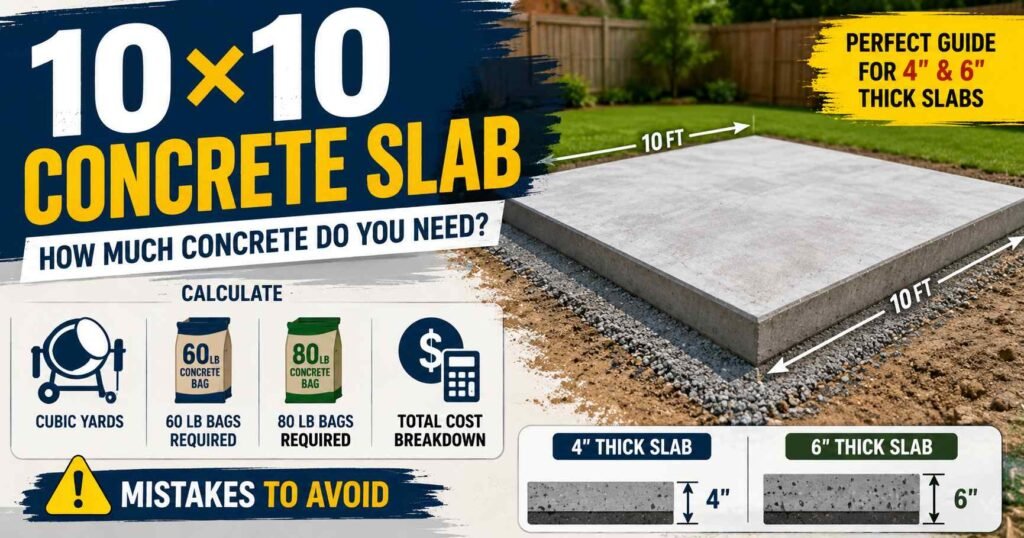
How much concrete do you need for a 10×10 concrete slab? If you have a 10×10 concrete slab, the first step is to find its area. Multiply the length by the width:
10 × 10 = 100 square feet
Still, the amount of concrete you need depends on the slab thickness. A 4-inch slab is commonly used for lighter residential work, while 5 inches provides more strength for areas with heavier use. A 6-inch slab may be suitable for applications that need greater strength, such as areas exposed to heavier vehicles.
The required thickness should always match the intended use, soil conditions, loads, and applicable requirements. For the calculation, first convert the thickness from inches to feet. For a 4-inch slab:
4 ÷ 12 = 0.33 feet
Then calculate cubic feet:
10 × 10 × 0.33 = 33 cubic feet
Finally, divide by 27 to convert cubic feet to cubic yards:
33 ÷ 27 ≈ 1.23 cubic yards
We’ll also explain bag calculations, supplier guidance, and ordering considerations.
How Much Concrete Does a 10×10 Concrete Slab Need
Concrete is usually ordered by volume, so we first calculate the area of the slab. For example, a 10 × 10 ft slab has a surface area of 100 square feet. After finding the area, we take the slab thickness and multiply it by the area. This gives us the concrete volume in cubic feet.
To convert cubic feet into cubic yards, divide the cubic feet by 27. The cubic yards tell us approximately how much concrete will be needed for the slab or project. The amount of concrete also changes with the slab thickness. A 4-inch slab needs less concrete, while a 6-inch slab needs more because it is thicker.
This calculation is mainly used to get an estimate of the concrete required. When placing the actual concrete order, it is a good idea to add around 5–10% extra. This extra amount helps cover small losses caused by spillage, leakage, uneven surfaces, or other site conditions.
Due to this, the calculated quantity and the actual ordered quantity may be slightly different. The calculated volume gives us the basic requirement, while the final order includes some extra concrete for practical reasons.
| Slab Thickness | Total Volume Needed | Bags Required @ 0.45 cu ft/bag |
| 4 inches | 33.3 cubic ft | 74 bags |
| 5 inches | 41.7 cubic ft | 93 bags |
| 6 inches | 50.0 cubic ft | 111 bags |
How to Calculate Concrete for a 10×10 concrete slab
Step 1: Calculate the Square Footage
Square footage tells us how much area the concrete will cover. For example, if the slab is 10 ft long and 10 ft wide, the total area will be:
10 × 10 = 100 square feet
This tells us that the concrete will cover 100 square feet. Knowing the area also helps us compare suppliers and check their minimum order quantities for your 10×10 concrete slab. Some suppliers may require a minimum amount, so ordering a smaller quantity may not always be practical.
Step 2: Convert Thickness to Feet
Concrete thickness is usually given in inches, such as 4, 5, or 6 inches. For the volume calculation through the concrete cost calculator, we need to convert the thickness into feet because the formula uses feet.
Example:
4 inches ÷ 12 = 0.333 feet
We divide by 12 because 1 foot = 12 inches. Keeping all measurements in feet helps us get the correct answer in cubic feet.
Step 3: Calculate Cubic Feet
Now we use the basic volume formula:
Length × Width × Thickness
For a 10 × 10 ft slab with 4-inch thickness:
10 × 10 × 0.333 = 33.3 cubic feet
Accordingly, the slab will need approximately 33.3 cubic feet of concrete.
Step 4: Convert Cubic Feet to Cubic Yards
Concrete suppliers usually sell and deliver concrete by cubic yards. To convert cubic feet into cubic yards, divide the cubic feet by 27.
33.3 ÷ 27 = 1.23 cubic yards
As a result, the calculated requirement is approximately 1.23 cubic yards.
Step 5: Check the Final Quantity
Before placing the order, check the final quantity and consider adding some extra concrete for spillage, uneven surfaces, or small measurement differences. This makes the actual order slightly different from the calculated volume.
Example
Suppose you want to pour a 12 ft × 15 ft slab with a 6-inch thickness.
Step 1: Area = 12 × 15 = 180 square feet
Step 2: Thickness = 6 ÷ 12 = 0.5 feet
Step 3: Volume = 12 × 15 × 0.5 = 90 cubic feet
Step 4: Cubic yards = 90 ÷ 27 = 3.33 cubic yards
So, a 12 × 15 ft slab with a 6-inch thickness requires approximately 3.33 cubic yards of concrete before adding any extra quantity for practical site needs.
Volume by Thickness for a 10×10 concrete slab
4 Inch 10×10 Concrete Slab
First, calculate the area of the slab.
Multiply the length by the breadth: 10 × 10 = 100 square feet. The slab is 4 inches thick.
Convert inches into feet by dividing 4 by 12: 4 ÷ 12 = 0.33 feet.
Now multiply the area by the thickness: 100 × 0.33 = 33.3 cubic feet of concrete. Convert cubic feet into cubic yards by dividing 33.3 by 27: 33.3 ÷ 27 = 1.23 cubic yards. This is the basic concrete volume. In a real order, some extra concrete is usually added for waste, uneven ground, and other small project needs.
4 Inch 10×10 Concrete Slab
For the same 10 × 10 slab, the area is still 100 square feet. If the thickness is 6 inches, convert it into feet: 6 ÷ 12 = 0.5 feet.
Multiply 100 × 0.5 = 50 cubic feet.
Then divide 50 by 27 to convert it into cubic yards: 50 ÷ 27 = 1.85 cubic yards. A thicker slab needs more concrete. A 6-inch slab uses about 50% more concrete than a 4-inch slab, not just 25% more. The right thickness depends on what will be placed on the slab, the weight it will carry, soil conditions, and the amount of rebar needed.
Example:
If a slab is being used for vehicle parking, it must handle repeated pressure from the vehicle’s weight. A suitable thickness, proper base, and enough reinforcement help reduce cracking and early damage. It is better not to make the slab too thin just to save money. A small saving in concrete can lead to repairs or replacement later if the slab cannot handle the load.
How Many Bags of Concrete Do You Need for a 10×10 concrete slab
60 Lb Concrete Bags
The number of concrete bags depends on the slab thickness, so first calculate the required concrete volume before estimating the bags. Bag quantity also depends on the product because different companies can provide different coverage for the same bag size.
For example, a 60 LB concrete bag may cover around 0.45 cubic feet, while another product may provide around 0.60 cubic feet. Some product information may show that a 60 LB bag provides about 0.40 cubic feet, so always check the manufacturer’s information before buying. Use the cubic feet formula to find the required concrete volume, then divide it by the coverage given on the bag to calculate the number of bags.
For example, if the required volume is 33.3 cubic feet and one bag covers 0.45 cubic feet, then 33.3 ÷ 0.45 gives about 74 bags. If the calculation gives 73.6 bags, round it up to 74 bags, because you cannot buy a fraction of a bag. Check the coverage information from at least two or three companies, as their bag coverage can be different.
Always read the information printed on the bag before purchasing, and add about 10% extra for waste and unexpected needs. Even if you use 40 LB, 50 LB, 60 LB, or 80 LB bags, use the company’s actual product data instead of estimating.
Ready-Mix vs. Bagged Concrete for a 10×10 concrete slab
Ready-Mix Concrete
Ready mix concrete comes to the site in a truck and is already mixed by the supplier, so you do not need to mix anything yourself. It is useful for large slabs because it saves time and can be poured quickly. When ordering, you usually give the required volume in cubic yards.
Yet, the concrete truck needs proper access to the site. If it cannot reach the work area, extra labor and equipment may increase the cost. Some suppliers may also have minimum order requirements, while larger orders may receive better pricing.
Bagged Concrete
Bagged concrete is easy to find at local stores and usually comes in 60-lb or 80-lb bags. You add water and mix it yourself using a mixer, wheelbarrow, bucket, or another large container. It works well for small projects, but using hundreds of bags can take more labor and equipment.
Which Option Is Better
| Factor | Ready-Mix Concrete | Bagged Concrete |
| Total volume | Better for large volume | Better for small volume |
| Delivery | Delivered by truck | Pick up or store delivery |
| Equipment | Less mixing equipment | Mixer and wheelbarrow needed |
| Labor | Usually less labor | More labor for large quantities |
| Site access | Truck needs good access | Easier to move around |
| Supplier | Ordered from concrete supplier | Available from local stores |
| Requirements | Cubic yard order and access | Bags, water, and mixing tools |
| Project schedule | Faster for large pours | Takes longer to mix and place |
There is no single cheaper option. The better choice depends on the project size, quantity, site conditions, and location. For example, for a 10×10 concrete slab, ready mix can be a better choice if you want to save mixing time and labor.
Do You Need Extra Concrete for a 10×10 concrete slab?
When your concrete calculator gives you 1.23 cubic yards, adding a 10% waste allowance brings the order to about 1.35 cubic yards. This extra amount helps cover small measurement differences and site conditions that can require more concrete.
Measurements may have small differences in feet or inches, which can increase the concrete needed. Uneven ground or soft soil can cause concrete to settle, requiring additional material. Extra concrete may be needed around slab edges where more thickness is required. Wooden forms can shift or bend slightly, affecting the final amount needed.
Footings, ramps, or other additional sections can also increase the concrete requirement. For a small, simple slab, 5% extra may be enough, while uneven or difficult sites may need 10–15%.
There is no fixed waste percentage for every project. Before placing your order, ask your concrete supplier to estimate the required amount based on your project size and site conditions. This can help avoid ordering too little and paying for another delivery later.
What Factors Affect How Much Concrete a 10×10 Concrete Slab Needs
Slab Thickness
Thickness is one of the biggest factors affecting concrete quantity. Common slab thicknesses can be 3, 4, 5, or 6 inches. If the thickness increases by 2–3 inches, the required concrete can increase by around 25–35%. A thicker slab needs more concrete, even when the slab area stays the same.
Actual Slab Dimensions
The actual dimensions may be slightly larger than the planned 10 × 10 feet. For example, if the slab becomes 10.5 × 10.2 feet, its volume will increase. The length and width should be measured carefully because larger dimensions mean more concrete is needed.
Uneven or Sloped Ground
Uneven areas can also increase concrete usage. Before pouring, the ground should be leveled, graded, and compacted properly. If some areas are lower than others, more concrete may be needed to bring the surface to the required level.
Reinforcement and Thickened Sections
Reinforcement itself does not usually add much concrete, but thickened edges, footings, or deeper sections can increase the overall volume. For example, keeping the slab edges 6 inches thick requires additional concrete in those areas.
Site Preparation
Proper site preparation includes leveling, grading, soil preparation, compaction, and adding a gravel base when needed. A strong and well-prepared base helps provide proper support before the concrete is poured.
Additional Features
Extra features such as thickened edges, footings, steps, curbs, and drainage sections increase the total concrete requirement. A basic 10 × 10 slab may need about 1.23 cubic yards, while additional features could bring the requirement closer to 1.5 cubic yards.
Common Mistakes When Calculating Concrete for a 10×10 Slab
Many people forget to calculate the slab area correctly. For example, they use 10 + 10 = 20 instead of 10 × 10 = 100 square feet. Always convert the slab thickness from inches into feet before calculating the concrete volume.
After getting the concrete volume in cubic feet, divide it by 27 to convert it into cubic yards. Keep in mind that 27 cubic feet is equal to 1 cubic yard, which is the common unit used when ordering ready-mix concrete.
Bag sizes can be different, such as 40 lb, 54 lb, 60 lb, or 80 lb, and each bag can cover a different amount. Before ordering bagged concrete, check the coverage information written on the product because the required number of bags depends on the product.
Some people order concrete by only looking at the slab area and forget to consider its thickness. A 4-inch slab and a 6-inch slab may have a big difference in the amount of concrete needed, even when the area is the same. Extra concrete may also be needed for edge footings, steps, or other parts of the project, so these areas should be included in the calculation.
If your calculation gives you 2 cubic yards, do not order exactly 2 yards without considering a waste allowance. Adding around 10% extra can help cover small mistakes, spillage, uneven areas, and other unexpected needs during the project. Do not order concrete just because you see a price or quantity written online.
First, check what product and bag size that information is referring to. The information printed on the concrete bag is important because different products can have different coverage and mixing requirements. My own project also had several mistakes, including the issues discussed in #3 and #7, which became useful examples for these common ordering mistakes.
Frequently Asked Questions
Q: How many cubic yards are needed for a 10×10 slab?
The amount of concrete depends on the slab thickness. A 4-inch slab needs about 1.23 cubic yards, while a 6-inch slab needs about 1.85 cubic yards.
Formula:
Length × Width × Thickness (in feet) ÷ 27
Q: How many 80-lb bags do I need for a 10×10 slab?
The number of 80-lb bags depends on the slab thickness and the yield listed on the bag. For example, 4 inches needs about 56 bags, while 6 inches needs about 84 bags.
Q: Should I order extra concrete?
It is a good idea to order about 5–10% extra concrete, depending on your project. Uneven ground, slopes, or small amounts of waste can increase the required quantity..
Conclusion
Start by measuring the 10 × 10 slab to find its total area, which is 100 square feet. Check the required slab thickness, such as 4, 5, or 6 inches, before calculating the concrete. Convert the thickness from inches to feet because the concrete volume formula uses feet.
Multiply the length, width, and thickness to find the required concrete in cubic feet. Divide the cubic feet by 27 to convert the amount into cubic yards. Use the cubic-yard amount to estimate how many concrete bags you may need for the project. Check the bag’s yield information because different manufacturers and brands can have different yields.
Consider site conditions such as uneven ground, slopes, and possible concrete waste before placing your order. Keep around 5–10% extra concrete, depending on your project and actual site conditions. Finally, review your calculation and confirm the final quantity with your concrete supplier before ordering.