Concrete Step Calculator: Easy Complete Guide 2026
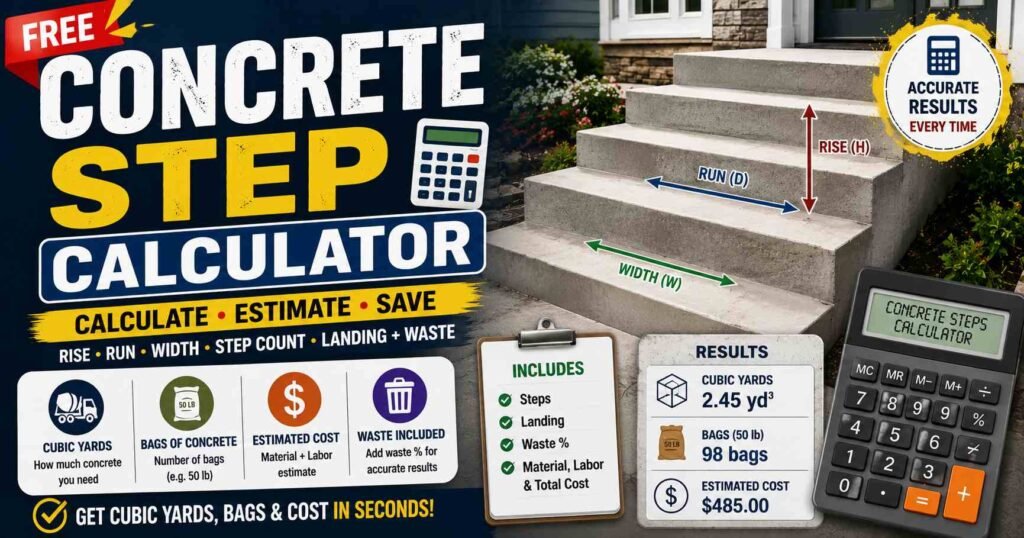
Planning concrete steps for your porch or entrance, do you know how many steps you need, how high each riser should be, and how much concrete the entire staircase will require? Some people estimate concrete only by measuring the length and width of an area. Still, this method does not work well for concrete steps because steps have different rises and runs.
Each step has a different volume, which can greatly affect the total concrete quantity. If the staircase includes a landing, the landing should be calculated separately as a slab. A landing can use a large part of the total concrete, depending on its size. Extra concrete, fitting, and concrete waste allowance can also increase the required quantity. We explain how to use a Concrete Step Calculator to estimate concrete using rise and run measurements. We also explain the formula, provide an example, and show how many concrete bags may be needed.
Common mistakes in concrete quantity calculations are also discussed. The concrete step calculator gives an estimate only; structural design and building-code requirements should be checked by a qualified professional such as an engineer.
What Is a Concrete Step Calculator
A Concrete Step Calculator is a useful tool that helps estimate how much concrete is needed to build a staircase. It uses the rise, run, and width of the steps to calculate the required concrete quantity. It can also help estimate the number of steps and the concrete needed for them.
A landing platform can be added, especially for U-shaped or U-turn staircases. The concrete step calculator first finds the total concrete volume in cubic feet. This volume is then converted into cubic yards, which is the common unit used when ordering concrete.
The calculator only provides an estimate of the concrete quantity. For structural design, safety, and local building codes, always consult a qualified professional or engineer. For example, if a staircase has 4 risers, each 7 inches high, and each tread is 11 inches deep, the calculator can estimate the concrete needed for the steps.
What Measurements Do You Need?
To get a more accurate estimate, the Concrete Step Calculator needs a few important measurements. If any required measurement is missing, the concrete volume may not be accurate.
| Input | Meaning |
| Number of steps | Total number of risers |
| Rise | Vertical height of each step |
| Run | Horizontal depth of each tread |
| Width | Side-to-side width of the steps |
| Landing depth | Depth of the top platform |
| Landing thickness | Concrete thickness of the platform |
| Waste allowance | Extra concrete % to add for ordering |
| Bag yield | Volume of concrete one bag will produce |
Total Rise: The complete vertical height from the ground to the top of the staircase.
Total Run: The overall horizontal length of the staircase.
Step Width: The width of each step.
Keep the same measurement unit throughout the calculation, either inches or feet. Do not mix inches and feet, as this can cause calculation errors. For bag calculations, check the yield printed on the bag, because different brands may provide different coverage. Always use the product’s stated yield when estimating the required number of bags.
How to Calculate Concrete Steps Rise and Run
Creating stairs starts with two important measurements: rise and run. If these are calculated correctly, your stairs will be easier to use, and the layout will be more consistent. Let’s follow these four simple steps.
Step 1: Measure the Total Rise
First, measure the total vertical height from the starting floor to the top landing. This is called the total rise. For example, if the height from the lower floor to the landing is 35 inches, your total rise is 35 inches. Make sure you measure the actual finished floor levels so the stairs fit correctly.
Step 2: Choose the Riser Height
Next, choose a practical riser height. A common planning range is around 6 to 7.5 inches, but the final height should suit your project and local requirements.
Divide the total rise by your desired riser height:
35 ÷ 7 = 5 risers
As a result, you would need 5 risers, each 7 inches high. The important thing is that every riser should be equal. Uneven risers can make stairs uncomfortable and unsafe to use.
Step 3: Calculate the Total Run
Now, calculate how far the stairs will extend horizontally. This is called the total run.
First, choose the tread depth, which is the horizontal distance from one tread to the next. Then multiply the number of treads by the tread depth.
Total run = Number of treads × Tread depth
For example, if you have 5 risers, you will usually have 4 treads when the top landing is the final walking surface.
If each tread is 10 inches deep:
4 × 10 = 40 inches
Hence, the total run would be 40 inches. The landing is not counted as an extra tread in this example.
Step 4: Verify the Layout
Finally, check that every riser has the same height and every tread has the same depth. This helps make the stairs comfortable and consistent. You should also verify the local building codes before finalizing the design. For example, the IRC provides residential stair requirements, while the IBC covers many commercial and other building situations. The exact requirements can vary by project and location.
Concrete Steps Volume Formula
To calculate the exact concrete volume for stairs, you can treat the staircase cross-section like a triangle made from rectangular steps. Each step is calculated separately, and the volumes are then added together.
Staircase Concrete Formula
V = W × R × T × n × (n + 1) ÷ 2
That:
V = Total concrete volume
W = Staircase width
R = Rise of each step
T = Run of each step
N = Total number of steps
Each step can be considered a rectangular block. As the stairs go upward, the blocks become smaller. The final concrete quantity is found by adding the volume of all these blocks together.
If the staircase has a landing, calculate it separately:
Landing Volume = Length × Width × Thickness
Then use:
Total Concrete Volume = Steps Volume + Landing Volume
Small Worked Example
Suppose a staircase has:
Width = 3 ft
Rise = 0.5 ft
Run = 1 ft
Number of steps = 8
Steps volume:
3 × 0.5 × 1 × 8 × 9 ÷ 2 = 54 cubic feet
If the landing is 3 ft × 4 ft × 0.5 ft:
3 × 4 × 0.5 = 6 cubic feet
Consequently, total concrete volume is:
54 + 6 = 60 cubic feet
For ordering concrete, convert the final volume from cubic feet to cubic yards.
Worked Example: Concrete Step Calculator
The following example shows how a Concrete Step Calculator works from measurements to the estimated number of concrete bags.
Given Measurements
| Measurements | Value |
| Number of risers | 4 |
| Rise | 7 inches |
| Run | 11 inches |
| Stair width | 44 inches |
| Landing depth | 21 inches |
| Landing thickness | 4 inches |
Step 1: Calculate Steps Volume
Use the staircase formula:
Steps Volume = W × R × T × N × (N + 1) ÷ 2
= 44 × 7 × 11 × 4 × 5 ÷ 2
= 33,880 cubic inches
Step 2: Calculate Landing Volume
Landing Volume = Length × Width × Thickness
= 21 × 44 × 4
= 3,696 cubic inches
Step 3: Find Raw Concrete Volume
33,880 + 3,696 = 37,576 cubic inches
So, the raw concrete volume is 37,576 cubic inches.
Step 4: Convert to Cubic Yards
Since 1 cubic yard = 46,656 cubic inches:
37,576 ÷ 46,656 = 0.81 cubic yards
Step 5: Add 10% Waste Allowance
0.81 × 1.10 = 0.89 cubic yards
Hence, order approximately 0.89 cubic yards of concrete.
Step 6: Estimate Concrete Bags
If one 80-lb bag yields 0.60 cubic feet:
0.89 × 27 = 24.03 cubic feet
24.03 ÷ 0.60 ≈ 41 bags
Thus, you would need approximately 41 bags, based on the stated bag yield.
How Many Cubic Yards of Concrete Do Steps Need
A Concrete Step Calculator may give the volume in cubic inches, but ready-mix concrete is usually ordered in cubic yards. First, convert cubic inches into cubic feet by dividing the result by 1,728. Then convert cubic feet into cubic yards by dividing by 27.
You can also convert cubic inches directly into cubic yards by dividing by 46,656.
Add the required waste allowance before giving the final quantity to the ready-mix supplier. The supplier should receive the waste-adjusted cubic-yard quantity for delivery.
Always confirm delivery charges, concrete content, and minimum order requirements with the supplier. For small projects, bagged concrete may be more practical, while larger projects often use ready-mix concrete.
How Many Bags of Concrete for Steps
If you are not using ready-mix concrete and prefer bagged or bulk concrete, the calculation works differently. First, find the total concrete volume in cubic feet. Then divide the cubic feet by the yield of one bag to find the required number of bags.
Bagged concrete is available in different sizes, such as 40-lb, 50-lb, and other common bag options. Always check the yield printed on the product bag, because the yield can vary between products and brands.
After calculating the basic quantity, add a 5–10% waste allowance to cover spillage, uneven areas, and small measurement differences. Finally, always round up the result to a whole bag. For example, if your calculation gives 6.2 bags, you should order 7 bags, not 6.
Concrete Step Calculator With Landing
If your concrete stairs include a landing or platform, do not ignore it or calculate it separately from the total concrete requirement. The landing is part of the same staircase project, so its volume must be added to the step volume.
Follow these four steps:
Measure the landing dimensions: Measure the landing’s length, width, and thickness separately.
Calculate the landing volume: Multiply the landing length × width × thickness.
Add both volumes: Add the landing volume to the staircase step volume to find the total concrete required.
Check the connection: If the landing connects to an existing porch or slab, check how it will connect and whether reinforcement is needed. Structural details should be confirmed with a qualified professional.
Formula:
Total Concrete Volume=Step Volume+Landing Volume
For example, if your steps require 1.5 cubic yards of concrete and the landing requires 0.5 cubic yards, the total is 2.0 cubic yards before adding any waste allowance. Some people ignore the landing platform or calculate it separately without adding it to the staircase total. This can lead to a significant difference in the amount of concrete ordered. Always include the landing when calculating the total concrete requirement.
Common Mistakes When Calculating Concrete Steps
Do not confuse the number of risers with the number of treads. For example, five risers may have four treads, depending on the staircase layout. Forgetting the landing or platform can lead to an incorrect concrete estimate.
Use feet or inches consistently when measuring length, width, and thickness. Convert inches to feet before calculating cubic feet, and cubic feet to cubic yards when needed. Include a reasonable waste allowance, such as 5–10%, when appropriate. Use the actual bag yield or material information rather than making assumptions.
Add the landing volume to the step volume for the total concrete requirement. A concrete step calculator estimates concrete quantity; it does not determine reinforcement, load capacity, or structural safety. Keep the riser heights consistent and verify the staircase dimensions.
Double-check your measurements and calculations to reduce mistakes. Concrete quantity calculations do not replace structural design advice. If the stairs connect to an existing slab or require reinforcement, consult a qualified professional.
Frequently Asked Questions
Q: How do I calculate concrete for steps?
Start by measuring the run, rise, width, and number of risers. Calculate the step volume, then the landing volume.
Q: What is the formula for concrete steps?
For concrete steps, use this formula: Volume = Width × Rise × Run × N × (N + 1) ÷ 2. For the landing, use Length × Width × Thickness. Add the step volume and landing volume for the total.
Q: How much concrete do I need for 4 steps?
The amount depends on the rise, run, and width of the steps. For example, four steps that are 44 inches wide, with a 7-inch rise and 11-inch run, need the calculated step volume plus the landing volume.
Q: Do I need to add concrete for a landing?
Yes, if your steps have a landing at the start or between sections, you should include it. Calculate its volume separately using Length × Width × Thickness, then add it to the step volume.
Conclusion
Calculating concrete for steps becomes easier when you use proper measurements. Make sure the rise, run, width, and number of steps are measured correctly before using the calculator. Also, include the landing, base, and any other concrete areas so your quantity is not underestimated.
A Concrete Step Calculator helps remove guesswork and gives you a more accurate volume for your project. Before placing your order, check the local building codes and measurement requirements. Once you have the final volume, you can estimate the amount of concrete needed and its cost, including materials, labor, delivery, and other project expenses.