Concrete for Deck Post: Complete Guide in 2026
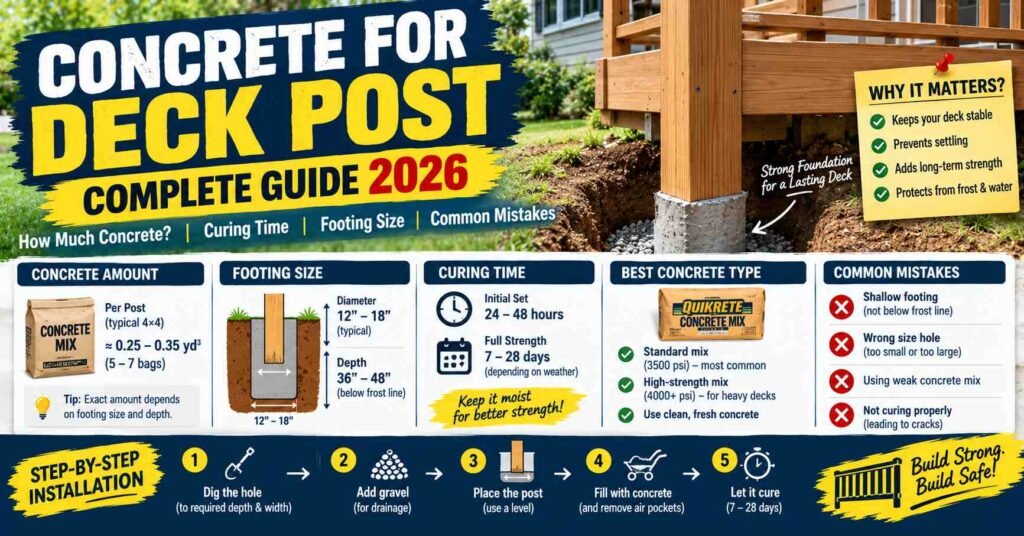
Are you using the right concrete for your deck post, or could a small mistake now lead to a leaning, sinking, or unstable deck later? Concrete is important for supporting deck posts because it provides a strong and stable base. A proper footing helps keep the post in place, prevents it from sinking into the ground, and reduces movement caused by rain, water, or changing soil conditions.
The right footing should not be chosen by guesswork concrete for deck post. It depends on the deck size, load on the posts, soil type, local frost depth, footing size, and building codes in your area. For most deck footings, structural concrete with about 3,000 PSI compressive strength is commonly recommended.
The footing should extend below the local frost line for better stability and load distribution. During installation, check the level, use a string line, position and secure the post anchor, and avoid adding too much water when mixing. Allow proper curing by keeping the concrete moist as needed.
Always follow local codes. If you are unsure, consider getting help from an engineer or professional worker. This guide covers concrete footings, deck blocks, and precast posts, along with the amount of concrete and PSI needed.
What Concrete Does for a Deck Post
First, check the total weight or load on the deck. The deck load moves through the posts and reaches the concrete footings below. The footing spreads the load over a wider area, reducing pressure on the soil concrete for deck post. The soil then supports the footing and the complete structure.
If any part of this chain is weak, the foundation can settle, move, or fail. A post placed directly on soil can sink because of rain, soft ground, or repeated loading. Moisture can also damage wooden posts, while wind or deck movement can make the post shift from its position.
Think of a high-heel shoe and a jogger. A heel puts weight on a small area and can sink into soft ground, while a jogger spreads the same weight over a larger area. A wider concrete footing works in a similar way by spreading the load over more soil area and reducing ground pressure.
A proper footing helps distribute vertical loads, resist side movement from wind and people, and reduce unwanted movement from seasonal soil changes. A strong concrete mix alone is not enough. The system also depends on soil bearing capacity, footing dimensions, anchoring, drainage, and post connections.
For example, strong concrete placed on weak soil can still settle because the soil cannot support the load. It is like building on solid rock compared with loose sand. Concrete is only one part of the foundation system.
The soil, post, footing size, connections, drainage, and load must work together. For structural requirements, especially larger or heavier decks, it is best to confirm the footing design with an engineer. As well, 3000 PSI concrete does not automatically mean it can support a ten-story building. The required concrete strength depends on the specific project, load, design, and engineering requirements.
What Type of Concrete Is Best for a Deck Post
Structural-strength concrete
Structural-strength concrete is a strong option for deck post footings and load-bearing applications. It helps create a stable base that can support the deck’s weight and loads concrete for deck post. The required PSI depends on the project size, design, and expected load. Avoid using one PSI level for every deck project because requirements can vary.
Ready-mix vs bagged concrete
Bagged concrete works well for small deck projects and DIY installations. It is easy to carry, mix, store, and purchase from local hardware stores. Ready-mix concrete is ordered from suppliers and usually delivered by truck.
It is commonly supplied in cubic yards for larger projects. Ready-mix may cost more when truck access, delivery, labor, and site conditions are difficult. It can provide consistent mixing when the required quantity is too large for DIY work.
Fast-setting vs regular concrete
Fast-setting concrete hardens quickly, often within about 20–30 minutes. It can help speed up deck post installation when time is an important factor. Fast-setting concrete still requires proper footing preparation and curing. Regular concrete takes longer to set but can work well for many deck post projects. Always follow the product instructions for mixing, setting, and curing requirements.
What about 2,500 or 3,000 PSI
PSI measures concrete’s compressive strength and indicates how much pressure it can withstand. Choosing between 2500 and 3000 PSI depends on the project and product requirements. Check local building codes before selecting the required concrete strength.
For example, some deck blocks may specify 3000 PSI concrete for installation. Always check the manufacturer’s specifications before choosing a concrete mix. Do not select PSI based only on personal preference; consider the project’s size, load, and design.
How Much Concrete Does a Deck Post Need
Start with footing dimensions, not the number of bags
Start by measuring the footing size instead of guessing the number of concrete bags. Check the footing diameter, depth, and thickness before calculating concrete needs concrete for deck post. Consider the number of footings, soil conditions, and expected deck load.
Local frost depth and building requirements can also affect footing dimensions. Calculate the required concrete volume instead of assuming a fixed number of bags per post. For example, one post may need two bags, but the exact amount depends on footing size and concrete yield.
Round vs square footings
Round and square footings require different formulas to calculate their concrete volume.
For a round footing, use V = π × r² × h.
You need the footing radius and height to calculate a round footing’s volume.
For a square footing, use V = L × W × H.
This calculation requires the footing’s length, width, and height.
Example:
Round footing: π × 0.5² × 2 = 1.57 cubic feet
Square footing: 1 × 1 × 2 = 2 cubic feet
Use a concrete calculator
A concrete calculator can simplify volume calculations for deck post footings concrete for deck post. Enter the diameter, length, width, height, and number of footings as required. The Decks.com calculator supports square, round, and cardboard tube pier forms.
Buy about 5-10% extra concrete to cover spillage, uneven areas, and minor waste. Avoid using a simple “X bags per post” rule without calculating the actual footing volume. Proper measurements help you order enough concrete without relying on guesswork.
How to Install Concrete for a Deck Post Step by Step
Step 1 — Plan and mark every footing
Measure the deck area carefully before starting the installation. Mark the exact locations where the deck posts will be installed. Check the post location from a distance to confirm proper alignment. Verify the location before digging to avoid placing the post in the wrong position.
Step 2 — Dig to the required depth
Dig the footing to the required depth and local frost requirements. Keep the hole in the correct location and follow the planned measurements. Avoid disturbing the firm soil at the bottom of the hole. Undisturbed soil can provide a stable base for the footing.
Step 3 — Prepare the bottom
Compact and level the bottom of the footing before adding concrete. A level base helps keep the footing stable and properly positioned. A gravel base is commonly recommended to provide a suitable foundation layer.
Step 4 — Set forms/reinforcement where required
Use form tubes to maintain the required footing shape during installation. Forms can be plastic tubes or round cardboard forms designed for concrete work. Proper reinforcement helps improve the strength and stability of the footing.
Step 5 — Mix the concrete correctly
Check the concrete bag instructions before adding water concrete for deck post. Use the recommended amount of water rather than adding extra. Mix the concrete thoroughly until no dry areas remain.
Step 6 — Pour and consolidate
Fill the form completely without leaving unnecessary empty spaces.Consolidate the concrete to reduce air pockets and unwanted bubbles. Level the top surface carefully after filling the form.
Step 7 — Position the post anchor
Check the anchor position before the concrete begins to set. Adjust the post while the concrete is still workable to keep it straight. Once the concrete hardens, correcting a crooked post becomes much harder. Keep a suitable barrier or base between wood and concrete to help limit moisture contact.
Step 8 — Cure before loading
Follow the concrete manufacturer’s instructions for the recommended curing process. Allow the footing to complete its initial setting before applying loads.
Check the final curing requirements before placing significant weight on the deck post. Proper curing helps the concrete develop the strength needed for long-term support.
Concrete Deck Blocks vs Poured Footings vs Precast Posts vs Helical Piers
| Foundation option | Best for | Main advantage | Main limitation |
| Poured Concrete Footing | Permanent structural decks | Flexible dimensions | Requires digging + mixing + curing |
| Concrete Deck Block | Suitable for approved low/near-ground applications | Simple installation | Not a universal replacement for below-grade footings |
| Precast Concrete Post | Projects using approved precast systems | Fast installation | Must follow specific product/system requirements |
| Helical Pier | Difficult access areas, certain soil/site conditions | Fast installation, little to no excavation | Requires professional installation and is system-specific |
| Buried Post | Certain low-profile applications | Simple concept | Concerns about moisture, decay, and building code compliance |
Keep concrete footings below the required depth to meet project and frost requirements. Plan footing depth before construction to avoid installation problems later. Precast footing systems can reduce setup time and simplify concrete installation for deck posts. Helical piers provide an alternative to traditional excavation for certain deck projects. Use helical piers only when installed according to approved requirements by certified installers.
10 Common Concrete Mistakes That Can Cause Deck Post Problems
Avoid using concrete that is not suitable for deck footings. Choose a concrete mix designed to provide the strength and support needed for the structure. Adding extra water can weaken the concrete and affect its performance concrete for deck post. Always check the bag instructions and use only the recommended amount of water.
A small footing may not provide enough support for the deck. Make sure its size matches the post, load, and project requirements. A shallow footing can become unstable and may shift over time. Dig to the required depth so the footing has enough support below ground. In cold areas, the footing should extend below the local frost line. If it does not, freezing soil can cause the footing to move or rise.
Do not place a footing on loose, unstable, or waterlogged soil without proper preparation. A firm and suitable soil base helps keep the footing stable. A post that is not level can become difficult or impossible to correct after the concrete cures. Check it from both directions before the concrete sets. Incorrect anchor placement can affect the post position and make the finished structure uneven. Measure carefully and place the anchor according to the planned layout.
Poor drainage can leave water around the post and gradually weaken the installation. Provide proper drainage so water can move away from the footing. Do not put heavy loads on a newly installed footing before the concrete has had enough time to cure. Follow the concrete manufacturer’s recommended curing time.
How Long Does Concrete for a Deck Post Take to Set and Cure
Concrete setting means it has become hard enough to stay in place, while curing is the longer process that makes the concrete stronger from the inside. Fast-setting and regular concrete have different setting and curing times, so do not treat them as the same concrete for deck post.
After placing the concrete, avoid adding weight to the post too soon. Even if the surface feels dry or hard, the footing may not be fully cured. For many installations, it is safer to wait at least 24 hours before putting normal loads on the post, unless the product instructions state otherwise.
Always check the concrete bag or manufacturer’s instructions for the recommended setting, loading, and curing times. Weather conditions also matter. Cold temperatures, heat, moisture, and humidity can change how quickly concrete sets and gains strength. Give the footing enough time to develop proper strength before loading the post or using the deck.
Frequently Asked Questions
Q: How much concrete do I need for one deck post?
Concrete for deck post quantity depends on footing diameter, depth, soil, and deck load. Check local code and use a concrete calculator.
Q: Can I use a concrete deck block instead of a footing?
Yes, for some small, low decks. They may not suit larger or heavier decks, so check local requirements.
Q: How long should concrete cure before building on it?
It may set within minutes, but full strength takes longer. Follow product instructions and consider weather and temperature.
Conclusion
First, identify the foundation type, such as a poured footing or deck block, based on your project needs. Decide the footing size and depth according to the frost line, expected load, and soil conditions.
Choose the right concrete mix and follow the manufacturer’s requirements for water, mixing, and use. Install the post anchor and post base in the correct position, keeping everything straight and level concrete for deck post .
Allow proper setting and curing time before placing weight on the footing or post. Check local building codes for required footing depth, size, materials, and installation details. If any requirement is unclear, consult a qualified local building professional before continuing.