Cubic Feet to Cubic Yards: Complete Guide in 2026
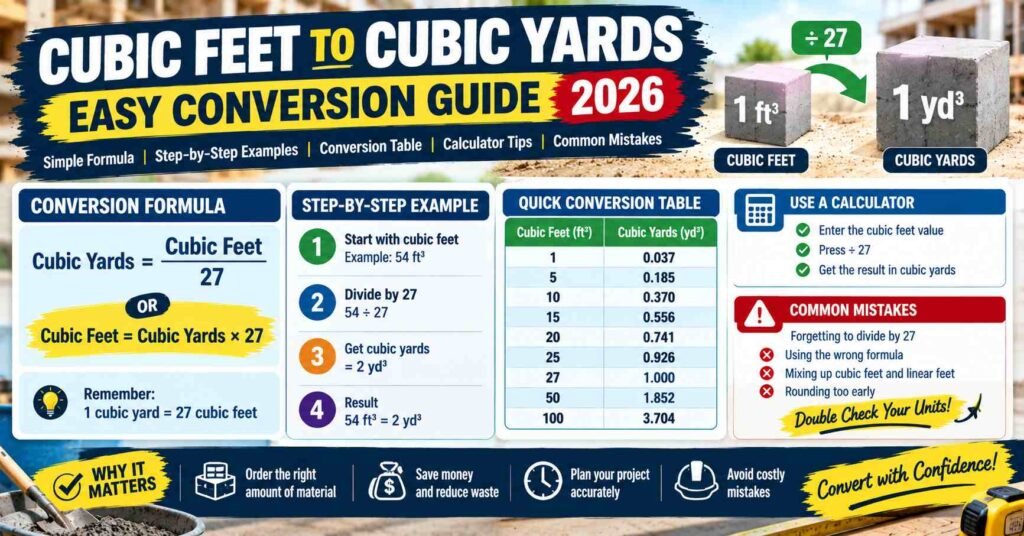
Need to convert cubic feet to cubic yards but aren’t sure whether to divide by 27 or multiply by a decimal? If you are trying to convert cubic feet to cubic yards but are unsure whether to divide by 27 or multiply by a decimal, you are not alone. This is a common confusion in construction and landscaping.
Cubic feet and cubic yards are units used to measure volume. When ordering concrete, soil, gravel, sand, or mulch, you often need to calculate the volume in cubic feet first and then convert it to cubic yards. The key rule to remember is simple: 1 cubic yard = 27 cubic feet. Consequently, to convert cubic feet into cubic yards, divide the cubic feet by 27. Getting the volume wrong can cause you to order too much or too little material, increasing costs and delaying your project.
We will explain the formula, show the conversion step by step with easy examples, explain how to use a concrete calculator, and cover common mistakes and helpful tips.
What Are Cubic Feet and Cubic Yards
What Is a Cubic Foot
A cubic foot is the volume of a cube with sides that measure one foot. It is commonly written as cu ft or ft³.
To find the volume, use the formula:
Length × Width × Height
For one cubic foot:
1 ft × 1 ft × 1 ft = 1 cubic foot
This unit is commonly used to measure materials such as concrete, soil, gravel, and other materials.
What Is a Cubic Yard
A cubic yard is the volume of a cube with sides measuring one yard. It is commonly written as cu yd or yd³.
Formula:
Length × Width × Height
For one cubic yard:
1 yd × 1 yd × 1 yd = 1 cubic yard
Why Are They Different
Yes, cubic feet and cubic yards are different units, but they measure the same thing: volume. The difference comes from their size. Since 1 yard = 3 feet, one cubic yard contains:
3 ft × 3 ft × 3 ft = 27 cubic feet
Consequently, 1 cubic yard = 27 cubic feet. The number 27 comes from multiplying the three dimensions of volume.
How to Convert Cubic Feet to Cubic Yards
The Cubic Feet to Cubic Yards Formula
The cubic feet to cubic yards conversion is simple once you know the basic formula. First, calculate the volume in cubic feet by multiplying the length, width, and height:
Length × Width × Height = Cubic Feet
Once you have the cubic-foot measurement, divide it by 27 to convert it into cubic yards.
Cubic Feet ÷ 27 = Cubic Yards
The number 27 is used because one cubic yard equals 27 cubic feet. This makes the conversion quick and easy for construction, landscaping, and other volume calculations.
Step-by-Step Conversion Process
Step 1: Start with the Cubic Foot Measurement
First, check the available measurements and determine the total volume in cubic feet. For example, suppose the volume is 54 cubic feet.
Step 2: Write the Formula
Use the standard conversion formula:
Cubic Feet ÷ 27 = Cubic Yards
Step 3: Divide the Cubic Feet by 27
Presently divide the given volume by 27:
54 ÷ 27 = 2 cubic yards
Step 4: Keep the Answer in Cubic Yards
After completing the calculation, write the final result with the correct unit:
2 cubic yards
Step 5: Round the Result When Needed
If your answer contains a decimal, round it according to the needs of your project. For material orders, you may need to round up to avoid having too little material, but the exact amount depends on the project and the supplier’s requirements.
Example:
If you have 54 cubic feet, divide it by 27:
54 ÷ 27 = 2 cubic yards
As a result, 54 cubic feet equals 2 cubic yards.
Cubic Feet to Cubic Yards Examples
Example 1: 10 Cubic Feet
Suppose you have 10 cubic feet of concrete and want to know how many cubic yards it equals. Use the standard conversion formula to get an accurate result.
Given Data:
Cubic feet = 10 ft³
Conversion factor = 27
Cubic yards =?
Formula:
Cubic Yards = Cubic Feet ÷ 27
Calculation:
10 ÷ 27 = 0.3704 cubic yards
Final Answer:
10 cubic feet = 0.37 cubic yards
Use this simple calculation when you need to convert a small quantity of concrete, soil, gravel, or another material from cubic feet to cubic yards. For practical projects, always check the required quantity carefully and consider adding a small amount for waste when ordering materials.
Example 2: 100 Cubic Feet
Suppose your project requires 100 cubic feet of material. The same conversion formula can be used to find the equivalent amount in cubic yards.
Given Data:
Cubic feet = 100 ft³
Conversion factor = 27
Cubic yards =?
Formula:
Cubic Yards = Cubic Feet ÷ 27
Calculation:
100 ÷ 27 = 3.7037 cubic yards
Final Answer:
100 cubic feet = 3.70 cubic yards
This conversion is useful for larger projects where materials are commonly sold or ordered by the cubic yard. Enter the cubic feet value into the formula, divide it by 27, and you will get the equivalent cubic yards.
Quick Tip
For any conversion, remember this simple rule:
Cubic feet ÷ 27 = Cubic yards
Keep the units consistent, double-check your calculation, and round the final result appropriately for your project.
Using a Cubic Feet to Cubic Yards Calculator
A cubic feet to cubic yards calculator makes material conversion quick and simple. It is useful for homeowners, DIY enthusiasts, and anyone working on projects that require concrete, soil, gravel, or other materials. Instead of doing the calculation every time, you can enter the cubic feet value and get the result in cubic yards.
How the Calculator Works
The calculator follows the same basic conversion formula used for manual calculations.
- First, enter the number of cubic feet you have.
- The calculator divides the cubic feet value by 27.
- The result is automatically shown in cubic yards.
- Check the result and make sure the unit is shown as cubic yards (yd³).
For example, if you enter 54 cubic feet, the calculator divides 54 by 27 and gives 2 cubic yards.
Always check the displayed unit after getting the result. This helps make sure the value has been converted correctly and that you are reading the answer in cubic yards rather than cubic feet.
Calculator vs Manual Calculation
A calculator is fast and convenient, especially when you need to convert several measurements or work with decimal values. It can save time and reduce the chance of making a basic calculation error.
Still, manual calculation is also useful. Use the formula Cubic Yards = Cubic Feet ÷ 27 to check the calculator result yourself. This gives you a simple way to verify the answer before ordering materials or starting a project.
For important projects, using both methods can give you extra confidence in your final measurement.
When Should You Double-Check
Double-check your result when working with a large amount of material, especially for concrete projects where an incorrect quantity can increase costs or cause delays. You should also verify the calculation when: Your measurements are unusual or have different units. The calculator gives a decimal result.
You are ordering a large quantity of concrete or other material. The final measurement will affect your project cost. Do not rely only on the calculator for important projects. Verify the result manually and make sure your measurements and units are correct before placing an order.
Cubic Feet to Cubic Yards Conversion Table
| Cubic Feet | Cubic Yards |
| 1 | 0.0370 |
| 10 | 0.3704 |
| 27 | 1 |
| 50 | 1.8519 |
| 100 | 3.7037 |
| 200 | 7.4074 |
| 500 | 18.5185 |
| 1000 | 37.0370 |
First, calculate the cubic feet using the given measurements.
Use the formula Length × Width × Height to find the cubic feet.
Once you have the cubic feet, divide the result by 27.
This will give you the final answer in cubic yards.
This simple method makes it easy to convert the numbers shown in the table.
Common Mistakes When Converting Cubic Feet to Cubic Yards
When converting cubic feet to cubic yards, a few common mistakes can lead to the wrong answer. Here are the mistakes to avoid:
Some people divide cubic feet by 3, but 3 only converts a linear measurement from feet to yards. For volume, all three dimensions must be converted, so 3 × 3 × 3 = 27. Hence, divide cubic feet by 27 to get cubic yards. To convert cubic feet to cubic yards, divide the volume by 27. Multiplying by 27 will give an incorrect result. Make sure your measurements use the correct units before calculating volume.
Convert the dimensions into a consistent unit first. If the depth is given in inches, convert it to feet when the other dimensions are in feet. Always write the correct unit, such as cubic feet (ft³) or cubic yards (yd³). Leaving out the cubic unit can cause confusion about what the measurement represents. Keep the decimal value during the calculation and round only the final answer.
Early rounding can slightly change the final result. Volume is calculated using length × width × depth. Using the wrong measurements will produce an incorrect volume. The calculator gives the estimated volume, but it may not be the exact amount needed for a real project. Waste, compaction, settling, and supplier requirements can affect the actual material quantity. It is often wise to allow a small extra amount.
How Cubic Yards Are Used in Real Projects
Concrete
Concrete is commonly measured in cubic yards for larger projects. It is used for projects such as slabs, footings, foundations, driveways, and other large concrete work. Before ordering, check the supplier’s recommended quantity and delivery requirements.
Soil and Topsoil
Soil and topsoil are commonly used for garden beds, lawn work, planting areas, and filling low spots or holes. Topsoil is useful when you need a suitable upper layer for growing grass, plants, or other landscaping.
Gravel and Sand
Gravel and sand are often used for base layers, drainage, and preparing a dry base before construction or landscaping. The amount needed depends on the project area and the required layer depth.
Mulch
Mulch is commonly used in landscaping, garden beds, and around plants. It helps cover the soil surface and gives landscaping areas a cleaner, finished look.
Before placing an order, check the supplier’s requirements and your project conditions. Material needs can vary between suppliers; hence, it is a good idea to compare their recommendations before ordering.
Frequently Asked Questions
Q: How many cubic feet are in one cubic yard?
One cubic yard equals 27 cubic feet (3 × 3 × 3 = 27).
Q: Can I use a calculator instead of the formula?
Yes, a calculator divides cubic feet by 27 to give cubic yards.
Q: What if my dimensions are in inches?
Convert inches to feet first, then calculate length × width × depth and divide by 27.
Conclusion
Converting cubic feet to cubic yards is simple once you remember one important number: 27. To convert cubic feet into cubic yards, divide the cubic feet by 27 to get your answer in cubic yards. Before doing the conversion, calculate the cubic feet from your dimensions and check that all measurements use the correct units.
Avoid common mistakes such as using the wrong conversion factor, mixing units, or rounding too early. When ordering material for a real project, remember that the calculator gives an estimate. It is always a good idea to confirm the required quantity, material type, and the supplier’s requirements before placing your order.