Concrete Driveway Cost Calculator: Complete Guide in 2026
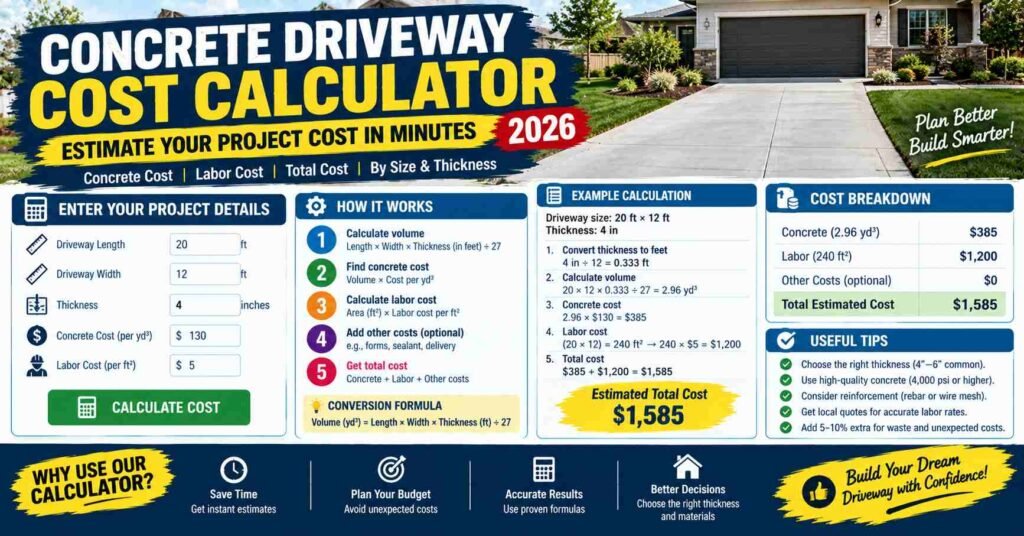
How much will your concrete driveway cost based on its size, thickness, and installation needs? Your concrete driveway cost depends on more than just its size. Length, width, thickness, concrete, labor, site preparation, and other installation needs can all affect the total cost.
This concrete calculator gives you a planning estimate, not a final contractor bill. Actual prices may vary based on your location, concrete supplier, site condition, and contractor.
We’ll learn how to enter your driveway measurements, estimate the amount of concrete needed, and calculate the total cost. You can also use a concrete calculator to check your material estimate. A concrete driveway cost estimator helps homeowners estimate material, labor, and site preparation expenses before starting a project.
Concrete Driveway Cost Calculator
A concrete driveway cost calculator helps you estimate the total cost of your driveway. It can include more than just concrete, such as labor and other installation expenses.
What You Need to Enter
Enter these details into the calculator:
Driveway length, driveway width, concrete thickness in inches, concrete cost per cubic yard, labor cost per square foot, and optional costs, such as:
Gravel or base, old driveway removal, reinforcement, finishing and delivery charges.
What the Calculator Estimates
Based on your information, the calculator can estimate:
Total driveway square footage, concrete volume needed in cubic yards, estimated material cost, estimated labor cost, additional costs, and estimated total driveway cost.
Basic Calculator Formula
To calculate the cost of a concrete driveway, first determine the driveway area, concrete volume in cubic yards, material cost, and labor expenses.
First, calculate the driveway area:
Length × Width = Square Feet
Next, calculate the concrete volume:
Length × Width × Thickness (in feet) = Cubic Feet
Since driveway thickness is usually entered in inches, convert it to feet first. For example, 4 inches = 0.33 feet.
Then convert cubic feet to cubic yards:
Cubic Feet ÷ 27 = Cubic Yards
For example, if the driveway is 20 ft long and 10 ft wide: To figure out the yards of concrete required, multiply the driveway length by its width and thickness in feet, then divide the cubic feet by 27.
20 × 10 = 200 sq. ft.
Next, calculate the concrete volume:
Length × Width × Thickness (in feet) = Cubic Feet
For a 4-inch-thick driveway, convert inches to feet first:
4 ÷ 12 = 0.33 ft
At present, calculate the concrete volume:
20 × 10 × 0.33 = 66 cubic feet
Then convert cubic feet to cubic yards:
66 ÷ 27 = 2.44 cubic yards
The calculator uses basic assumptions, such as a level ground surface and normal site access. Difficult access, uneven ground, or extra site work can increase the actual cost.
How to Use the Concrete Driveway Cost Calculator
Using a concrete driveway cost calculator is simple. Follow these steps to get a basic estimate.
Step 1: Enter Driveway Length
Measure the driveway length in feet. If your measurement is in inches, convert it to feet before entering it into the calculator.
Step 2: Enter Driveway Width
For a rectangular driveway, measure its width in feet. The calculator will multiply the length by the width to find the total area.
Step 3: Select Concrete Thickness
Choose the thickness based on how the driveway will be used:
4 inches: Common for areas with lighter vehicles.
5 inches: Suitable for more regular use and heavier loads.
6 inches: Often used for heavier vehicles.
The right thickness can vary based on vehicle weight, soil conditions, and other site factors.
Step 4: Enter Local Concrete Price
Enter the ready-mix concrete price per cubic yard. Prices can vary between cities and suppliers; accordingly, check the current rate in your local area.
Step 5: Add Labor and Extra Costs
Include costs for base preparation, old driveway removal, reinforcement, delivery, and finishing. Avoid relying only on an average labor rate. Use current local market rates to make your estimate more realistic.
What Factors Affect Your Concrete Driveway Cost
The cost of a concrete driveway depends on more than just its size. Several factors can change the total price, including the concrete thickness, soil condition, gravel base, reinforcement, drainage, old driveway removal, and your location. Here are the main factors to consider when estimating your driveway cost.
Driveway Size
The larger your driveway is, the more concrete and base material you will need. This means a larger driveway will usually cost more. A properly prepared and strong base is also important for supporting the concrete and can affect the total cost.
Concrete Thickness
A thicker driveway needs more concrete, which increases material and labor costs. A 4-inch thickness is commonly suitable for normal residential cars, while 6 inches may be needed for heavier loads. The right thickness depends on the vehicles and site conditions.
Soil and Site Preparation
Soft or uneven soil may need extra preparation before pouring concrete. This can include excavation, grading, leveling, and compaction. These additional steps can increase the overall project cost.
Gravel Base
A compacted gravel base helps support the driveway and improves water drainage. The required base thickness can vary depending on soil conditions, drainage needs, climate, and expected traffic.
Reinforcement
Rebar, wire mesh, and fiber reinforcement can add to the cost of a driveway. They can help improve crack control and concrete performance, but they do not make concrete 100% crack-proof.
Drainage
Poor drainage can cause water to collect under or around the driveway, which may lead to cracking and other problems over time. Proper drainage should be considered before the concrete is poured.
Old Driveway Removal
If an existing damaged driveway needs to be removed first, you will also need to pay for demolition, hauling, and disposal. This can increase the total project cost.
Location
Material delivery and labor rates vary by location. A concrete driveway cost calculator can provide a useful estimate, but a difficult site may require extra work. For a more accurate price, it is better to get an on-site assessment from a local contractor.
Concrete Cost Per Square Foot
The cost of concrete per square foot depends on local material prices, slab thickness, labor, and site preparation. Check local prices to estimate your actual project cost.
Concrete Driveway Cost Calculator Example
Let’s use a simple example to understand how to estimate the cost of a concrete driveway:
Driveway size: 20 × 40 feet
Total area: 20 × 40 = 800 square feet
Concrete thickness: 4 inches
Step 1: Convert thickness to feet
4 inches ÷ 12 = 0.333 feet
Step 2: Calculate concrete volume
Formula:
Length × Width × Thickness ÷ 27 = Cubic Yards
20 × 40 × 0.333 ÷ 27 = about 9.9 cubic yards
Add 10% extra for waste and small measurement differences.
9.9 × 1.10 = about 10.9 cubic yards
Step 3: Estimate material cost
If concrete costs $150 per cubic yard:
10.9 × $150 = about $1,635
Step 4: Estimate labor cost
If labor costs $4 per square foot:
800 × $4 = $3,200
Step 5: Add other costs
For example, allow $500 for gravel and other additional work.
Estimated total:
$1,635 + $3,200 + $500 = about $5,335
This is only an example. Concrete, labor, gravel, delivery, permits, and other costs can vary by location and project. Check local requirements and get 2–3 contractor quotes before starting the work.
Concrete Driveway Cost by Size
The size of your driveway is a good starting point for estimating the cost, but it does not determine the final price. A larger driveway usually needs more concrete and labor, while other project details can also change the total cost. A driveway cost calculator helps homeowners compare different driveway sizes and estimate how size affects concrete and installation costs.
The table below shows estimated concrete driveway costs by square footage.
Driveway size: More square footage usually means higher material and labor costs.
Concrete thickness: A thicker driveway needs more concrete, which can increase the cost.
Ground condition: Soft, uneven, or poorly prepared soil may need extra site preparation.
Additional work: Gravel, drainage, reinforcement, removal, delivery, or finishing can add to the total.
Installation conditions: Easy access and a well-prepared site may keep labor costs lower.
| Driveway Size | Square Feet | What Changes |
| 10×20ft | 200 sq ft | Smaller material / labor requirement |
| 12×40ft | 480 sq ft | Medium residential driveway |
| 20×40ft | 800sq ft | Larger driveway |
| Custom size | Calculate | Use calculator |
Use the table as a starting estimate, not a final price. Local material and labor rates can vary; accordingly, check the full project scope and get 2–3 contractor quotes before starting.
Common Concrete Driveway Cost Calculator Mistakes
When using a concrete driveway cost calculator, small mistakes can affect your final estimate. Avoid these common errors: Always measure the driveway length and width carefully. Entering incorrect numbers can give you an inaccurate cost estimate.
Concrete thickness is usually given in inches, but the calculator may require feet. For example, 4 inches is about 0.33 feet. Do not calculate the cost from the driveway area alone. The required concrete thickness also affects the amount of concrete and total cost. Add about 5–10% extra concrete for waste and small measurement differences. This helps avoid ordering too little material. Concrete prices can change. Check current local prices instead of relying on older rates. If you are hiring a contractor, include labor costs along with material costs.
If an existing driveway needs to be removed, include demolition and disposal costs in your estimate. A proper gravel base, leveling, and compaction can affect the project cost and should be included. Make sure estimates include similar items, such as labor, delivery, preparation, and removal, before comparing them. A calculator provides an estimate, not a final contractor quote. Use current local pricing and get contractor quotes for a more accurate project cost.
Frequently Asked Questions
Q: How many cubic yards of concrete do I need?
Multiply length × width × thickness, divide by 27, then add 10% for waste.
Q: Does a concrete driveway cost calculator include labor?
Some calculators include labor, while others only include material costs.
Q: Are online driveway cost calculators accurate?
They provide a useful estimate, but local prices can make the final cost different.
Q: How many yards of concrete do I need for a driveway?
Calculate the driveway length, width, and thickness to find the concrete volume in cubic feet. Divide by 27 to convert it into cubic yards, then allow for reasonable material waste.
Q: How much is 2 yards of concrete?
Multiply the local price per cubic yard by two. Add delivery and other charges if they are not included in the quoted price.
Conclusion
A concrete driveway cost calculator can help you estimate your project budget before starting the work. Your driveway size is important because it affects how much concrete you need. Other costs, such as labor, base preparation, driveway removal, and materials, can also change the final price.
Local prices may vary depending on your area, project requirements, and current market rates. Use the calculator as a helpful budgeting tool, not as a final price. For the actual project cost, confirm the details and pricing with local concrete contractors and get a clear quote before starting the work.