Sonotube Concrete Calculator: Complete Guide in 2026
How much concrete do you need to fill your sonotube forms without running short or paying for unnecessary extra material? A sonotube concrete calculator helps estimate the concrete needed to fill cylindrical forms without wasting materials or money.
Enter the tube diameter, height or depth, and number of tubes to calculate the required concrete in cubic feet, cubic yards, or bags. This guide explains the formula, a practical example, common mistakes, and ordering tips. The calculator estimates concrete volume only; it does not determine footing size or structural design.
What Is a Sonotube Concrete Calculator
A sonotube concrete calculator estimates the concrete volume needed to fill round forms. Sonotube forms are cylindrical tubes that hold wet concrete in place until it sets. Sonotube is also a brand name commonly used for these forms. These forms are useful for deck supports, fence posts, round pillars, and other cylindrical concrete structures.
The calculator uses the tube diameter, height or depth, and number of tubes to estimate the total concrete required. It helps users plan materials, reduce waste, and estimate concrete costs before ordering. Recall, the tube acts as a form only. Footing size and structural design must be determined separately based on the project requirements.
How to Use a Sonotube Concrete Calculator
1. Enter the Tube Diameter: Measure the inside diameter of the Sonotube form. Use the correct unit, such as inches or feet.
2. Add the Tube Height: Enter the filled height or depth of the tube. Measure only the section that will contain concrete.
3. Enter the Number of Tubes: Add the total number of tubes you need to fill. The calculator will estimate the volume for one tube and all tubes combined.
4. Check the Results: Review the required concrete volume in cubic feet or cubic yards. If available, check the estimated number of concrete bags.
5. Add Extra Concrete: Include an additional 5–10% to allow for minor waste and measurement differences.
Additional Tip: Extra concrete for a wider base, uneven excavation, or overfilling may require a separate estimate. Check your measurements carefully before ordering to avoid material shortages or unnecessary costs.
Sonotube Concrete Calculator Formula
The Sonotube concrete calculator uses the cylinder volume formula to estimate how much concrete is needed to fill round forms.
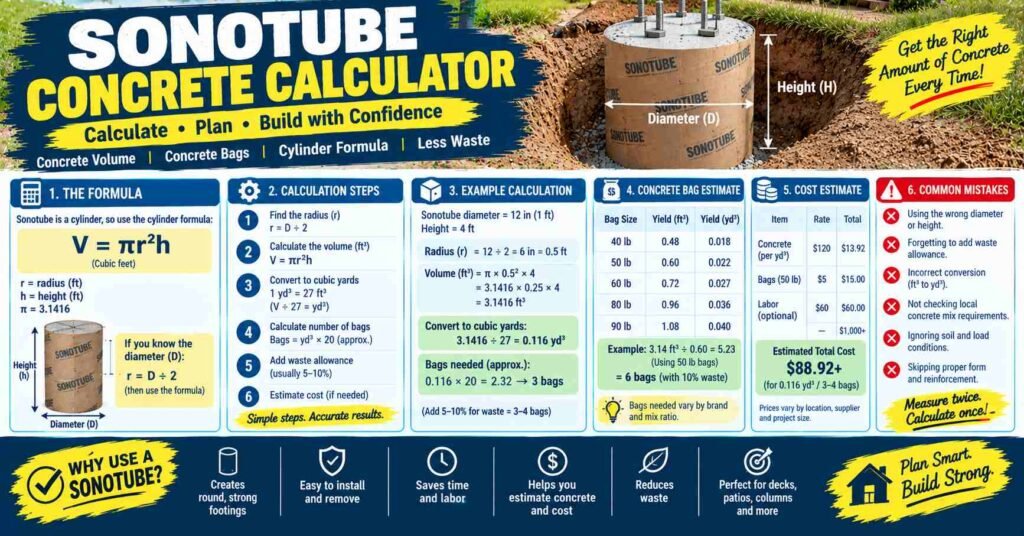
Formula: V = πr²h
V: Concrete volume
π (Pi): Approximately 3.1416
r: Inside radius of the tube
h: Concrete-filled height of the tube
How to Calculate the Radius
Measure the inside diameter of the sonotube. Divide the diameter by 2 to find the radius. Keep all measurements in the same unit before calculating. Square the radius, then multiply it by π and the filled height to find the volume.
The sonotube concrete calculator uses the inside radius to estimate the required concrete volume.
Tip: Because the radius is squared, even a small measurement error can affect the result.
How to Convert Cubic Inches to Cubic Feet and Yards
The formula gives the volume of one tube. For multiple tubes of the same size, multiply the single-tube volume by the total number of tubes.
Cubic inches to cubic feet: Divide by 1,728.
Cubic feet to cubic yards: Divide by 27.
These conversions help you estimate the total concrete needed for your project and order the correct quantity. The sonotube concrete calculator makes it easier to convert the calculated volume into cubic feet or cubic yards.
Sonotube Concrete Calculator Worked Example
Example Measurements
Diameter: 12 inches
Height: 4 feet
Number of tubes: 4
Calculate Concrete for One Sonotube
Radius: 12 ÷ 2 = 6 inches (0.5 feet)
Volume: 3.1416 × 0.5² × 4 = 3.1416 cubic feet
Cubic yards: 3.1416 ÷ 27 = 0.116 cubic yards
Calculate the Total for Four Tubes
Total volume: 3.1416 × 4 = 12.57 cubic feet
Cubic yards: 12.57 ÷ 27 = 0.466 cubic yards
Add a 10% Waste Allowance
Final estimate: 0.466 × 1.10 = 0.513 cubic yards
Planning estimate: Approximately 0.51 cubic yards, before accounting for extra concrete needed for uneven excavation or additional base depth.
How Many Concrete Bags Does a Sonotube Need
The number of concrete bags depends on the total volume required and the yield listed on each bag. The sonotube concrete calculator can help estimate the total volume before you determine the number of bags.”
Formula:
Number of Bags = Total Concrete Volume (cubic feet) ÷ Yield per Bag (cubic feet)
Concrete Bag Yield
A 60 lb bag typically yields about 0.45 cubic feet.
An 80 lb bag typically yields about 0.60 cubic feet.
Actual yield may vary by manufacturer, so always check the bag label.
Example:
Four Sonotubes
Total concrete volume: 12.57 cubic feet.
Yield per 80 lb bag: 0.60 cubic feet.
Bags required: 12.57 ÷ 0.60 = 20.95, or approximately 21 bags before adding extra for waste.
Tips for Ordering Concrete Bags
Add a 5–10% waste allowance to help avoid shortages.
Check the manufacturer’s stated yield before purchasing.
Consider uneven excavation and additional base depth separately, as these can increase concrete requirements. Accurate measurements and yield calculations help you order the right amount of concrete and reduce material waste.
What Affects Sonotube Concrete Volume
Tube Diameter
A larger tube diameter requires more concrete because the radius is squared in the cylinder volume formula. Even a small diameter increase can significantly raise the total volume. The sonotube concrete calculator estimate depends on the tube diameter, filled height, and number of tubes.
Tube Height
Taller tubes require more concrete when the diameter stays the same. Concrete volume increases in direct proportion to the filled height.
Number of Tubes
For tubes of the same size, multiply the volume of one tube by the total number of tubes to estimate the overall concrete requirement.
Excavation and Base Shape
Oversized holes, uneven sides, and wider bases can increase concrete use beyond the basic cylindrical estimate. The standard formula assumes a regular cylinder and does not account for irregular excavation shapes.
Tip: Measure tube dimensions carefully and consider site conditions before ordering concrete. Soil conditions and structural requirements should also be assessed separately when determining the appropriate footing design.
Concrete Waste Allowance and Ordering Tips
A little extra concrete is often needed because of spills, uneven surfaces, or deeper trenches than expected. That’s why it’s smart to add a 5–10% waste allowance, depending on your project. Skipping this step may leave you short during the pour. After using the sonotube concrete calculator, add a suitable waste allowance before ordering concrete.”
Formula:
Order Volume = Calculated Volume × (1 + Waste Percentage)
For example, with 10% extra concrete, multiply your calculated volume by 1.10.
For small projects, bagged concrete may be easier to manage, while larger jobs usually work better with a ready-mix truck. Before ordering, check these three things with your supplier:
Concrete yield: How much concrete will the order provide? Ask about minimum order sizes and extra quantities, such as 0.5 cubic yards.
Delivery charges: Confirm any additional fees.
Total cost: Material estimates and final prices can differ depending on your location and supplier.
Common Sonotube Concrete Calculation Mistakes
When using a sonotube concrete calculator, a few common mistakes can affect your concrete estimate. Here’s how to avoid them. The radius is half the diameter. Divide the diameter by 2, then square the radius when calculating the tube’s volume. Using different units can lead to incorrect results.
Keep all measurements in one unit, preferably feet, before calculating. Calculate the volume of one tube first, then multiply it by the total number of tubes. Check the excavation before pouring. Add around 5–10% extra concrete to allow for waste and uneven ground. Always round up to the next whole bag so you don’t run short.
For example, if your estimate is 20.2 bags, order 21 bags. This helps ensure you have enough concrete to finish the job.
Frequently Asked Questions
Q: How do you calculate concrete for a sonotube?
Use V = πr²h. Divide the diameter by 2 to get the radius. Divide cubic feet by 27 to get cubic yards.
Q: How much concrete does a 12-Inch sonotube need?
2 feet deep: 1.57 cu ft
3 feet deep: 2.36 cu ft
4 feet deep: 3.14 cu ft
Q: How many 80 lb bags fill a sonotube?
Assuming 0.60 cu ft per bag:
3 feet deep: 4 bags
4 feet deep: 6 bags
Conclusion
A sonotube concrete calculator makes it easier to estimate the concrete needed for round tube footings. It uses the formula V = πr²h to calculate volume and helps convert the results into cubic feet, cubic yards, or concrete bags. For accurate results, make sure your diameter, height, number of tubes, and unit conversions are correct.
Before placing an order, check the bag yield or ready-mix supplier details. Also, allow for uneven excavation and around 5–10% extra concrete for waste, depending on your project. Remember, this calculator estimates material quantities only. The final footing size and structural design should be determined separately based on soil conditions, building loads, and local building codes.