How Many 80 lb Bags of Concrete are in a Yard: Concrete Bag Yield in 2026
How Many 80 lb Bags of Concrete are in a Yard: Concrete Bag Yield in 2026
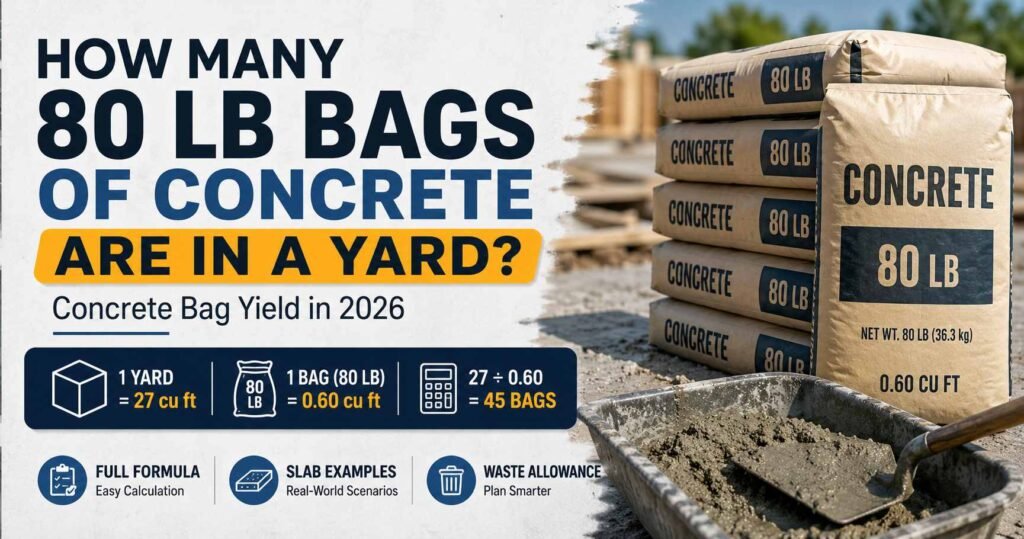
How many 80 lb bags of concrete are in a yard? One cubic yard equals 27 cubic feet. If an 80-lb bag yields 0.60 cubic feet, then 27÷ 0.60 = 45 bags. On the other hand, 45 bags is not a fixed quantity because bag yield varies by concrete mix and manufacturer. Always check the product’s stated yield for an accurate estimate. Estimating How Many 80 lb Bags of Concrete are in a Yard accurately is essential for budgeting and planning your delivery.
The number of concrete bags needed depends on the manufacturer’s stated yield, which can vary by product and mix. Since 1 cubic yard equals 27 cubic feet, an 80-lb bag yielding 0.60 cubic feet would require about 45 bags (27 ÷ 0.60). This article explains how to apply the same calculation to different project sizes, including 10 × 10-foot slabs with 4- to 6-inch thicknesses, while allowing for material waste. It also compares bagged concrete with ready-mix concrete to help you estimate the required quantity and select a suitable option for your project.
How Many 80 lb Bags of Concrete Are in a Yard
Why the Number Can Vary
The yield of an 80-lb concrete bag varies by manufacturer, so the number of bags per cubic yard is not always exactly 45. One bag may yield 0.55, 0.56, 0.60, or 0.67 cubic feet, which can change the total bag count. The yield printed on the bag is the most reliable figure for that specific product.
When evaluating How Many 80 lb Bags of Concrete are in a Yard, contractors often rely on these specific yield ratings to avoid over-ordering.
As well, the calculated quantity may not be enough because some concrete can be lost during mixing, handling, or placement. Thus, adding around 10% extra can provide a practical allowance and help avoid running short.
Why Does One Cubic Yard Equal 27 Cubic Feet
Cubic Yard to Cubic Feet Conversion
One cubic yard equals 27 cubic feet. Since one yard is 3 feet, multiply the three dimensions: 3 ft × 3 ft × 3 ft = 27 cubic feet. This conversion is useful when calculating concrete volume and determining the number of concrete bags required for a project.
Why This Matters for 80 lb Bags
When you buy an 80-lb bag of concrete, the bag shows its yield, such as 0.60 cubic feet. Larger concrete orders, such as truck orders, are measured in cubic yards. So, you first convert cubic yards into cubic feet. Then, divide the total cubic feet by the yield of one bag to determine how many bags of concrete you need.
Understanding this math helps you answer the question of How Many 80 lb Bags of Concrete are in a Yard for any specific brand.
How Much Concrete Does an 80 lb Bag Make
Typical 80 lb Bag Yield
An 80-lb concrete bag may yield around 0.60 cubic feet, but this is not a fixed value. The actual yield can vary by manufacturer and product. Always check the manufacturer’s bag label, where the concrete yield is usually stated. Use that listed yield to calculate how many bags are needed for your project rather than assuming every 80-lb bag provides the same volume.
Convert One Bag’s Yield to Cubic Yards
An 80-lb bag of concrete that yields approximately 0.60 cubic feet provides only a small portion of one cubic yard. Since 1 cubic yard = 27 cubic feet, the bag yield in cubic yards is:
0.60 ÷ 27 = 0.022 cubic yards per bag
This means one 80-lb bag provides about 0.022 cubic yards of concrete. Thus, a full cubic yard typically requires more than 40 bags—about 45 bags when each bag yields 0.60 cubic feet.
This calculation is the standard method for determining How Many 80 lb Bags of Concrete are in a Yard when prepping for a driveway or patio.
Why Product Yield Matters
First, calculate the total concrete volume in cubic feet. Then check the manufacturer’s stated yield per bag and divide the total volume by that yield. For example, 10 cubic feet ÷ 0.60 = 16.67, so you need about 17 bags. Remember that bag yields vary by manufacturer, even for the same 80-lb weight. Always check the yield printed on the bag before using an online calculator.
How to Calculate 80 lb Bags of Concrete in a Cubic Yard
Step 1 Determine Cubic Feet in One Yard
One cubic yard equals 27 cubic feet.
This is the baseline for figuring out How Many 80 lb Bags of Concrete are in a Yard regardless of the bag weight.
Step 2 Find the Bag Yield
Always check the yield printed on the manufacturer’s package because different brands can provide different amounts of concrete. If one 80-lb bag yields 0.60 cubic feet, use that figure for the calculation.
Step 3 Divide Total Volume by Bag Yield
For one cubic yard, calculate 27 ÷ 0.60 = 45 bags.
Step 4 Round Up
If your calculation gives a decimal, always round up to the next whole bag. For example, 16.2 bags becomes 17 bags, not 16. Rounding down can leave you short of concrete during the project. If your project requires a specific waste allowance, add it to the calculated quantity.
This provides a small reserve for material loss, measurement differences, or unexpected site conditions. Rounding ensures that your assessment of How Many 80 lb Bags of Concrete are in a Yard covers the entire project area.
Quick formula:
Required bags = Total concrete volume ÷ Bag yield
How Many 80 lb Bags Are Needed for Different Amounts of Concrete
This table shows how many 80-lb concrete bags are needed for each cubic yard, based on a bag yield of 0.60 cubic feet. On the other hand, the required number of bags can change when the manufacturer’s yield is different. For example, if an 80-lb bag yields 0.56 cubic feet, the bag quantity will be calculated separately using that yield.
| ¼ | yard | 12 |
| ½ | yard | 23 |
| ¾ | yard | 34 |
| 1 | yard | 45 |
| 1¼ | yard | 57 |
| 1½ | yard | 68 |
| 2 | yard | 90 |
How to Use the Table
This table uses a 0.60 cubic feet yield for an 80-lb bag, so the numbers are not fixed for every manufacturer. Bag yields can vary, such as 0.56 cubic feet, so always check the yield printed on your bag and recalculate the required quantity accordingly.
This table also does not include any waste allowance. Use this as a general guide to help visualize How Many 80 lb Bags of Concrete are in a Yard before you start buying materials.
How Many 80 lb Bags Do I Need for My Concrete Project
Step 1 Measure Length
Measure the concrete area’s length in feet and note the measurement accurately.
Step 2 Measure Width
Measure the width in feet to calculate the required concrete volume.
Step 3 Measure Thickness
Measure the thickness in inches and divide it by 12. For example, 4 inches ÷ 12 = 0.33 feet.
Step 4 Calculate Cubic Feet
Calculate the total volume in cubic feet. First, multiply the length by the width, then multiply the result by the thickness. This gives you the total cubic feet of concrete needed for the area. The formula is Length × Width × Thickness = Total Cubic Feet. For example, if the length is 10 ft, width is 5 ft, and thickness is 0.5 ft, the calculation will be 10 × 5 × 0.5 = 25 cubic feet.
Step 5 Calculate Bags
Now, divide the total cubic feet you calculated by the yield of one bag. The yield can vary from one company or bag to another, so use the yield printed on the bag you are using. This will give you the total number of concrete bags needed. The formula is Total Cubic Feet ÷ Cubic Feet per Bag = Total Bags.
For example, if you need 25 cubic feet and one bag provides 0.60 cubic feet, then 25 ÷ 0.60 = 41.67, so you would need about 42 bags. By following this step, you can precisely identify How Many 80 lb Bags of Concrete are in a Yard for your custom measurements.
Step 6 Round Up and Add Allowance
After calculating the final concrete quantity, round it up to the next whole yard. For example, if the result is 12.2 cubic yards, round it up to 13 cubic yards. This provides a small extra amount in case of minor calculation or measurement errors. You should also consider waste because some concrete may be lost due to uneven ground, irregular surfaces, spillage, or measurement mistakes.
Example: How Many 80 lb Bags for a 10 × 10 Slab
Calculate the Slab Volume
For a 10 × 10 ft concrete slab, first calculate the slab volume. The length is 10 ft, the width is 10 ft, and the thickness is 4 inches. Convert the thickness into feet: 4 ÷ 12 = 0.333 ft. Now calculate the volume: 10 × 10 × 0.333 = 33.3 cubic feet.
Convert Volume Into 80 lb Bags
For the 10 × 10 ft slab, the calculated volume is 33.3 cubic feet. Now divide this volume by the yield of one 80-lb concrete bag, which is 0.60 cubic feet per bag. So, 33.3 ÷ 0.60 = 55.5 bags. Since you cannot use half a bag for the final order, round the result up to 56 bags.
Add an Example Allowance
Once you have 56 bags, add a waste allowance based on the project’s conditions. For example, if you use a 10% waste allowance, calculate 56 × 1.10 = 61.6 bags, then round up to 62 bags. This buffer is key when you calculate How Many 80 lb Bags of Concrete are in a Yard for slabs on uneven soil.
The 10% is only an example, not a fixed rule. Waste allowance can vary depending on the project, measurements, site conditions, uneven surfaces, and the expected amount of concrete waste.
Comparison How Many 80 lb Bags for a 4 and 6-Inch Concrete Slab
Always check the yield printed on the specific bag for example, another manufacturer may provide 0.56 cubic feet per bag.
| Slab Size (ft) | Square Feet | 4-Inch Slab (0.33 ft) Bags | 6-Inch Slab (0.5 ft) Bags |
| 8 x 8 | 64 sq ft | 36 bags | 54 bags |
| 10 x 10 | 100 sq ft | 56 bags | 84 bags |
| 10 x 12 | 120 sq ft | 67 bags | 100 bags |
| 12 x 12 | 144 sq ft | 80 bags | 120 bags |
| 10 x 20 | 200 sq ft | 112 bags | 167 bags |
| 12 x 20 | 240 sq ft | 134 bags | 200 bags |
| 20 x 20 | 400 sq ft | 223bags | 334 bags |
The same formula is used to calculate concrete for both 4-inch and 6-inch slab thicknesses. A 6-inch slab is 1.5 times thicker than a 4-inch slab because 6 ÷ 4 = 1.5. Thus, a 6-inch slab requires 50% more concrete than a 4-inch slab of the same area. For example, a 10 × 10 ft slab at 4 inches may require 56 bags of concrete. If the same slab is increased to 6 inches, the requirement becomes 84 bags, assuming the same bag yield.
Common Mistakes When Calculating 80 lb Concrete Bags
Confusing Cubic Feet and Cubic Yards
A common mistake when calculating concrete bags is confusing cubic yards with cubic feet. Remember that 1 cubic yard = 27 cubic feet. If your bag yield is given in cubic feet, first convert the total volume from cubic yards to cubic feet.
Multiply the cubic yards by 27 before dividing by the bag yield to get the correct number of bags. Avoiding this confusion is the first step in correctly calculating How Many 80 lb Bags of Concrete are in a Yard.
Forgetting Thickness
Another common mistake is skipping the slab thickness measurement. Length × width only gives you the area, not the concrete volume. To calculate the volume correctly, you must include the slab thickness or height in the formula. Without thickness, the required concrete quantity cannot be calculated accurately.
Using the Wrong Bag Yield
Another common mistake is not checking the product specifications before calculating concrete bags. Bag yield can vary by manufacturer for example, one product may yield 0.56, 0.45, or 0.60 cubic feet. Always check the specific bag’s yield and use that value for an accurate calculation.
Rounding Down
Another common mistake is rounding the required bags down. For example, if the calculation gives 55.5 bags, using 55 bags can leave you short of concrete. This shortage may interrupt the work and create problems during slab construction. It is safer to round up to the next whole bag, so 55.5 becomes 56 bags.
Confusing Cement With Concrete
A common mistake is confusing cement with concrete. They are not the same thing. Cement is only one component of concrete, acting as the binding material. Concrete is generally made from cement, sand, and gravel or other aggregates, mixed with water. Ready-mix concrete bags already contain the dry ingredients in the required proportions; you usually only need to add water according to the manufacturer’s instructions. Understanding this difference is important when calculating concrete bag quantities.
Ignoring Waste
Some people ignore concrete waste when estimating the required number of bags. Concrete can be wasted due to uneven surfaces, formwork, placement, and handling. Since the calculated quantity is theoretical, it is better to allow some extra concrete. Ordering slightly more helps prevent shortages and avoids unnecessary work interruptions.
80 lb Concrete Bags vs. Other Bag Sizes
40 lb Bags
A 40-lb concrete bag contains roughly half the material of an 80-lb bag. Thus, if a project requires one 80-lb bag, you would generally need about two 40-lb bags for an equivalent amount of material. Still always check the manufacturer’s stated yield because bag size and concrete yield can vary by product.
60 lb Bags
A 60-lb concrete bag is another common bag size, but its yield depends on the specific product. Manufacturers may provide different yield specifications for different bag sizes and product formulations. Always check the yield information printed on the bag and use that value when calculating the required number of bags. This ensures your calculation matches the actual product you are using.
80 lb Bags
Yet, this is not a fixed number. The yield can vary by manufacturer and product, such as 0.56 or 0.45 cubic feet per bag. Always use the manufacturer’s stated yield to calculate the correct number of 80-lb concrete bags required.
Frequently Asked Questions
Q: How many 80 lb bags of concrete are in a yard?
For 80-lb bags of concrete, one cubic yard equals 27 cubic feet. If each bag yields about 0.60 cubic feet, then:
27 ÷ 0.60 = 45 bags
So, approximately 45 80-lb bags are needed for one cubic yard.
Q: How many 80 lb bags make half a yard?
Half a cubic yard = 13.5 cubic feet. At 0.60 cubic feet per 80-lb bag, you need about 23 bags.
Q: How many 80 lb bags make one cubic yard?
If an 80-lb bag yields 0.60 cubic feet, one cubic yard (27 cubic feet) requires about 45 bags. The exact number depends on the bag’s yield.
Q: How much does 45 bags of 80 lb concrete weigh?
Each 80-lb concrete bag weighs 80 pounds. For 45 bags: 45 × 80 = 3,600 pounds. So, 45 bags of 80-lb concrete weigh 3,600 pounds in total (before adding water).
Conclusion
1 cubic yard = 27 cubic feet. Always use the manufacturer’s stated yield for the specific product. Measure length, width, and thickness to find the required concrete volume. Always round fractional results upward to avoid a shortage. Allow around 5–10%, depending on project conditions; some projects may need more. Cement is one component of concrete, while concrete also contains aggregates and other ingredients. DIY methods suit small projects; structural or large projects should involve a qualified professional.