Concrete Bag Sizes: Complete Guide in 2026
Not sure whether you need a 40 lb, 60 lb, 80 lb, or 90 lb concrete bag for your project? Choosing the right bag size is not only about weight. Concrete is usually calculated by volume, so you should also check the yield listed by the manufacturer.
For example, one company may state that an 80 lb bag provides 0.60 cubic feet of concrete, while another may provide 0.57 cubic feet. This difference can affect how many bags you need for your project. Before choosing a concrete bag, consider your project size, the type of concrete required, and the bag’s stated yield.
We will cover different concrete bag sizes, their typical quantities and costs, and how to choose the right bag for your project. Always check the yield instead of relying on weight alone.
What Are Concrete Bag Sizes
Concrete mix bags contain pre-measured dry materials that can be mixed with water and used for different projects. The bag size refers to the amount of dry concrete mix inside the bag. Common sizes include 40 lb, 60 lb, and 80 lb bags. Still, the listed weight applies to the dry mix only. After adding water, the total weight increases, and once the concrete dries, the water leaves the mix.
Larger bags contain more dry material, but the concrete yield can vary between manufacturers. For example, two bags with the same weight may provide different amounts of concrete. Thus, always check the manufacturer’s label or product sheet for the stated yield before buying concrete for your project.
Does Bag Weight Mean Concrete Strength
No. An 80 lb or 60 lb bag is not automatically stronger because it weighs more. Bag weight only shows the amount of dry material inside. Concrete strength depends on the product type and its specifications. Check the label for strength requirements and recommended uses.
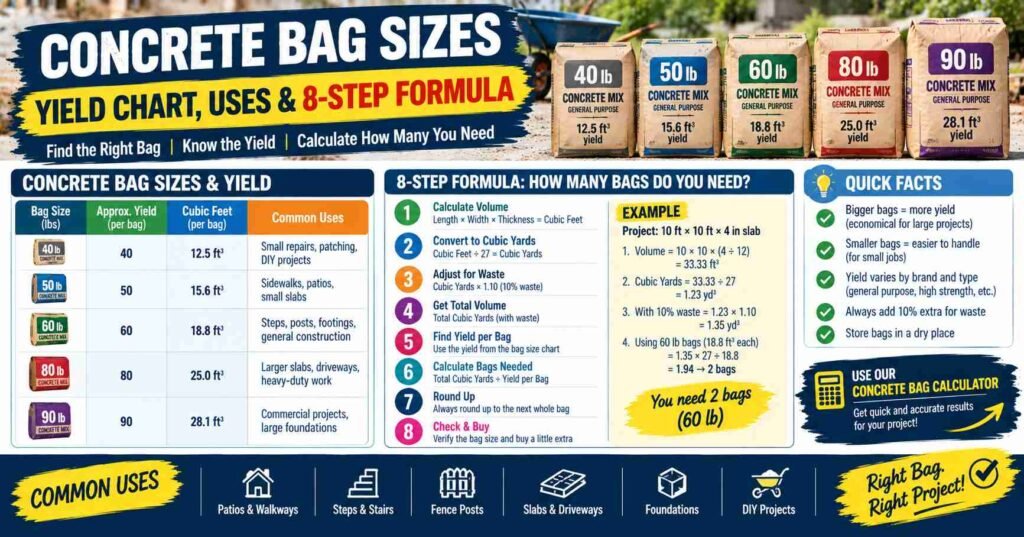
Concrete Bag Sizes Chart
| Bag size | Approx yield | Typical use |
| 40 lb | ~0.30 cubic feet | small repairs and DIY jobs |
| 50 lb | ~0.375 cubic feet | small-to-medium projects |
| 60 lb | ~0.45 cubic feet | medium DIY projects |
| 80 lb | ~0.60 cubic feet | larger DIY projects |
| 90 lb | ~0.675 cubic feet | larger-volume work |
These templates are product-specific examples, not universal values. Always check the product label and manufacturer’s information. Use accurate calculations and verify the stated yield for each product before making final quantity estimates.
Concrete yield is important because it shows how much concrete a bag can provide after mixing. Larger bags usually provide more concrete, but the yield can differ between companies, even for bags with the same weight. Always use the yield stated on the bag when calculating how many bags your project needs.
40 lb Concrete Bag Sizes
How Much Does a 40 lb Bag Yield
A 40 lb concrete bag does not have one fixed yield. Different manufacturers may provide different yield amounts, even when the bag weight is the same. Always check the product label and use the manufacturer’s stated yield for accurate calculations.
Common Uses
Small concrete repairs and patching, filling small cracks or damaged areas, DIY concrete projects, small sheds, and outdoor projects, small molds and forms,
projects that require only a small amount of concrete.
Main Advantage
Easy to carry and handle, convenient for small projects, easier to manage than larger bags, helps reduce leftover concrete, a practical choice when only a.
50 lb Concrete Bag Sizes
How Much Does a 50 lb Bag Yield
A 50 lb concrete bag size does not have one universal yield. The actual amount of concrete depends on the specific product and manufacturer.
Example:
Manufacturer’s stated yield = 0.45 cubic ft per bag
Number of bags = 2
Total yield = 0.45 × 2 = 0.90 cubic ft
Always use the yield printed on the product label for accurate calculations.
Common Uses
Small to medium repair projects, small farm projects, DIY construction work needing more material than smaller packs, small outdoor structures and repairs.
What to Check Before Buying
Check the stated yield, check the concrete type, make sure it suits your project, check the required strength, follow the recommended water amount, and read the manufacturer’s instructions before mixing.
60 lb Concrete Bag Sizes
How Much Does a 60 lb Bag Yield
A 60 lb concrete bag can provide more material than smaller bags.
Example:
Yield per bag = 0.45 cubic feet
Bags needed = 2
Total yield = 0.45 × 2 = 0.90 cubic feet
This is only an example. Actual yield can vary by product and manufacturer. Always check the bag label before calculating quantities.
Common Uses
60 lb concrete bag sizes can work well for small to medium projects, including: Concrete slabs, concrete installations, small repairs, small outdoor projects, and DIY construction work. The right bag size depends on the project requirements.
Do not choose a bag only by weight. Larger bags, such as 80 or 98 lb, can be harder to lift, while a 60 lb bag may be easier to handle for some users.
80 lb Concrete Bag Sizes
How Much Does an 80 lb Bag Yield
An 80 lb concrete bag can provide more material per bag.
Example:
Yield per bag = 0.60 cubic feet
Number of bags = 3
Total yield = 0.60 × 3 = 1.80 cubic feet
This is only an example. Actual yield can vary by product and manufacturer. Always check the product label and use its stated yield for accurate calculations.
Common Uses
80 lb concrete bags can be useful for medium to large projects, such as footings, small concrete slabs, walkways, steps, large piers, and other projects requiring more concrete.
Handling Considerations
An 80 lb bag contains more material, so fewer bags may be needed. So, the heavier weight can make handling more difficult. Consider whether you can safely lift and carry the bag.
Make sure you can comfortably mix and work with the material. Check the project size before choosing the bag size. Always follow the manufacturer’s mixing and handling instructions.
An 80 lb concrete bag can provide more material, so fewer bags may be needed for a project. Hence, the yield is not always the same for every product. This 0.60 cubic feet yield is only an example.
Some 80 lb products may have a different stated yield. Always check the product label, use the manufacturer’s yield, and order the correct number of bags according to your project requirements.
90 lb Concrete Bag Sizes
Availability and Yield
90 lb concrete bag sizes are not available from every manufacturer or store. Some suppliers offer them in specific markets. An estimated yield may be around 0.675 cubic feet per bag, but actual yield varies by product.
Example:
6 cubic feet ÷ 0.675 ≈ 8.9 bags; accordingly, about 9 bags may be needed.
Benefits and Limitations
Larger bags can reduce the number of bags needed. Consequently, 90 lb bags are heavy and harder to lift, move, unload, and mix. They may not be practical for small projects.
What to Check
Always compare the product label, stated yield, project size, and handling needs before buying. A larger bag is not automatically the better choice.
How to Choose the Right Concrete Bag Sizes
Choosing the right concrete bag size can help you avoid buying too much material or running short during the project. Consider these simple points before you buy.
Consider Your Project Size
Start by estimating your project volume. Multiply the length by the width and height to find the required volume. For small projects, lighter bags can be easier to handle. Larger projects may benefit from bigger bags because they contain more material and can reduce the number of bags you need. Use your project volume to estimate the total bag quantity.
Check Bag Yield
Do not choose a bag based only on its weight. Check the yield listed on the label. For example, an 80 lb bag may provide about 0.60 cubic feet of concrete, depending on the product. The yield helps you calculate how many bags your project actually needs.
Consider Bag Weight
40 or 50 lb bags are easier to lift, while 60, 80, or 90 lb bags contain more material but are heavier to handle.
Check Product Type
Choose a product that matches your application, such as general-purpose or fast-setting concrete.
Follow Manufacturer Instructions
Always check the listed yield, water requirements, strength specifications, mixing instructions, and curing guidance before use.
Common Mistakes When Choosing Concrete Bag Sizes
Choosing the right concrete bag size is not only about checking its weight. A few simple mistakes can lead to extra costs, wasted material, or not having enough concrete for the project. A heavier bag does not always mean stronger concrete. Bag weight mainly shows the amount of dry material inside.
The yield information tells you how much concrete the bag can produce after mixing. Always check it before buying. Product information can vary between brands and products. The label gives the correct yield, mixing instructions, and other important details. Thickness directly affects the total concrete volume.
Even a small change in thickness can change how many bags you need. Avoid rounding your bag calculation down. Round up to make sure you have enough material. Add a small waste allowance to your estimated quantity instead of buying exactly the calculated amount.
Heavy bags can be difficult to lift and move, especially when several bags are needed. Cement is only one ingredient in concrete. Concrete also contains materials such as sand and gravel. These practical mistakes may seem small, but they can affect your project budget and material requirements.
Frequently Asked Questions
Q: What are the common concrete bag sizes?
Common sizes include 40, 50, 60, 80, and 90 lb. 90 lb bags may not be available everywhere.
Q: Does a bigger concrete bag mean stronger concrete?
No. A heavier bag does not mean stronger concrete. Strength depends on the concrete product and project requirements.
Q: Which concrete bag size should I buy?
Choose the size based on your project volume. Calculate the volume in cubic feet, then divide it by the bag yield.
40–50 lb: Smaller projects.
60–80 lb: Larger projects.
Conclusion
Concrete bags are available in different sizes, such as 40, 50, 60, 80, and 90 lb. A heavier bag does not always mean stronger concrete. The bag weight mainly tells you how much dry material the bag contains. The strength depends on the type and specifications of the concrete product.
Before buying, always check the yield information on the bag label. It tells you how much concrete the bag can produce. This information helps you calculate how many bags your project needs.
To estimate the right number of bags, follow these simple steps: measure your project area correctly, check the required concrete thickness, calculate the concrete volume in cubic feet, divide the total volume by the bag’s stated yield, add a reasonable amount for waste, and round up the final number.
Keep in mind that water requirements and yield can vary between products and manufacturers. As a result, it is better to check the information printed on the actual bag instead of relying only on its weight. Spending a few minutes checking the yield can help you avoid an extra trip to the store.