Concrete Patio Thickness: Complete Guide in 2026
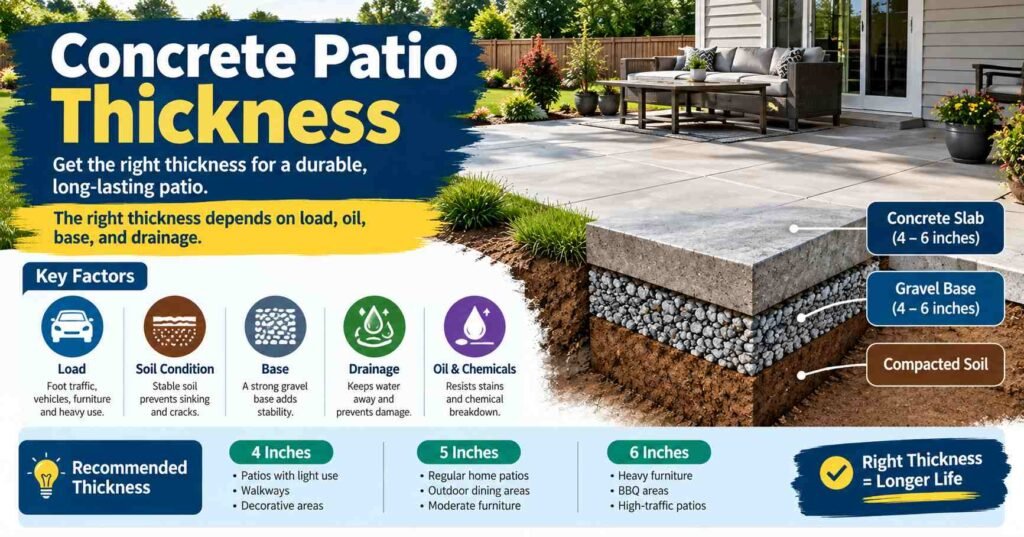
Are you wondering how thick a concrete patio should be to stay strong, durable, and safe for years? For most residential patios, 4 inches of concrete is a common concrete patio thickness. This is generally enough for normal use, such as placing chairs, tables, and other light outdoor furniture. If you plan to place heavy items on the patio, or the soil is soft or unstable, you may need a thicker slab. In such situations, a thickness of 5 to 6 inches can provide more support.
Still, thickness alone does not make a patio strong. The base underneath the concrete also needs to be properly prepared and compacted. A patio with a weak or poorly compacted base can crack, settle, or sink even if the concrete is 6 inches thick. For example, if the base is not compacted properly, a 4-inch patio can start developing cracks or uneven areas within months. Hence, proper base preparation is just as important as choosing the right concrete thickness.
The right patio thickness depends on several factors, including the expected load, soil condition, base preparation, drainage, and how the patio will be used. Clay soil can expand and shrink with changes in moisture, which can cause movement under the concrete. A properly prepared gravel base can help provide better support and improve drainage.
Weather is another factor to consider. Areas with heavy rain, freezing temperatures, or regular changes in moisture may need better drainage and base preparation to reduce movement and cracking. For a typical residential patio used for normal outdoor furniture, 4 inches is generally a practical choice. If the patio will support heavier loads or the ground conditions are poor, increasing the thickness to 5 or 6 inches may be more suitable.
We will explain the recommended patio thickness, how soil and weather affect it, when reinforcement may be needed, how the base should be prepared, and how thickness can affect the overall cost.
What Is Concrete Patio Thickness
Concrete patio thickness means how deep the concrete slab is from the top surface down to the bottom of the concrete. This thickness is usually measured in inches, such as 4 inches, 5 inches, or 6 inches. The thickness you need depends on how the patio will be used, the expected load, and the condition of the ground below it.
It is important to understand that concrete thickness and the gravel base are not the same thing. The concrete is the top structural layer that supports the weight placed on the patio, such as chairs, tables, people, or heavier items. The gravel base goes underneath the concrete and helps create a firm and stable surface for the slab.
A strong base can also help reduce movement, settling, and cracking. If the soil underneath is weak or the base is not properly compacted, the concrete can move or crack over time. Making the slab thicker does not always solve this problem. Even a 6-inch slab can develop cracks if it is placed over a poorly prepared base.
Thus, a strong patio needs both the right concrete thickness and a properly prepared base underneath it.
Is 4 Inches Enough for a Concrete Patio
A 4-inch concrete patio is usually enough for normal residential use, but it is not suitable for every situation concrete patio thickness. It works well for areas where people mainly walk, sit, or move around. A 4-inch slab can also support light outdoor furniture, such as chairs, small sofas, flower pots, BBQ grills, and other everyday items. For a backyard family seating area, 4 inches is often a practical choice. Yet, if you plan to place heavier furniture, equipment, or loads on the patio, a 5- to 6-inch slab may provide better support and durability.
When Should a Patio Be 5 Inches Thick
A 5-inch-thick concrete slab can be used when the surface needs to handle heavier loads than normal foot traffic or patio furniture concrete patio thickness. It may be suitable for areas that support heavier outdoor features, such as an outdoor kitchen, counter, pizza oven, or hot tub, depending on the design and site conditions. A thicker slab may also be considered for areas where vehicles will regularly pass over the concrete or where heavier loads are expected.
Though, thicker concrete alone does not guarantee that the slab will not crack. The base underneath the concrete is very important. Soft, expansive, poorly compacted, or waterlogged soil can cause movement and cracking even when the concrete is 5 or 6 inches thick. Thus, the soil should be properly prepared, and the base should be well compacted before pouring the concrete. Drainage and reinforcement may also be needed depending on the load and site conditions.
When Should a Patio Be 6 Inches Thick
A 6-inch concrete patio is suitable for heavier and more demanding use concrete patio thickness. It can be used when the patio will support heavy loads, such as a hot tub filled with water, which can weigh around 3,000 to 4,000 pounds. It may also be needed when large vehicles will be parked on or driven across the patio.
A thicker slab can also help when the soil has poor conditions or engineering concerns. For these situations, it is better to consult a professional or structural engineer. Check local building codes and permits before starting the project.
How Soil Conditions Affect Patio Thickness
Soil conditions play an important role in deciding concrete patio thickness. If the soil is strong, stable, and already settled, a 4-inch slab may be suitable for normal use. Clay soil can be more difficult because it expands and shrinks with changes in moisture and temperature, which may cause slab movement and cracks.
Loose or recently filled soil, such as soil around a new home, also needs extra preparation. Before pouring concrete, weak areas should be repaired through proper compaction and leveling. Good drainage is also important to prevent water from affecting the soil. If the soil is poor, removing it and adding a compacted gravel base can provide better support. A thicker slab cannot fully fix weak soil underneath.
How Thick Should the Gravel Base Be
A gravel base is usually 4 to 6 inches thick and should be well compacted concrete patio thickness. Before adding the gravel, remove loose soil, grass, roots, and other debris from the ground. The surface should be level so the gravel is spread evenly without thick or thin spots. Simply adding gravel is not enough.
It should be properly compacted to remove air gaps and create a firm, stable base for the concrete. The gravel base and the concrete slab are two separate layers.
Example: A contractor may first clear and level the ground, then spread 4–6 inches of gravel equally and compact it with a plate compactor before pouring the concrete on top.
Why Is Compaction Important
Proper compaction gives your patio a strong and stable base concrete patio thickness. If the soil underneath is loose, it can settle later and cause uneven areas or cracks. The gravel base should be firm, level, and well compacted so it can support the concrete properly. First, remove loose soil, grass, roots, and debris from the area. Then level the ground before adding the gravel.
Add gravel in 2–3 inch layers instead of putting the entire base down at once. After adding each layer, use a plate compactor or similar machine to press the gravel firmly. Check the surface level, add the next layer, and compact it again. Repeat this process until the required base thickness is reached. Good compaction reduces movement and helps prevent settling, uneven surfaces, and concrete cracks over time. Create a downloadable DOCX file here in this chat containing the editable prose above.
Does Drainage Affect Patio Thickness
Good drainage is important for a long-lasting concrete patio thickness. Water should not stay on the surface after rain. A slight slope helps move water away from the patio. A 1–2% slope is commonly used for proper drainage. The patio should be designed so water can flow away from the slab and surrounding areas.
Poor drainage can make the soil under the patio soft and unstable, which may lead to settling and cracks. For areas with heavy rainfall, proper drainage becomes even more important. You may need drainage channels, pipes, or other suitable systems. Good drainage keeps water from collecting around the slab and helps protect the base, soil, and concrete over time. Drainage does not necessarily mean making the patio thicker, but it helps the concrete perform better and last longer.
Does a Concrete Patio Need Rebar or Wire Mesh
Rebar or wire mesh can help make a concrete patio stronger and more stable, especially when it needs to handle heavier loads concrete patio thickness. Reinforcement helps hold the concrete together and can limit how wide cracks become if cracking occurs. Wire mesh is commonly used in many residential patios and can be a practical, lower-cost reinforcement option.
Rebar is generally used when additional reinforcement is needed for heavier loads or specific structural requirements. Fiber-reinforced concrete uses small fibers mixed into the concrete. These fibers can help reduce small cracks and improve crack control.
Reinforcement does not mean the concrete will never crack. Concrete can still develop cracks from shrinkage, movement, temperature changes, or soil settlement. Rebar or mesh should be placed at the correct position and height in the slab. If it is placed incorrectly, it may not provide the expected benefit. The main purpose of reinforcement is to control cracking and improve the concrete’s performance, not to guarantee a crack-free patio.
How to Calculate Concrete for a Patio
Calculating concrete for a patio is simple when you know the patio’s length, width, and thickness.
Formula
Length × Width × Thickness = Cubic Feet
Measure the length and width in feet.
Convert the thickness from inches to feet.
Divide the cubic feet by 27 to get cubic yards.
Order about 5–10% extra concrete to allow for spillage, waste, or small measurement differences.
Mathematical Example
Suppose a patio is 10 feet long, 12 feet wide, and 4 inches thick.
First, convert 4 inches to feet:
4 ÷ 12 = 0.33 feet
Now calculate the concrete volume:
10 × 12 × 0.33 = 39.6 cubic feet
Convert cubic feet to cubic yards:
39.6 ÷ 27 = 1.47 cubic yards
Add 5–10% extra for waste:
1.47 × 1.10 ≈ 1.62 cubic yards
Thus, you should plan for about 1.6 cubic yards of concrete.
Practical Process
Measure the patio carefully, convert the thickness to feet, calculate cubic feet, and then divide by 27. Finally, add 5–10% extra before ordering the concrete.
Common Mistakes When Choosing Patio Thickness
Choosing the right concrete patio thickness is important for a strong and long-lasting surface. Avoid these common mistakes: A patio used only for walking may need less thickness than one used for vehicles. Choosing too little thickness can lead to cracking or surface damage. Four inches may work for many basic patios, but it is not suitable for every load or condition.
Using the wrong thickness can reduce durability. Adding thick concrete over weak or unsettled soil does not solve the problem. The ground can settle and cause cracks or uneven areas. A loose base can shift under the concrete. This movement may cause cracks, sinking, or an uneven patio. Poor water drainage can weaken the base and soil. Over time, this can contribute to settling, cracks, and other damage.
Without properly placed control joints, cracks may form randomly as the concrete shrinks. Local rules may have specific requirements for patio construction. Ignoring them can cause approval or compliance problems. Fresh concrete needs time to gain strength. Heavy loads too early can damage the surface or cause permanent marks and cracks.
Frequently Asked Questions.
Q: How thick should a concrete patio be?
4 inches is common for residential patios. 5–6 inches may be needed for vehicles or heavy loads.
Q: How thick should a patio be for a hot tub?
A 6-inch reinforced slab may be suitable because hot tubs create heavy loads.
Q: Does thicker concrete prevent cracks?
No. A thicker slab cannot fix a weak base. Proper compaction, drainage, and control joints are also important.
Conclusion
For most residential patios, 4 inches of concrete is a common starting point, but it is not the right thickness for every project. The required thickness depends on the expected load, soil condition, base preparation, drainage, and future use. If the soil or base is weak, simply making the concrete thicker will not solve the problem.
Proper compaction, reinforcement, control joints, drainage, and curing all help the patio last longer. If you plan to add a hot tub, allow large vehicles, or place other heavy loads, professional design may be needed. Always consider your specific site before choosing the final concrete patio thickness.