Ready- Mix Concrete vs Bagged Concrete: What is Best Choice in 2026
Ready- Mix Concrete vs Bagged Concrete: What is Best Choice in 2026
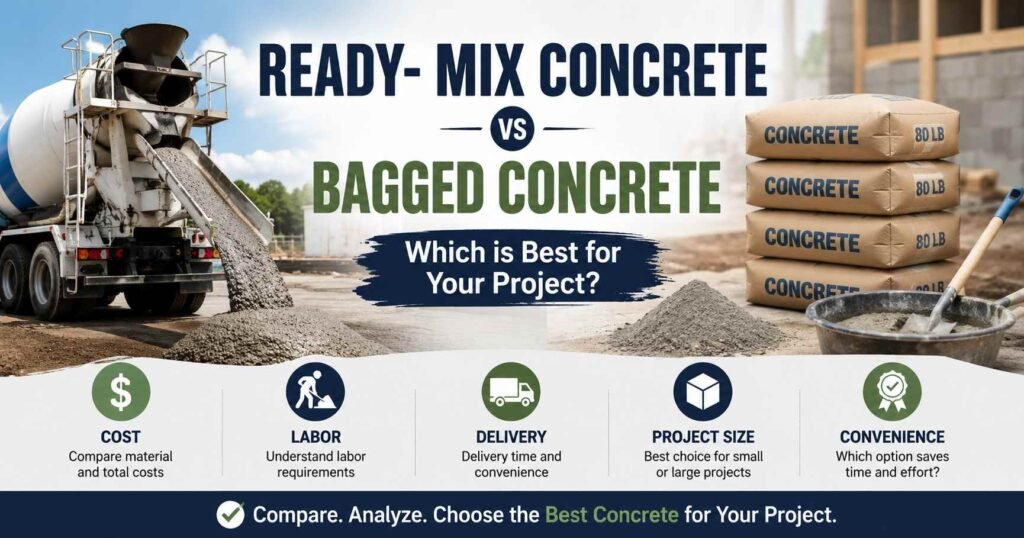
When deciding between Ready- Mix Concrete vs Bagged Concrete for your project, it’s important to weigh your options. Ready-mix concrete suits large projects like foundations, while bagged concrete is ideal for small DIY jobs, repairs, and fence posts. Choose bagged concrete for easy, manageable mixing. Choose ready-mix concrete for efficient bulk work. Pre-mixed and ideal for driveways, foundations, and large projects. Best for small projects like fence posts and small slabs. Ready-mix saves mixing time and labor, while bagged concrete requires self-mixing. Consider quantity, delivery, labor, project size, time, and truck access. We compared both options based on cost, quantity, labor, delivery, and quality.
Ready-Mix Concrete vs. Bagged Concrete: Quick Answer
The debate of Ready- Mix Concrete vs Bagged Concrete is practical for DIY projects and small-scale work. Ideal when you need faster completion and less mixing effort. The right option depends on project size, requirements, and conditions. Consider equipment, labor, delivery fees, and other additional charges, not just concrete prices.
Quick Comparison Table
| Factor | Bagged Concrete | Ready-Mix Concrete |
| Best for | Small projects | Large projects |
| Mixing | On-site | Plant/truck mixed |
| Labor | More | Less on-site mixing |
| Delivery | Usually not required | Required |
| Speed | Slower for large quantities | Faster |
| Quantity | Individuals bags | Cubic yards |
| Storage | Required | Not required |
| Site access | More flexible | Truck access needed |
What Is Bagged Concrete
Bagged concrete contains pre-measured dry ingredients such as cement, sand, and gravel. Before use, water must be added according to the manufacturer’s instructions to achieve the recommended consistency. Bags are available in different sizes, including 40, 50, 60, and 80 pounds. They can be mixed using a concrete mixer, wheelbarrow, or suitable mixing container.
Advantages of Bagged Concrete
Choosing between Ready- Mix Concrete vs Bagged Concrete depends largely on your specific project needs and location access. It works well for DIY jobs, fence posts, small slabs, repairs, and other manageable tasks. Bagged concrete is widely available at hardware and home-improvement stores without requiring advance delivery. You can mix only the amount needed and work at your preferred pace. It is practical for locations where ready-mix trucks cannot easily access the work area.
Disadvantages of Bagged Concrete
Each bag must be carried, opened, measured with water, and mixed separately. Using many bags can require more labor, equipment, and working time, increasing the overall project cost. Mixing multiple batches separately can make it harder to maintain the same consistency throughout the project. You must manage the bags, water, and mixing equipment yourself.
What Is Ready-Mix Concrete
Ready-mix concrete is produced in a controlled batching plant using measured amounts of cement, sand, gravel, and water. The mixture is prepared by machines and delivered to the project site by concrete trucks. Customers should order the required quantity and mix strength according to their project needs, while considering delivery, truck access, and additional charges.
Advantages of Ready-Mix Concrete
It arrives ready to use, helping complete large projects more quickly. There is no need to manually measure and mix ingredients at the job site. Factory-controlled mixing helps maintain a uniform mixture throughout the order. It is commonly used for driveways, foundations, slabs, and other high-volume work. For high-volume work, understanding the nuances of Ready- Mix Concrete vs Bagged Concrete can save significant time on-site. Different strengths and mix designs can be ordered based on project requirements and weather conditions.
Disadvantages of Ready-Mix Concrete
A delivery truck must reach the project area; difficult access may require a concrete pump and increase costs. Small quantities may be expensive because suppliers often apply minimum-load or short-load charges. Once delivered, concrete should be placed promptly before it begins to set. Orders usually require advance scheduling to ensure the truck and required quantity are available. When evaluating Ready- Mix Concrete vs Bagged Concrete, keep in mind that ready-mix often requires advance scheduling, unlike bagged options.
Ready-Mix Concrete vs. Bagged Concrete: Key Differences
Quantity
Bagged concrete: You can buy as many bags as your project requires, making it practical for small quantities.
Ready-mix concrete in the context of Ready- Mix Concrete vs Bagged Concrete: It is ordered by cubic yards, and suppliers may have minimum-order or short-load requirements.
Mixing
Bagged concrete: Water must be measured and added manually according to the manufacturer’s instructions.
Ready-mix concrete: Ingredients and water are mixed in controlled proportions at the batching plant before delivery.
Labor
Bagged concrete: Requires more physical effort because bags must be carried, opened, measured, and mixed individually.
Ready-mix concrete: Reduces mixing labor because the concrete arrives prepared and only needs to be placed.
Speed
Bagged concrete: Mixing individual batches takes additional time, especially when many bags are required.
Ready-mix concrete: Speeds up placement because the concrete arrives ready to use, making it more efficient for larger jobs. Speed is a primary factor in the Ready- Mix Concrete vs Bagged Concrete comparison.
Site Access
Bagged concrete: Works well in areas with limited access because bags can be carried directly to the work location.
Ready-mix concrete: Requires suitable truck access, including enough space for the truck to enter, position, and safely deliver the concrete.
Scheduling
Bagged concrete offers flexible timing, while ready-mix requires scheduled delivery and immediate placement after the truck arrives.
Ready-Mix vs. Bagged Concrete Cost
Bagged Concrete Cost
The basic material cost of bagged concrete can be calculated by multiplying the number of bags by the price per bag. Still, the final project cost may include several additional expenses. Labor is an important factor because workers must carry, open, measure, and mix the bags. If a concrete mixer is rented, its rental fee should also be included.
Transportation costs may apply when collecting bags from a store or supplier. Water used for mixing can also add a small expense. Eventually, it is useful to include a waste allowance because some material may be left over or lost during handling and placement.
Ready-Mix Concrete Cost
Ready-mix concrete is generally priced according to the number of cubic yards ordered. A simple calculation is:
Cubic yards × price per cubic yard = basic concrete cost
The final price can increase because of additional supplier charges when we compare Ready- Mix Concrete vs Bagged Concrete. These may include delivery fees, short-load charges, waiting-time fees, and other applicable service charges. Smaller orders can sometimes cost more because suppliers may apply a minimum-load or short-load fee. Thus, comparing only the advertised concrete price may not show the actual project cost.
Generally, both options should be compared using material, labor, equipment, delivery, waste, and additional charges.
Which Option Is Cheaper
When you analyze the true cost of Ready- Mix Concrete vs Bagged Concrete, don’t just look at material prices. Bagged concrete can be more economical for jobs requiring around 10–20 bags, such as small steps or repairs. Ready-mix can reduce labor and mixing costs, making it more practical for larger quantities. Concrete rates vary by location, so compare material, labor, delivery, and additional charges. Consider all project expenses rather than comparing the concrete price alone.
How Much Concrete Do You Need
To estimate how much concrete your project needs, first calculate the volume in cubic feet and then convert it to cubic yards.
Example: 10 × 10-Foot Slab
For a 10 × 10-foot slab with 4-inch thickness:
Convert thickness: 4 ÷ 12 = 0.333 feet
Calculate volume: 10 × 10 × 0.333 = 33.3 cubic feet
Convert to cubic yards: 33.3 ÷ 27 ≈ 1.23 cubic yards
So, the slab requires approximately 1.23 cubic yards of concrete, before adding any waste allowance.
Calculating Bagged Concrete
If one 80-lb bag provides approximately 0.60 cubic feet, divide the required volume by the bag yield:
33.3 ÷ 0.60 = 55.5 bags
Since you cannot purchase half a bag, round up to 56 bags. Always check the manufacturer’s stated yield because bag coverage can vary between products.
Labor and Time: Ready-Mix vs. Bagged Concrete
Bagged Concrete Workflow
Bags must be transported to the work area, opened, and prepared for mixing. Add the correct amount of water according to the manufacturer’s instructions. Large quantities require multiple batches, increasing preparation time and physical effort. Each mixed batch must be transported to the placement area and poured. Mixing and carrying continue until the required amount of concrete is completed. Larger quantities require more workers, making bagged concrete increasingly labor-intensive and costly.
Ready-Mix Concrete Workflow
Arrange the truck in advance and confirm delivery, quantity, and additional charges. Make sure the placement area is ready before the truck arrives. Coordinate with the driver and position the truck safely for placement. The ready-mixed concrete is discharged directly into the prepared area. Spread, level, and finish the concrete before it begins setting. Since mixing is completed before delivery, large projects can require less manual mixing work.
Quality and Consistency Comparison
Concrete strength depends on the correct balance of cement, aggregates, and other materials. Use the recommended water amount; excess water can reduce concrete strength. Proper mixing ensures all ingredients are evenly distributed throughout the concrete. Adequate curing helps concrete develop strength and improves long-term durability. Correct placement, compaction, and finishing help achieve the intended performance. Follow manufacturer guidelines carefully for both bagged and ready-mix concrete. For large or structural projects, consult a qualified engineer or concrete professional.
Delivery, Site Access, and Equipment
Before choosing ready-mix or bagged concrete, consider how easily the material can reach your work area.
Ready-Mix Concrete
Check whether the concrete truck can safely reach and position near the site. If access is limited, alternative placement methods may be required. Schedule a specific delivery time so the site and workers are ready when the truck arrives. If the placement area is far from the truck or difficult to reach, a concrete pump may be needed. Clear and prepare the placement area before delivery, ensuring there is enough working and positioning space. Check narrow roads, traffic conditions, turning space, and other restrictions that could delay delivery.
Bagged Concrete
Bags can usually be transported using smaller vehicles, making them practical where large trucks cannot enter. They are suitable for narrow streets, stairs, upper floors, and other hard-to-access areas. When many bags are required, arrange suitable mixing equipment and a practical way to move materials around the site.
On the whole, open and accessible sites are often more convenient for ready-mix concrete, while restricted locations may be better suited to bagged concrete.
What About Bulk-Bag Concrete
Bulk bags offer a practical middle option between individual Ready- Mix Concrete vs Bagged Concrete. A bulk bag can hold a much greater amount of dry concrete than standard bags. Where concrete trucks cannot reach, bulk bags can sometimes be moved using a crane. You need suitable lifting equipment and mixing tools to prepare the concrete on-site. It is generally slower than ready-mix but can be more efficient than handling many individual bags.
Common Mistakes When Choosing Ready-Mix or Bagged Concrete
A frequent error in the Ready- Mix Concrete vs Bagged Concrete decision process is underestimating the time and labor required for manual mixing. Add around 5–10% extra material to reduce the risk of running short. Ready-mix should arrive only after the placement area is fully prepared. Check road width, turning space, and site access before scheduling delivery. Ready-mix may include delivery, waiting, pump, or short-load fees beyond the basic price. Bagged concrete can sometimes be the better choice for larger projects when site access is restricted. Consider labor, equipment, delivery, waste, time, and site conditions before choosing an option.
Ready-Mix vs. Bagged Concrete Decision Guide
Best for small projects where you need a limited quantity and want to mix only what is required. You can mix bagged concrete whenever convenient without coordinating a delivery truck. Bags are practical for narrow spaces, stairs, and locations where trucks cannot reach. Mixing is done on-site, giving you more control over small projects. Suitable for larger projects such as foundations, driveways, and large slabs requiring substantial volume.
Ready-mix arrives prepared, reducing on-site mixing and helping complete large pours efficiently. Controlled batching provides uniform concrete throughout the delivery. A suitable truck route and placement area are essential for ready-mix delivery. For projects between small and large, compare quantity, labor, access, delivery, and total cost before choosing.
Frequently Asked Questions
Q: Is ready-mix concrete better than bagged concrete?
Ready-mix isn’t always better than bagged concrete; the best choice depends on project size, location, quantity, labor, and site access.
Q: Is bagged concrete cheaper than ready-mix?
Bagged concrete is often cheaper for small projects, but for larger jobs, ready-mix may be more cost-effective due to lower labor and mixing costs.
Q: How many bags of concrete equal one cubic yard?
The number of bags needed per cubic yard depends on bag size and manufacturer yield; calculate using the stated cubic-foot yield.
Q: Can I use bagged concrete for a driveway?
Bagged concrete can work, but larger driveways may require significant mixing, labor, and handling, making ready-mix more practical.
Conclusion
Best suited for small, manageable projects where you can mix and place the concrete yourself. More practical for larger projects, especially when you need a large volume placed quickly, such as driveways, foundations, and large slabs. Estimate the required concrete volume before choosing an option. Larger quantities may favor ready-mix, while smaller amounts can make bagged concrete more convenient.
Compare the price of bags or the ready-mix price per cubic yard rather than looking at the material price alone. Bagged concrete usually requires more manual work because bags must be carried, measured, and mixed individually. Consider mixer rental, wheelbarrows, tools, pumps, and other equipment needed to prepare and place the concrete. Ready-mix usually requires scheduled truck delivery, while bagged concrete can often be transported using smaller vehicles. Narrow roads, stairs, upper floors, or restricted areas may make bagged concrete more practical. Ready-mix requires suitable truck access.