Concrete for Fence Post Calculator: Easy 2026 Guide
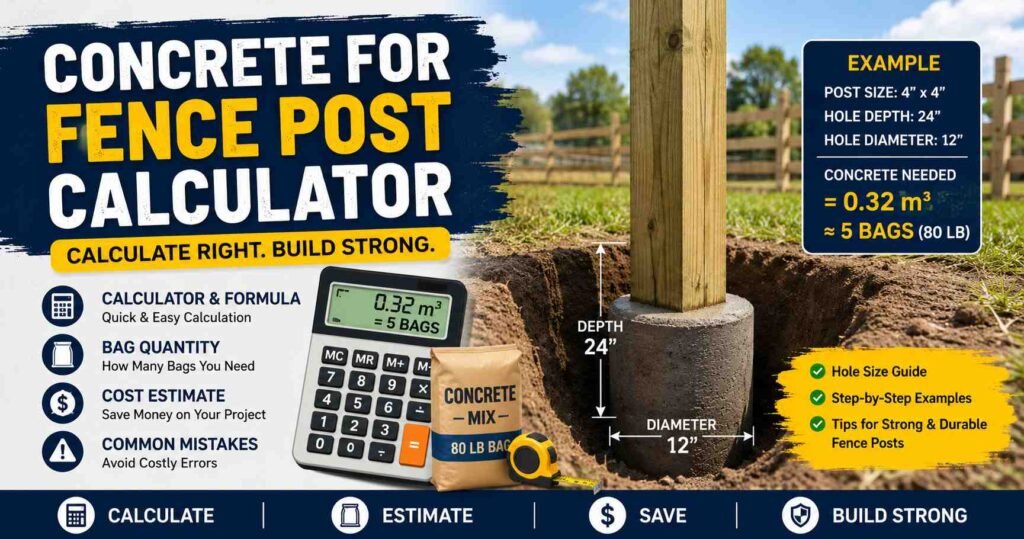
How much concrete do you need for a fence post, and how can you calculate the right amount before you start your fence project? For a fence post, measure the hole diameter and depth, calculate its volume using π × radius² × depth, then add about 10% extra for waste. A concrete for fence post calculator helps you determine how much concrete you need for your fence posts. It gives you the estimated concrete volume and the number of bags needed for the project.
To use the calculator, you normally enter a few simple details:
– Hole diameter
– Hole depth
– Post size
– Number of posts
The concrete for fence post calculator uses these measurements to work out the total amount of concrete required. This helps you avoid buying too much concrete and wasting money. It also helps you avoid buying too little, which can stop your work.
The concrete for fence post calculator can also include a waste allowance, as some concrete may be lost during mixing and pouring. Still, the tool only tells you how much concrete is needed. It does not tell you about soil type, weather conditions, or the strength needed for your fence posts. For these factors, you need basic construction knowledge and should follow local building requirements.
What Is a Concrete for Fence Post Calculator
A concrete for fence post calculator helps estimate how much concrete is needed to set fence posts. It calculates the concrete volume for one post hole and then gives the total amount for multiple holes. Based on the required volume, you can estimate how many bags, such as 50-lb or 80-lb bags, you may need and get a rough material cost.
For a round post hole, the basic formula is π × radius² × depth.
Yet, the calculator provides an estimate, not a final project cost. Actual requirements can change because of soil conditions, weather, hole size, or site conditions. Extra charges may also apply when ordering concrete or other materials. Therefore, use the calculator for planning, then confirm the final quantity and cost with your supplier.
What Measurements Do You Need
Post Size
The post size determines how much space is left for concrete inside the hole. A larger post changes the available space and can affect the concrete quantity.
Hole Diameter
A wider hole requires more concrete. Increasing the diameter increases the hole’s volume and the amount of concrete needed.
Hole Depth
A deeper hole also increases the concrete volume. Even a small increase in depth can require more concrete for each post.
Number of Posts
More posts mean more holes to fill. Increasing the number of posts increases the total concrete requirement.
Concrete Bag Yield
Bag yield shows how much concrete one bag can produce. An 80-lb bag may yield about 0.60 cubic feet, while a 50-lb bag may yield about 0.37 cubic feet. Always check the manufacturer’s yield.
A concrete for fence post calculator combines these measurements to estimate the total concrete needed and the number of bags required. Changing any measurement updates the calculation, helping you plan your concrete order more accurately.
How to Calculate Concrete for a Fence Post
Step 1: Calculate Hole Volume
First, find the volume of the round post hole. Use this formula:
Volume = π × radius² × depth
For π, use 3.14. Measure the hole’s radius and depth in the same unit before calculating. For example, a 10-inch-wide and 30inch deep hole gives you 1.36 cubic ft.
Step 2: Account for the Post
The post takes up some space inside the hole, so you cannot fill that space with concrete. Calculate the post’s volume and subtract it from the hole volume. This gives the concrete needed for one post. For example, a 4×4 post is about 0.2 cubic ft. Subtract this from the hole volume. So, 1.36-0.2 = 1.16 cubic ft of concrete per post.
Step 3: Calculate Multiple Posts
Multiply the concrete required for one post by the total number of posts. This gives the overall concrete volume for the project. If you have 10 posts, then 1.16 times 10= 11.6 cubic ft.
Step 4: Convert to Bags
Finally, divide the total concrete volume by the yield of one concrete bag. This information, often found in a concrete for fence post calculator, tells you roughly how many bags you need. For example, an 80 lb bag makes 0.60 cubic ft. 11.6÷ 0.6 = 20 bags and 10% extra for free.
Fence Post Concrete Calculator Example
Suppose you need to install 10 fence posts. Each post is 4 inches wide, the hole is 12 inches in diameter, and the hole depth is 36 inches.
- Convert the measurements: Convert inches to feet because concrete volume is usually calculated in cubic feet.
12 inches = 1 ft
Radius = 0.5 ft
Depth = 3 ft
- Calculate the hole volume: Use the formula π × radius² × depth. For a 12-inch hole, the radius is 6 inches.
π × radius² × depth
3.14 × 0.5² × 3=2.36 cubic ft
3. Subtract the post volume: Calculate the volume occupied by the 4-inch post and subtract it from the hole volume. This gives the concrete needed for one post.
Concrete per post = 2.36 – 0.22 = 2.14 cubic ft
4. Calculate for all posts: Multiply the concrete needed for one post by 10 posts. The result gives the total concrete volume needed for the project.
Concrete per post =2.14 cubic ft
This final volume can then be used to estimate how many concrete bags you need.
- Calculate Total Concrete: Once you know the concrete volume for one post, multiply it by the total number of posts. For example, if one post needs 0.5 cubic feet and you have 10 posts:
0.5 × 10 = 5 cubic feet
So, you need about 5 cubic feet of concrete before adding waste.
- Convert Concrete to Bags: Divide the total concrete volume by the yield of one bag. Bag yield varies by manufacturer.
80lb bag yield = 0.6 cu ft. 21.4 ÷ 0.6 = 35.6 bags
50lb bag yield = 0.37 cu ft. 21.4 ÷ 0.37 = 57.8 bags
- Final Rounded Quantity: It is helpful to allow around 10% extra for waste and small measurement differences. For example, if your calculation gives 35.2 bags, round it up to 36 bags first. With a 10% allowance, you would order about 40 bags.
80lb: 36bags + 4(10% waste allowance) = 40 bags
50lb: 58bags + 6(10% waste allowance) = 64 bags
How Many Bags of Concrete Do You Need per Fence Post
When calculating how many concrete bags you need, it is important to check the yield of the specific bag you plan to use. Different brands can provide different yields, even when the bags have the same weight. For example, one 80 lb bag may yield 0.60 cubic feet, while another may yield 0.55 cubic feet.
This difference can affect the total number of bags required for your project. Smaller bags may also require more bags to produce the same amount of concrete compared with larger bags.
The easiest way to get an accurate estimate is to first calculate the total concrete volume needed for the project. Later, divide that volume by the yield listed on the bag.
Number of bags = Total concrete volume ÷ Bag yield
If you need 2.14 cubic feet per post
Using 80-lb bags: 2.14 ÷ 0.6 = 3.6 Buy 4 bags
Using 50-lb bags: 2.14 ÷ 0.37 = 5.7 Buy 6 bags
Using 40-lb bags: 2.14 ÷ 0.3 = 7.1 Buy 8 bags
Always check the manufacturer’s yield before ordering. This helps you avoid buying too few bags and gives you a more accurate estimate based on the brand and bag size you choose.
Different brands use different materials and mix designs, so the concrete yield can vary from one company’s bag to another, even at the same weight.
How Much Concrete Do You Need for Multiple Fence Posts
After calculating the concrete volume for one fence post, multiply it by the total number of posts to find the overall concrete volume.
| Number of Posts | Total Concrete | 80lb Bags Needed |
| 5 Posts | 10.7 cu ft | 18 bags |
| 10 Posts | 21.4 cu ft | 36 bags |
| 20 Posts | 42.8 cu ft | 72 bags |
| 50 Posts | 107 cu ft | 179 bags |
Total concrete volume = Concrete volume for one post × Number of posts
A small mistake in one post can create a big difference when you have many posts. For example, if your calculation is short by 0.1 cubic feet per post, 50 posts would create a 5 cubic feet difference.
This can leave you without enough concrete and may cause delays during installation. To avoid this problem, consider ordering about 10% extra concrete.
Extra concrete can often be used for another small project instead of being wasted.
Ordering a little extra gives you a safety margin and helps keep the project running smoothly without unexpected stops.
Should You Add Extra Concrete for Waste
Irregular holes may require more concrete because their shape or size is not consistent. Soil conditions can also vary: soft or sandy soil may cause a post hole to change during installation, while rocky ground can make digging uneven. Spillage during mixing and pouring can also lead to some material being wasted. Every hole may have slightly different dimensions, so the actual concrete requirement can vary.
Formula: Estimated concrete × 1.10 = estimate with 10% allowance
Example:
If your estimate is 20 cu ft
Then: 20 cu ft × 1.10 = 22 cu ft. So you should plan for 22 cubic feet instead of 20 cubic feet.
A 10% waste allowance is often recommended, but it is not a fixed rule. For simple projects, 5% may be enough, while difficult or rough jobs may need around 15%. Choose the allowance based on your project conditions and expected material waste.
What Size Should a Fence Post Hole Be
The size of a fence post hole is not the same for every project. It depends on several factors:
Larger posts usually need wider holes for proper support. Taller fences may require deeper and wider holes to stay stable. Soft or sandy soil may need larger holes, while firm or rocky ground may allow smaller holes. Local ground conditions can affect the required depth.
Posts supporting gates often need larger, stronger footings because they carry extra weight. Areas with strong winds may require deeper holes for better stability. Wider spacing can affect the support needed for the fence.
Heavy fencing may require stronger posts. Poorly drained soil can affect post stability. Building codes or project guidelines may specify minimum dimensions.
These factors are not universal rules. Always choose the hole size according to your post, fence design, soil, and local conditions.
Generally, hole width can be about 3 times the post width. For example, a 4-inch post may need a 12-inch hole. Hole depth can be around one-third of the fence height plus 6 inches. These are general guidelines, not fixed rules. For professional or large projects, follow local building codes.
How to Calculate Concrete for Different Fence Posts
4 × 4 Wood Post
Common for residential fences. Hole size depends on fence height, soil, and local requirements. Use enough concrete to provide stable support.
6 × 6 Wood Post
Larger posts generally require wider holes. They may need more concrete than 4 × 4 posts. Suitable for heavier or stronger fence structures.
Round Post
Hole size depends on the post diameter. Thicker round posts usually need more concrete. Soil conditions can also affect the required footing size.
Metal Post
Concrete secures the post firmly in the ground. The required amount depends on post diameter and fence design. Wind exposure may require additional support.
Gate Post
Gate posts carry the weight and movement of the gate. They usually need larger and deeper holes. More concrete may be needed for proper stability.
Corner Post
Corner posts support fence sections in two directions. They handle additional tension and pressure. They may require deeper holes and more concrete than standard posts.
Common Fence Post Concrete Calculation Mistakes
Accurate measurements are important when estimating concrete for fence post calculator. Common mistakes include confusing diameter with radius; the correct formula is Radius = Diameter ÷ 2. Another mistake is measuring post length instead of considering the required fence height and footing depth.
Using one concrete estimate for every post can also cause errors because soil, locations, and hole sizes may vary. The post itself should also be accounted for when calculating the concrete volume inside a hole. Simply subtracting the post volume without checking the actual footing dimensions can lead to an incorrect estimate. Choosing the wrong concrete bag size, such as 56-lb or 80-lb bags, can also affect the calculation.
For practical ordering, consider adding about 10% extra concrete for waste and irregular holes. Gate and corner posts often require stronger, larger footings than standard posts. These calculations provide an estimate; for large or structural projects, consult a qualified professional or follow local building requirements.
Frequently Asked Questions
Q: How many bags of concrete do I need per fence post?
A small post usually needs one 50-lb bag, but an 80-lb bag can also be used.
Q: Does post size affect concrete quantity?
The larger the post, the deeper the hole needs to be, which means more concrete will be required to fill it properly.
Q: Do gate posts need more concrete?
The larger the post, the deeper the hole needs to be, which means more concrete will be required to fill it properly.
Q: Is a fence post concrete calculator accurate?
The results from a concrete for fence post calculator are usually accurate, but not exact, so it is better to keep 5% to 10% extra concrete for unexpected needs.
Conclusion
Note the number, size, and required depth of the posts. Measure the hole dimensions and account for the space occupied by the post. Multiply the concrete needed for one hole by the total number of posts. Divide the required volume by the yield of the selected concrete bag.
Use the bag’s stated coverage instead of assuming a standard value. Allow for spillage, irregular holes, and measurement differences. Check your measurements and calculations before ordering.
A concrete for fence post calculator provides an estimate only. Actual requirements depend on soil conditions, post size, hole dimensions, fence design, and project conditions.