Sidewalk Concrete Calculator: Complete Guide in 2026
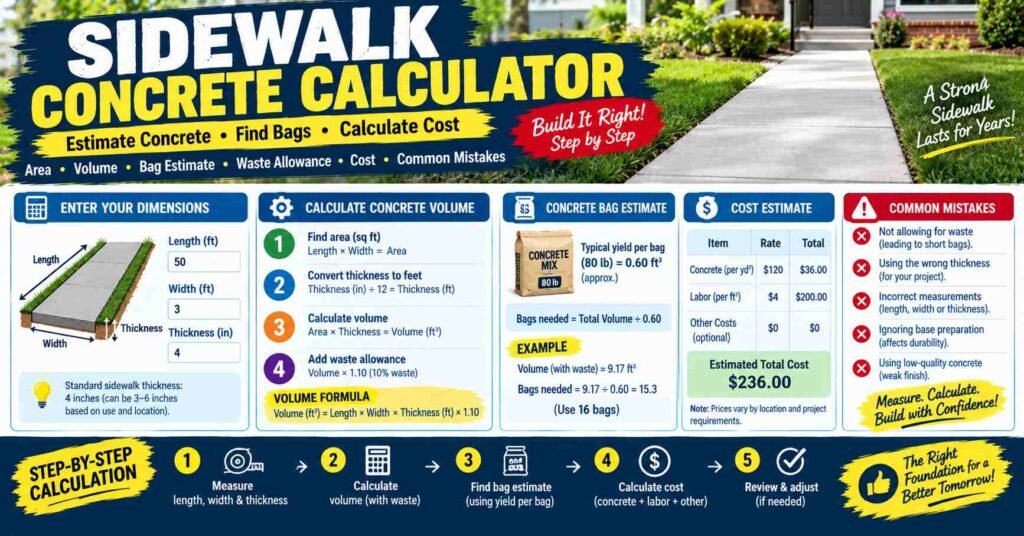
Wondering how much concrete you need for a sidewalk without buying too much or running short during the pour? Wondering how much concrete you need for a sidewalk? Ordering too much can increase your cost, while running short during pouring can lead to weak joints and another delivery fee.
A sidewalk concrete calculator makes estimating easier by using three measurements: length, width, and thickness. It shows the amount in cubic feet and cubic yards and can also estimate the number of concrete bags you need.
Add about 5–10% extra for waste, spills, and small measurement differences.
We’ll cover the simple formula, bag estimates, real-world examples, irregular sidewalks, common mistakes, and when professional advice may be needed. Keep in mind, the calculator provides an estimate, not structural or foundation design.
What Is a Sidewalk Concrete Calculator
A sidewalk concrete calculator is a simple tool that helps estimate how much concrete you need for a sidewalk. An online concrete calculator can make this process easier by estimating the concrete volume from your measurements. It uses the basic volume formula: Length × Width × Thickness.
You enter the sidewalk’s length, width, and thickness, and the calculator estimates the amount of concrete in cubic feet, cubic yards, or bags. It makes planning your project easier and helps you estimate the materials needed. Still, the result is only an estimate, not a fixed amount, because actual needs can vary due to waste, uneven surfaces, and other factors.
Sidewalk Concrete Calculation Formula
To calculate the concrete needed for a sidewalk, follow these simple steps with a sidewalk concrete calculator: A concrete slab calculator uses the same basic volume formula when the slab has a regular rectangular shape.
Find the volume in cubic feet: Use Length × Width × Thickness.
If thickness is in inches, convert it to feet by dividing it by 12.
The result gives you the concrete volume in cubic feet.
To convert cubic feet to cubic yards, divide the result by 27, because 1 cubic yard equals 27 cubic feet. A calculator for concrete yards can simplify this conversion and help you estimate the quantity needed for your sidewalk.
If length and width are in feet while thickness is in inches, you can use this shortcut:
Length × Width × Thickness ÷ 324 = Cubic Yards
To figure out concrete for a slab, measure its length, width, and thickness before calculating the total volume.
The number 324 comes from 12 × 27. This combines both conversions, making the calculation faster and easier.
How to Use a Sidewalk Concrete Calculator Step by Step
Follow these simple steps to get a useful estimate with a sidewalk concrete calculator: A concrete estimator is most useful when you enter accurate measurements and select the correct units.
Measure the length: Measure the sidewalk carefully. Even a small measurement error can affect the amount of concrete needed.
Measure the width: Take an accurate width measurement, especially when the sidewalk has uneven sections.
Choose the thickness: A typical sidewalk is around 4 inches thick. A sidewalk concrete calculator can use this measurement to estimate the required concrete.
Select the unit: Choose inches or feet based on your measurements. Concrete is commonly ordered in cubic yards.
Add waste allowance: Add about 5–10% extra to cover waste, spills, or uneven areas.
Check the result: Review the calculated cubic yards. If you need bags, convert the result and round up, not down, to avoid running short.
40 lb vs. 60 lb vs. 80 lb Concrete Bags
Different brands can provide different concrete volumes per bag. An 80-lb bag may provide about 0.60 cubic feet of concrete, although another brand may have a different yield. Higher-yield bags usually require fewer bags but can be harder to handle. Smaller bags are easier to lift and work well for smaller DIY projects.
Bag weight alone does not tell you the actual concrete volume. Always use the manufacturer’s stated yield per bag for your calculation. Different yields can change the total number of bags needed.
How Much Extra Concrete Should You Add for Waste
When placing your final concrete order, it’s smart to allow some extra material. A concrete slab estimator should also account for extra material needed because of waste, spills, and uneven areas.
A sidewalk concrete calculator can include this waste allowance in the estimate. Irregular surfaces can require more concrete than calculated. Some concrete may be lost during mixing, pouring, or handling. Curved or unusual layouts can make exact calculations difficult.
Add 5–10% extra: This helps prevent running short during the project.
A 5% allowance is usually enough for straightforward, regular-shaped work. Consider 10% extra when the project has difficult shapes or uneven areas. Ordering enough concrete initially can save you from paying for another delivery later.
Sidewalk Concrete Calculator Example
This sidewalk concrete calculator example shows how the total changes after adding waste. A concrete yardage calculator can help convert the measured volume into cubic yards before you place an order.
Given: Length = 40 ft, Width = 4 ft, Thickness = 4 in.
Step 1 – Find cubic feet:
40 × 4 × 4 ÷ 12 = 53.33 cubic feet
Step 2 – Convert to cubic yards:
53.33 ÷ 27 = 1.98 cubic yards
Step 3 – Add 10% waste:
1.98 × 1.10 = 2.18 cubic yards
Divide the total cubic feet by the manufacturer’s yield per bag.
This gives you a practical estimate for ordering enough concrete.
Sidewalk Concrete Calculator for Cost Estimation
The amount of concrete and its total cost are two different things. A concrete cost calculator can help estimate material expenses when you enter the required quantity and local prices. A sidewalk concrete calculator mainly estimates material costs using cubic-yard or bag prices.
Delivery, ground preparation, formwork, rebar, labor, and finishing can add to the final cost. Costs vary depending on your location and supplier. Use the calculator for an estimate, then confirm the final price with your concrete supplier. A concrete cost estimator can provide a useful starting figure, but supplier quotes are needed for the final price.
Common Sidewalk Concrete Calculator Mistakes
Don’t confuse excavation depth with concrete thickness. Measure the actual concrete thickness before calculating. Forgetting to convert inches into feet can change the result. Convert all measurements to the required units first. Guessing the sidewalk width can lead to an inaccurate estimate.
Measure the width carefully at each section. Different sidewalk sections may have different measurements. Calculate each section separately and add the results. This can overestimate or underestimate concrete needs. Measure curved or irregular areas separately. Bag weight alone does not show how much concrete it produces. Always check the manufacturer’s stated yield.
A sidewalk concrete calculator can help avoid these mistakes when the correct measurements and bag yield are used. Exact calculations may not cover spills or uneven areas. Add 5–10% extra for waste. Running short may require another delivery and extra charges. Include a waste allowance before placing the final order.
Frequently Asked Questions:
Q: How do I calculate concrete for a sidewalk?
Multiply length × width × thickness, convert units, divide by 27, and add 5–10% waste.
Q: How much extra concrete should I order?
Add 5% for simple projects and 10% for complex projects.
Q: Can I use a concrete calculator for a curved sidewalk?
Yes. Divide the sidewalk into smaller sections and calculate each separately.
Q: Is a sidewalk calculator accurate?
Yes, it gives a close estimate when measurements are accurate. Follow local codes.
Conclusion
Start by measuring the sidewalk’s length, width, and thickness accurately. An accurate concrete estimate starts with careful measurements and the correct volume calculation. Convert the measurements and find the required cubic yards.
Check the manufacturer’s yield to determine how many concrete bags you need. Add around 5–10% extra concrete for spills and uneven areas. Compare ready-mix and bagged concrete based on project size, cost, and convenience.
Treat the calculator result as an estimate, not an exact quantity. A sidewalk concrete calculator is useful for planning, but the final quantity should be confirmed before ordering. Follow local rules, project specifications, and contractor recommendations before ordering.